Joshua 1
NET Bible · Tap a verse to see its cross-references.
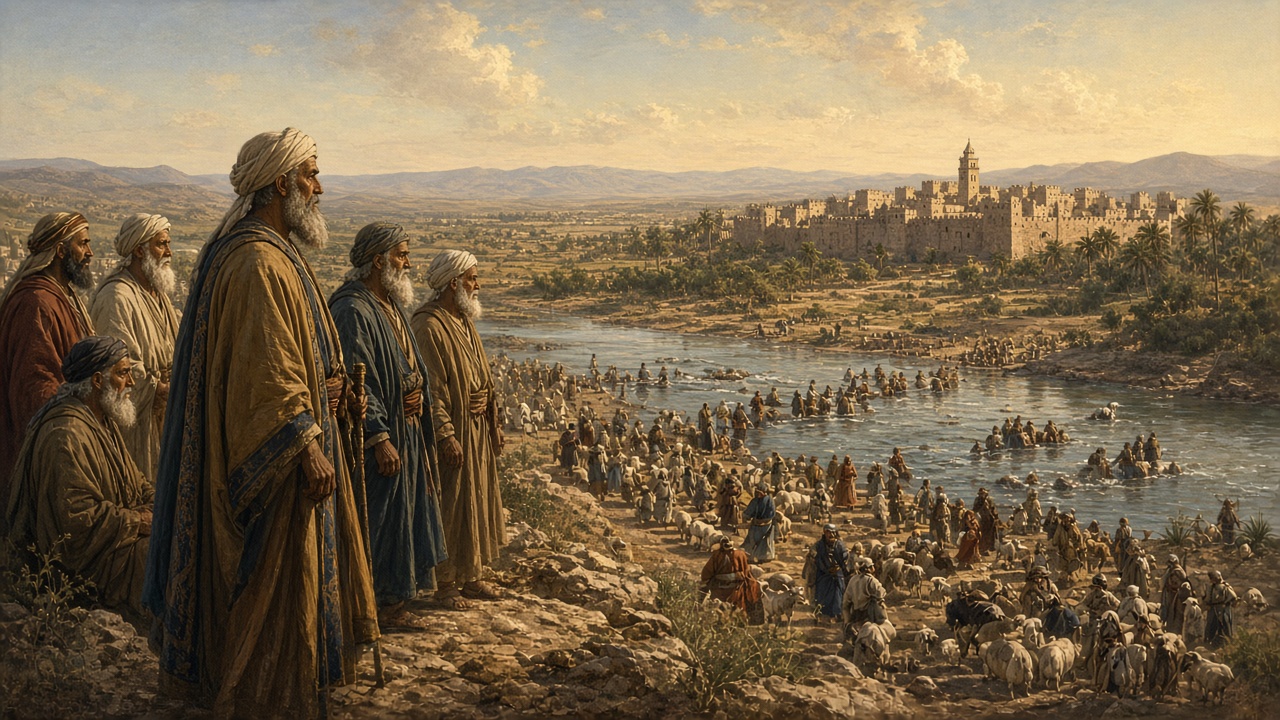
About this book
About Joshua
- Easton's Bible Dictionary (1897) explains Joshua's name as "Jehovah is his help" or "Jehovah the Saviour." He was the son of Nun, of the tribe of Ephraim, born in Egypt, and Moses' successor as leader of Israel; the wars of conquest he carried on are recorded in the book that bears his name. That entry does not name the book's author or give a date for its writing.Sources: Easton: Joshua · Joshua
- When Joshua took command, the people were encamped at Shittim. They crossed the Jordan and camped at Gilgal, where, Easton says, he circumcised the people and kept the Passover. Jericho, a fortified city among palm trees about five miles west of the Jordan, is described as Canaan's strongest fortress and the key to western Palestine; Ai, east of Bethel, was the second Canaanite city taken, after an initial defeat.Sources: Easton: Joshua · Jericho · Ai
- Easton's Bible Dictionary (1897) says Joshua conquered six nations and thirty-one kings, then divided the land among the tribes, with Timnath-serah in Mount Ephraim assigned to himself. East of the Jordan, Gilead is described as a mountainous region held by the tribes of Gad and Reuben and the southern part of Manasseh.Sources: Easton: Joshua · Gilead
- Quoting Edersheim, the dictionary says Joshua's name was changed from Oshea, "help," to Jehoshua, "Jehovah is help," and notes that he is called Jesus in Acts 7:45 and Hebrews 4:8. It states that he died at the age of one hundred and ten, twenty-five years after crossing the Jordan, and was buried in his own city of Timnath-serah; of his father Nun, nothing more is recorded than that he was Joshua's father.Sources: Easton: Joshua · Joshua · Nun
- Before leading the conquest, Joshua commanded Israel's host against the Amalekites at Rephidim, served as Moses' minister, and was one of twelve sent to explore Canaan; only he and Caleb brought back an encouraging report. As Easton sketches the book, it runs from the crossing of the Jordan and the taking of Jericho through years of war to the division of the land and Joshua's last address.Sources: Easton: Joshua
Notes written with AI assistance from open sources (Theographic Bible Metadata, CC BY-SA 4.0; Easton’s Bible Dictionary, public domain) and reviewed before publishing.
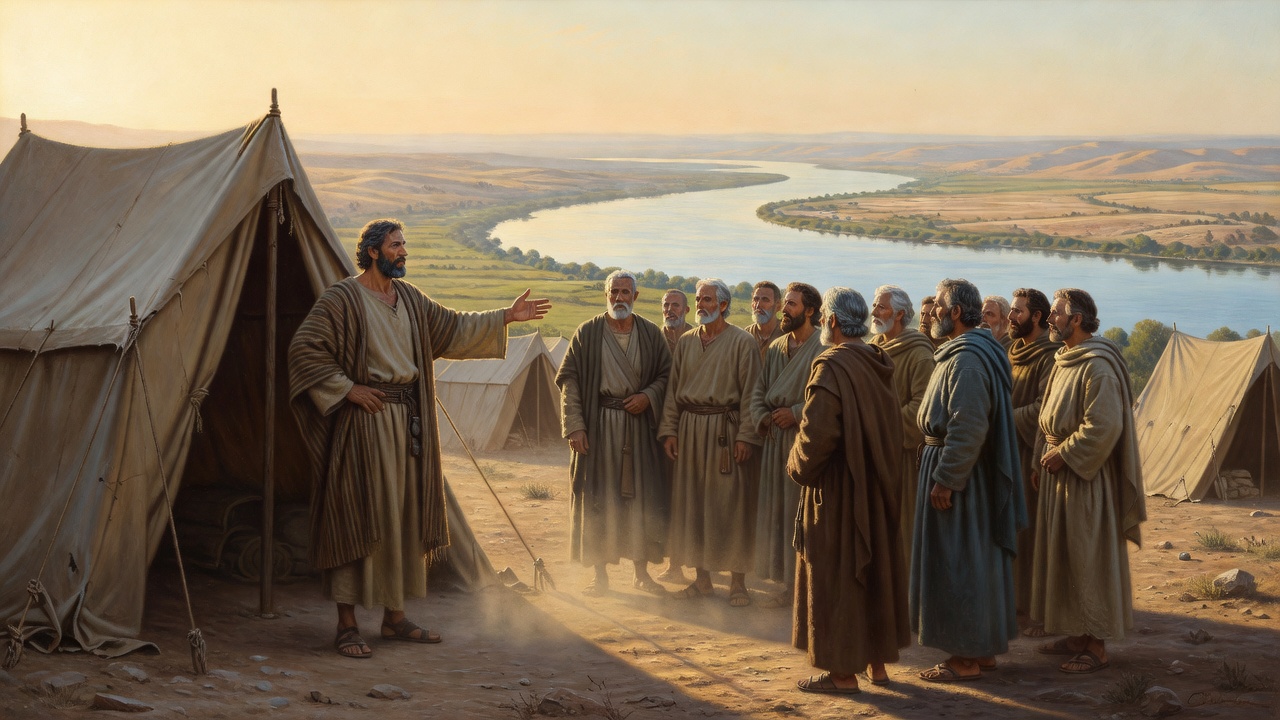
The Lord Commissions Joshua
1After Moses the Lord’s servant died, the Lord said to Joshua son of Nun, Moses’ assistant: 2“Moses my servant is dead. Get ready! Cross the Jordan River! Lead these people into the land which I am ready to hand over to them. 3I am handing over to you every place you set foot, as I promised Moses. 4Your territory will extend from the wilderness in the south to Lebanon in the north. It will extend all the way to the great River Euphrates in the east (including all of Syria) and all the way to the Mediterranean Sea in the west. 5No one will be able to resist you all the days of your life. As I was with Moses, so I will be with you. I will not abandon you or leave you alone. 6Be strong and brave! You must lead these people in the conquest of this land that I solemnly promised their ancestors I would hand over to them. 7Make sure you are very strong and brave! Carefully obey all the law my servant Moses charged you to keep! Do not swerve from it to the right or to the left, so that you may be successful in all you do. 8This law scroll must not leave your lips! You must memorize it day and night so you can carefully obey all that is written in it. Then you will prosper and be successful. 9I repeat, be strong and brave! Don’t be afraid and don’t panic, for I, the Lord your God, am with you in all you do.”
Joshua Prepares for the Invasion
10Joshua instructed the leaders of the people: 11“Go through the camp and command the people, ‘Prepare your supplies, for within three days you will cross the Jordan River and begin the conquest of the land the Lord your God is ready to hand over to you.’”
12Joshua told the Reubenites, Gadites, and the half tribe of Manasseh: 13“Remember what Moses the Lord’s servant commanded you. The Lord your God is giving you a place to settle and is handing this land over to you. 14Your wives, children and cattle may stay in the land that Moses assigned to you east of the Jordan River. But all you warriors must cross over armed for battle ahead of your brothers. You must help them 15until the Lord gives your brothers a place like yours to settle and they conquer the land the Lord your God is ready to hand over to them. Then you may go back to your allotted land and occupy the land Moses the Lord’s servant assigned you east of the Jordan.”
16They told Joshua, “We will do everything you say. We will go wherever you send us. 17Just as we obeyed Moses, so we will obey you. But may the Lord your God be with you as he was with Moses! 18Any man who rebels against what you say and does not obey all your commands will be executed. But be strong and brave!”
Did you know?
Joshua Assumes Leadership
- Joshua, the son of Nun from the tribe of Ephraim, served as Moses' assistant and military commander before being commissioned to succeed him as leader of Israel. His name means "Jehovah is his help" or "Jehovah the Saviour."Sources: Joshua · the Bible text itself
- The territory outlined in God's commission to Joshua stretches from the southern wilderness and the Lebanon mountain range in the north to the Euphrates (called "the great river") in the east and the Mediterranean ("the Great Sea") to the west.Sources: the Bible text itself · Lebanon · Euphrates · Great Sea
- The tribes of Reuben, Gad, and the half-tribe of Manasseh had already received territory east of the Jordan River under Moses. However, their armed warriors were required to cross over ahead of the other tribes to assist them until the entire land was secured.Sources: the Bible text itself · Manasseh (son of Joseph)
Notes written with AI assistance from open sources (Theographic Bible Metadata, CC BY-SA 4.0; Easton’s Bible Dictionary, public domain) and reviewed before publishing.
Places in this chapter
- Jordan · Today: Jordan River · 31.761, 35.558 · verses 2, 11, 14, 15
- Euphrates · Today: Euphrates River · 31.004, 47.442 · verse 4
- Great Sea · Today: Mediterranean Sea · 31.805, 34.170 · verse 4
- Lebanon · 33.540, 35.584 · verse 4
- Negeb · 31.245, 34.841 · verse 4
- Syria · Today: Aram · 33.511, 36.306 · verse 4
Only places identified with high confidence are shown (90% or more according to the scholarly sources compiled by OpenBible). Period map: DARE (Digital Atlas of the Roman Empire), CC BY 4.0; modern map: © OpenStreetMap contributors; places: OpenBible.info (CC BY 4.0).
Credits and license for this translation
NET Bible
NET Bible®, New English Translation (NET)
copyright © 1996-2016 Biblical Studies Press, L. L. C.
Please see https://netbible.com/copyright/ for full NET Bible copyright and permissions information. You can also read the NET Bible at http://NETBible.org .
Language: English
Dialect (if applicable): American
Language in English: English
Translation by:
Please see https://netbible.com/copyright/ for full NET Bible copyright and permissions information. You can also read the NET Bible at http://NETBible.org .
The NET Bible (New English Translation) is a completely new translation of the Bible with 58,506 translators’ notes ! It was completed by more than 25 scholars – experts in the original biblical languages – who worked directly from the best currently available Hebrew, Aramaic, and Greek texts. Turn the pages and see the breadth of the translators’ notes, documenting their decisions and choices as they worked.
The translators’ notes make the original languages far more accessible, allowing you to look over the translator’s shoulder at the very process of translation. This level of documentation is a first for a Bible translation, making transparent the textual basis and the rationale for key renderings (including major interpretive options and alternative translations).
This unparalleled level of detail helps connect people to the Bible in the original languages in a way never before possible without years of study of Hebrew, Aramaic, and Greek. It unlocks the riches of the Bible’s truth from entirely new perspectives.
A donation is appreciated. Donate at Bible.org/donations_form so we can continue to provide our material for free for our 16,000+ articles on Bible.org and our world class Bible Study tool at lumina.bible.org .
2026-10-02
Source: http://ebible.org/engnet/ · eBible.org