Job 30
NET Bible · Tap a verse to see its cross-references.
1“But now they mock me, those who are younger than I,
whose fathers I disdained too much
to put with my sheep dogs.
2Moreover, the strength of their hands –
what use was it to me?
Men whose strength had perished;
3gaunt with want and hunger,
they would gnaw the parched land,
in former time desolate and waste.
4By the brush they would gather herbs from the salt marshes,
and the root of the broom tree was their food.
5They were banished from the community –
people shouted at them
like they would shout at thieves –
6so that they had to live
in the dry stream beds,
in the holes of the ground, and among the rocks.
7They brayed like animals among the bushes
and were huddled together under the nettles.
8Sons of senseless and nameless people,
they were driven out of the land with whips.
Job’s Indignities
9“And now I have become their taunt song;
I have become a byword among them.
10They detest me and maintain their distance;
they do not hesitate to spit in my face.
11Because God has untied my tent cord and afflicted me,
people throw off all restraint in my presence.
12On my right the young rabble rise up;
they drive me from place to place,
and build up siege ramps against me.
13They destroy my path;
they succeed in destroying me
without anyone assisting them.
14They come in as through a wide breach;
amid the crash they come rolling in.
15Terrors are turned loose on me;
they drive away my honor like the wind,
and like a cloud my deliverance has passed away.
Job’s Despondency
16“And now my soul pours itself out within me;
days of suffering take hold of me.
17Night pierces my bones;
my gnawing pains never cease.
18With great power God grasps my clothing;
he binds me like the collar of my tunic.
19He has flung me into the mud,
and I have come to resemble dust and ashes.
20I cry out to you, but you do not answer me;
I stand up, and you only look at me.
21You have become cruel to me;
with the strength of your hand you attack me.
22You pick me up on the wind and make me ride on it;
you toss me about in the storm.
23I know that you are bringing me to death,
to the meeting place for all the living.
The Contrast With the Past
24“Surely one does not stretch out his hand
against a broken man
when he cries for help in his distress.
25Have I not wept for the unfortunate?
Was not my soul grieved for the poor?
26But when I hoped for good, trouble came;
when I expected light, then darkness came.
27My heart is in turmoil unceasingly;
the days of my affliction confront me.
28I go about blackened, but not by the sun;
in the assembly I stand up and cry for help.
29I have become a brother to jackals
and a companion of ostriches.
30My skin has turned dark on me;
my body is hot with fever.
31My harp is used for mourning
and my flute for the sound of weeping.
Did you know?
Humiliation, Physical Suffering, and Desert Outcasts
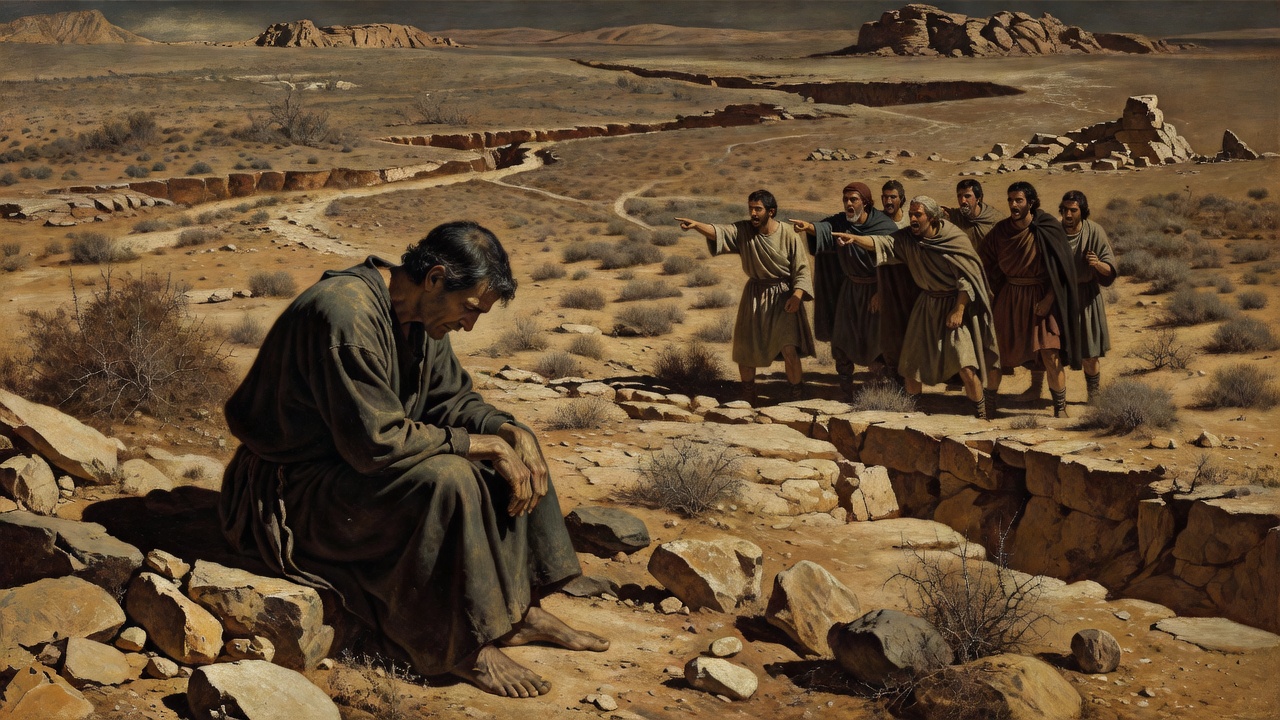
- In this chapter, Job contrasts his previous social standing with his current humiliation at the hands of impoverished outcasts. He describes these men as surviving on the margins of society, foraging for wild mallow and broom tree roots in desolate wadis and rock hollows.Sources: the Bible text itself
- Job uses vivid siege metaphors, picturing his attackers as an advancing army laying ramps and breaking through breaches against him, while he endures severe physical afflictions such as fever, gnawing pain, and blackened, peeling skin.Sources: the Bible text itself
- To convey the isolation and intensity of his grief, Job identifies with the mournful sounds of wilderness creatures, calling himself a companion to jackals and ostriches, while his musical instruments—the harp and flute—are turned entirely to weeping.Sources: the Bible text itself
Notes written with AI assistance from open sources (Theographic Bible Metadata, CC BY-SA 4.0; Easton’s Bible Dictionary, public domain) and reviewed before publishing.
Credits and license for this translation
NET Bible
NET Bible®, New English Translation (NET)
copyright © 1996-2016 Biblical Studies Press, L. L. C.
Please see https://netbible.com/copyright/ for full NET Bible copyright and permissions information. You can also read the NET Bible at http://NETBible.org .
Language: English
Dialect (if applicable): American
Language in English: English
Translation by:
Please see https://netbible.com/copyright/ for full NET Bible copyright and permissions information. You can also read the NET Bible at http://NETBible.org .
The NET Bible (New English Translation) is a completely new translation of the Bible with 58,506 translators’ notes ! It was completed by more than 25 scholars – experts in the original biblical languages – who worked directly from the best currently available Hebrew, Aramaic, and Greek texts. Turn the pages and see the breadth of the translators’ notes, documenting their decisions and choices as they worked.
The translators’ notes make the original languages far more accessible, allowing you to look over the translator’s shoulder at the very process of translation. This level of documentation is a first for a Bible translation, making transparent the textual basis and the rationale for key renderings (including major interpretive options and alternative translations).
This unparalleled level of detail helps connect people to the Bible in the original languages in a way never before possible without years of study of Hebrew, Aramaic, and Greek. It unlocks the riches of the Bible’s truth from entirely new perspectives.
A donation is appreciated. Donate at Bible.org/donations_form so we can continue to provide our material for free for our 16,000+ articles on Bible.org and our world class Bible Study tool at lumina.bible.org .
2026-10-02
Source: http://ebible.org/engnet/ · eBible.org