Jeremiah 39
NET Bible · Tap a verse to see its cross-references.
1King Nebuchadnezzar of Babylon came against Jerusalem with his whole army and laid siege to it. The siege began in the tenth month of the ninth year that Zedekiah ruled over Judah. 2It lasted until the ninth day of the fourth month of Zedekiah’s eleventh year. On that day they broke through the city walls. 3Then Nergal-Sharezer of Samgar, Nebo-Sarsekim, who was a chief officer, Nergal-Sharezer, who was a high official, and all the other officers of the king of Babylon came and set up quarters in the Middle Gate. 4When King Zedekiah of Judah and all his soldiers saw them, they tried to escape. They departed from the city during the night. They took a path through the king’s garden and passed out through the gate between the two walls. Then they headed for the Jordan Valley. 5But the Babylonian army chased after them. They caught up with Zedekiah in the plains of Jericho and captured him. They took him to King Nebuchadnezzar of Babylon at Riblah in the territory of Hamath and Nebuchadnezzar passed sentence on him there. 6There at Riblah the king of Babylon had Zedekiah’s sons put to death while Zedekiah was forced to watch. The king of Babylon also had all the nobles of Judah put to death. 7Then he had Zedekiah’s eyes put out and had him bound in chains to be led off to Babylon. 8The Babylonians burned down the royal palace, the temple of the Lord, and the people’s homes, and they tore down the wall of Jerusalem. 9Then Nebuzaradan, the captain of the royal guard, took captive the rest of the people who were left in the city. He carried them off to Babylon along with the people who had deserted to him. 10But he left behind in the land of Judah some of the poor people who owned nothing. He gave them fields and vineyards at that time.
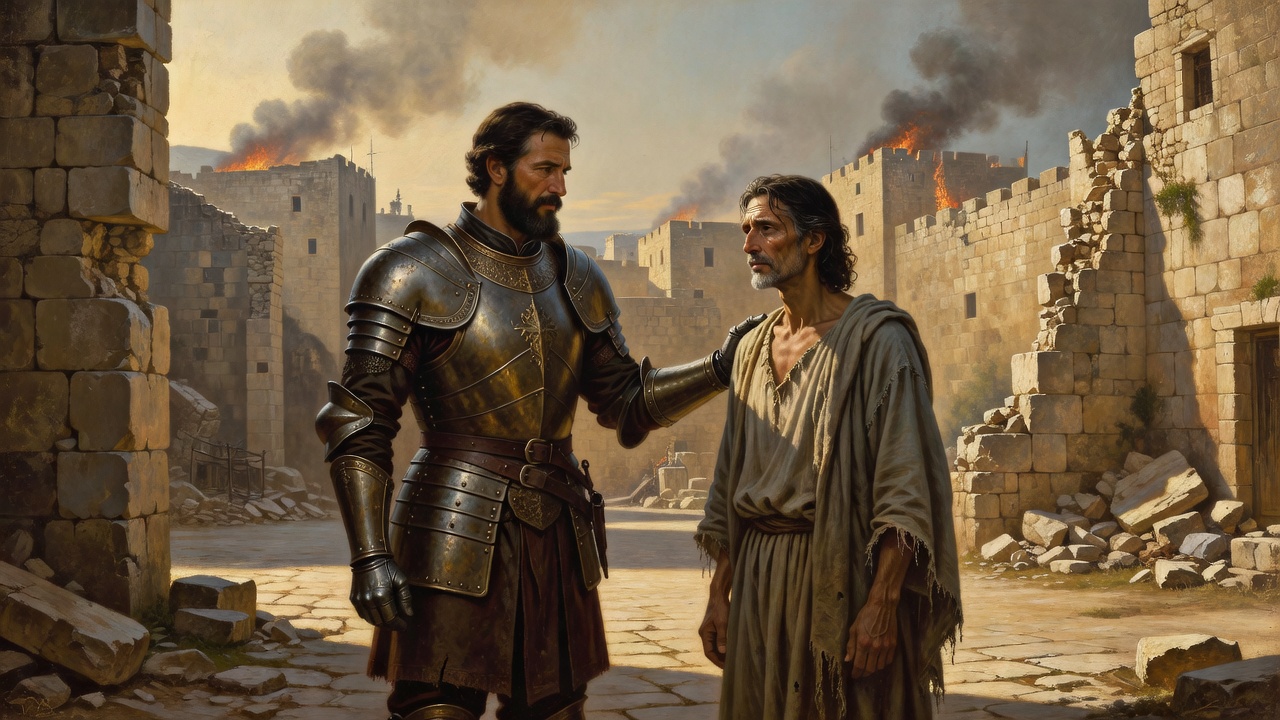
11Now King Nebuchadnezzar of Babylon had issued orders concerning Jeremiah. He had passed them on through Nebuzaradan, the captain of his royal guard, 12“Find Jeremiah and look out for him. Do not do anything to harm him, but do with him whatever he tells you.” 13So Nebuzaradan, the captain of the royal guard, Nebushazban, who was a chief officer, Nergal-Sharezer, who was a high official, and all the other officers of the king of Babylon 14sent and had Jeremiah brought from the courtyard of the guardhouse. They turned him over to Gedaliah, the son of Ahikam and the grandson of Shaphan, to take him home with him. But Jeremiah stayed among the people.
Ebed Melech Is Promised Deliverance because of His Faith
15Now the Lord had spoken to Jeremiah while he was still confined in the courtyard of the guardhouse, 16“Go and tell Ebed-Melech the Ethiopian, ‘The Lord God of Israel who rules over all says, “I will carry out against this city what I promised. It will mean disaster and not good fortune for it. When that disaster happens, you will be there to see it. 17But I will rescue you when it happens. I, the Lord, affirm it! You will not be handed over to those whom you fear. 18I will certainly save you. You will not fall victim to violence. You will escape with your life because you trust in me. I, the Lord, affirm it!”’”
Did you know?
The Fall of Jerusalem and the Fate of Survivors
- Riblah, where King Zedekiah was judged by Nebuchadnezzar, was a strategic city on the Orontes River in the territory of Hamath. Located on the main caravan route between Palestine and the Euphrates, it served as the Babylonian military headquarters during the siege of Jerusalem.Sources: Riblah · Hamath · the Bible text itself
- The Babylonian officials entering Jerusalem bore high-ranking titles such as Rab-mag and Rab-saris. Extrabiblical Babylonian records and inscriptions identify the official Nergal-sharezer as Neriglissar, who later ascended the throne of Babylon after the death of Nebuchadnezzar's son.Sources: Nergal-sharezer · the Bible text itself
- While King Zedekiah was captured in the plains of Jericho after fleeing toward the Arabah, Nebuchadnezzar ordered his guard commander Nebuzaradan to protect Jeremiah. The prophet was released from the court of the guard and entrusted to Gedaliah, while the Ethiopian Ebed-melech was also promised divine protection.Sources: Nebuzar-adan · Arabah · Jericho · the Bible text itself
Notes written with AI assistance from open sources (Theographic Bible Metadata, CC BY-SA 4.0; Easton’s Bible Dictionary, public domain) and reviewed before publishing.
Places in this chapter
- Babylon · 32.543, 44.422 · verses 1, 3, 5, 6, 7, 9, 11, 13
- Jerusalem · 31.777, 35.234 · verses 1, 3, 8
- Arabah · 30.417, 35.151 · verse 4
- Chaldea · 30.962, 46.104 · verses 5, 8
- Hamath · Today: Hama · 35.136, 36.750 · verse 5
- Jericho · Today: Tell es Sultan · 31.872, 35.445 · verse 5
- Riblah · Today: Rableh · 34.460, 36.573 · verses 5, 6
Only places identified with high confidence are shown (90% or more according to the scholarly sources compiled by OpenBible). Period map: DARE (Digital Atlas of the Roman Empire), CC BY 4.0; modern map: © OpenStreetMap contributors; places: OpenBible.info (CC BY 4.0).
Credits and license for this translation
NET Bible
NET Bible®, New English Translation (NET)
copyright © 1996-2016 Biblical Studies Press, L. L. C.
Please see https://netbible.com/copyright/ for full NET Bible copyright and permissions information. You can also read the NET Bible at http://NETBible.org .
Language: English
Dialect (if applicable): American
Language in English: English
Translation by:
Please see https://netbible.com/copyright/ for full NET Bible copyright and permissions information. You can also read the NET Bible at http://NETBible.org .
The NET Bible (New English Translation) is a completely new translation of the Bible with 58,506 translators’ notes ! It was completed by more than 25 scholars – experts in the original biblical languages – who worked directly from the best currently available Hebrew, Aramaic, and Greek texts. Turn the pages and see the breadth of the translators’ notes, documenting their decisions and choices as they worked.
The translators’ notes make the original languages far more accessible, allowing you to look over the translator’s shoulder at the very process of translation. This level of documentation is a first for a Bible translation, making transparent the textual basis and the rationale for key renderings (including major interpretive options and alternative translations).
This unparalleled level of detail helps connect people to the Bible in the original languages in a way never before possible without years of study of Hebrew, Aramaic, and Greek. It unlocks the riches of the Bible’s truth from entirely new perspectives.
A donation is appreciated. Donate at Bible.org/donations_form so we can continue to provide our material for free for our 16,000+ articles on Bible.org and our world class Bible Study tool at lumina.bible.org .
2026-10-02
Source: http://ebible.org/engnet/ · eBible.org