Jeremiah 24
NET Bible · Tap a verse to see its cross-references.
The Good and Bad Figs
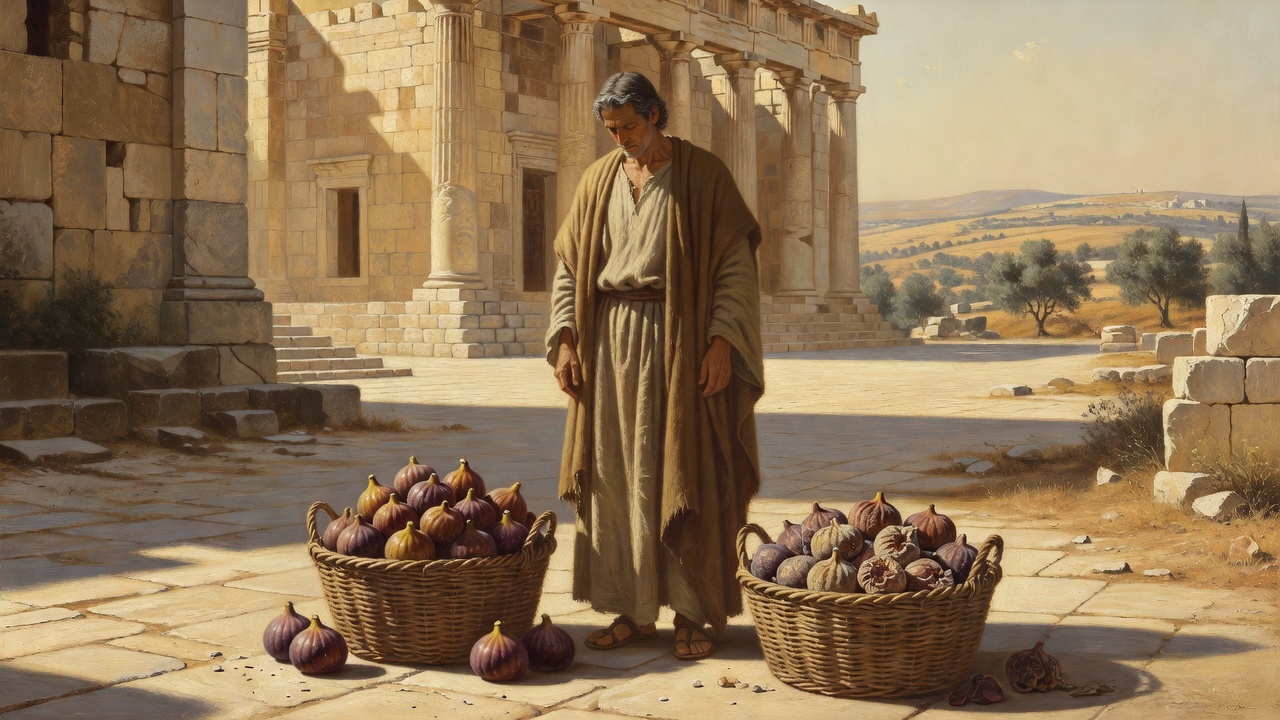
1The Lord showed me two baskets of figs sitting before his temple. This happened after King Nebuchadnezzar of Babylon deported Jehoiakim’s son, King Jeconiah of Judah. He deported him and the leaders of Judah, along with the craftsmen and metal workers, and took them to Babylon. 2One basket had very good-looking figs in it. They looked like those that had ripened early. The other basket had very bad-looking figs in it, so bad they could not be eaten. 3The Lord said to me, “What do you see, Jeremiah?” I answered, “I see figs. The good ones look very good. But the bad ones look very bad, so bad that they cannot be eaten.”
4The Lord said to me, 5“I, the Lord, the God of Israel, say: ‘The exiles whom I sent away from here to the land of Babylon are like those good figs. I consider them to be good. 6I will look after their welfare and will restore them to this land. There I will build them up and will not tear them down. I will plant them firmly in the land and will not uproot them. 7I will give them the desire to acknowledge that I am the Lord. I will be their God and they will be my people. For they will wholeheartedly return to me.’
8“I, the Lord, also solemnly assert: ‘King Zedekiah of Judah, his officials, and the people who remain in Jerusalem or who have gone to live in Egypt are like those bad figs. I consider them to be just like those bad figs that are so bad they cannot be eaten. 9I will bring such disaster on them that all the kingdoms of the earth will be horrified. I will make them an object of reproach, a proverbial example of disaster. I will make them an object of ridicule, an example to be used in curses. That is how they will be remembered wherever I banish them. 10I will bring war, starvation, and disease on them until they are completely destroyed from the land I gave them and their ancestors.’”
Did you know?
The Two Baskets of Figs
- Jeremiah received this vision after King Nebuchadnezzar of Babylon deported King Jeconiah (also called Jehoiachin), along with the officials, craftsmen, and metalsmiths of Jerusalem. Nebuchadnezzar subsequently installed Zedekiah as king over the remaining population in Judah.Sources: the Bible text itself · Jehoiachin · Zedekiah · Nebuchadnezzar
- In the vision set before the temple, the basket of prime, early-ripening figs symbolizes the exiles carried off to Babylon. The Lord promises to preserve them, give them a heart to know him, and restore them to their land.Sources: the Bible text itself
- In contrast, the basket of rotten, inedible figs symbolizes King Zedekiah, his leaders, and the remnant staying in Judah or fleeing to Egypt. Instead of finding security, they are warned of disaster, famine, disease, and derision among the nations.Sources: the Bible text itself · Zedekiah · Egypt
Notes written with AI assistance from open sources (Theographic Bible Metadata, CC BY-SA 4.0; Easton’s Bible Dictionary, public domain) and reviewed before publishing.
Places in this chapter
- Babylon · 32.543, 44.422 · verse 1
- Jerusalem · 31.777, 35.234 · verses 1, 8
- Chaldea · 30.962, 46.104 · verse 5
- Egypt · 30.129, 31.308 · verse 8
Only places identified with high confidence are shown (90% or more according to the scholarly sources compiled by OpenBible). Period map: DARE (Digital Atlas of the Roman Empire), CC BY 4.0; modern map: © OpenStreetMap contributors; places: OpenBible.info (CC BY 4.0).
Credits and license for this translation
NET Bible
NET Bible®, New English Translation (NET)
copyright © 1996-2016 Biblical Studies Press, L. L. C.
Please see https://netbible.com/copyright/ for full NET Bible copyright and permissions information. You can also read the NET Bible at http://NETBible.org .
Language: English
Dialect (if applicable): American
Language in English: English
Translation by:
Please see https://netbible.com/copyright/ for full NET Bible copyright and permissions information. You can also read the NET Bible at http://NETBible.org .
The NET Bible (New English Translation) is a completely new translation of the Bible with 58,506 translators’ notes ! It was completed by more than 25 scholars – experts in the original biblical languages – who worked directly from the best currently available Hebrew, Aramaic, and Greek texts. Turn the pages and see the breadth of the translators’ notes, documenting their decisions and choices as they worked.
The translators’ notes make the original languages far more accessible, allowing you to look over the translator’s shoulder at the very process of translation. This level of documentation is a first for a Bible translation, making transparent the textual basis and the rationale for key renderings (including major interpretive options and alternative translations).
This unparalleled level of detail helps connect people to the Bible in the original languages in a way never before possible without years of study of Hebrew, Aramaic, and Greek. It unlocks the riches of the Bible’s truth from entirely new perspectives.
A donation is appreciated. Donate at Bible.org/donations_form so we can continue to provide our material for free for our 16,000+ articles on Bible.org and our world class Bible Study tool at lumina.bible.org .
2026-10-02
Section headings adapted from the Berean Standard Bible (public domain); they are not part of this translation’s text.
Source: http://ebible.org/engnet/ · eBible.org