Haggai 2
NET Bible · Tap a verse to see its cross-references.
1On the twenty-first day of the seventh month, the Lord spoke again through the prophet Haggai: 2“Ask the following questions to Zerubbabel son of Shealtiel, governor of Judah, the high priest Joshua son of Jehozadak, and the remnant of the people: 3‘Who among you survivors saw the former splendor of this temple? How does it look to you now? Isn’t it nothing by comparison? 4Even so, take heart, Zerubbabel,’ says the Lord. ‘Take heart, Joshua son of Jehozadak, the high priest, and all you citizens of the land,’ says the Lord, ‘and begin to work. For I am with you,’ says the Lord who rules over all. 5‘Do not fear, because I made a promise to your ancestors when they left Egypt, and my spirit even now testifies to you.’ 6Moreover, the Lord who rules over all says: ‘In just a little while I will once again shake the sky and the earth, the sea and the dry ground. 7I will also shake up all the nations, and they will offer their treasures; then I will fill this temple with glory,’ says the Lord who rules over all. 8‘The silver and gold will be mine,’ says the Lord who rules over all. 9‘The future splendor of this temple will be greater than that of former times,’ the Lord who rules over all declares, ‘and in this place I will give peace.’”
The Promised Blessing
10On the twenty-fourth day of the ninth month of Darius’ second year, the Lord spoke again to the prophet Haggai: 11“The Lord who rules over all says, ‘Ask the priests about the law. 12If someone carries holy meat in a fold of his garment and that fold touches bread, a boiled dish, wine, olive oil, or any other food, will that item become holy?’” The priests answered, “It will not.” 13Then Haggai asked, “If a person who is ritually unclean because of touching a dead body comes in contact with one of these items, will it become unclean?” The priests answered, “It will be unclean.”
14Then Haggai responded, “‘The people of this nation are unclean in my sight,’ says the Lord. ‘And so is all their effort; everything they offer is also unclean. 15Now therefore reflect carefully on the recent past, before one stone was laid on another in the Lord’s temple. 16From that time when one came expecting a heap of twenty measures, there were only ten; when one came to the wine vat to draw out fifty measures from it, there were only twenty. 17I struck all the products of your labor with blight, disease, and hail, and yet you brought nothing to me,’ says the Lord. 18‘Think carefully about the past: from today, the twenty-fourth day of the ninth month, to the day work on the temple of the Lord was resumed, think about it. 19The seed is still in the storehouse, isn’t it? And the vine, fig tree, pomegranate, and olive tree have not produced. Nevertheless, from today on I will bless you.’”
Zerubbabel the Chosen One
20Then the Lord spoke again to Haggai on the twenty-fourth day of the month: 21Tell Zerubbabel governor of Judah: ‘I am ready to shake the sky and the earth. 22I will overthrow royal thrones and shatter the might of earthly kingdoms. I will overthrow chariots and those who ride them, and horses and their riders will fall as people kill one another. 23On that day,’ says the Lord who rules over all, ‘I will take you, Zerubbabel son of Shealtiel, my servant,’ says the Lord, ‘and I will make you like a signet ring, for I have chosen you,’ says the Lord who rules over all.”
Did you know?
The Promise of Future Glory
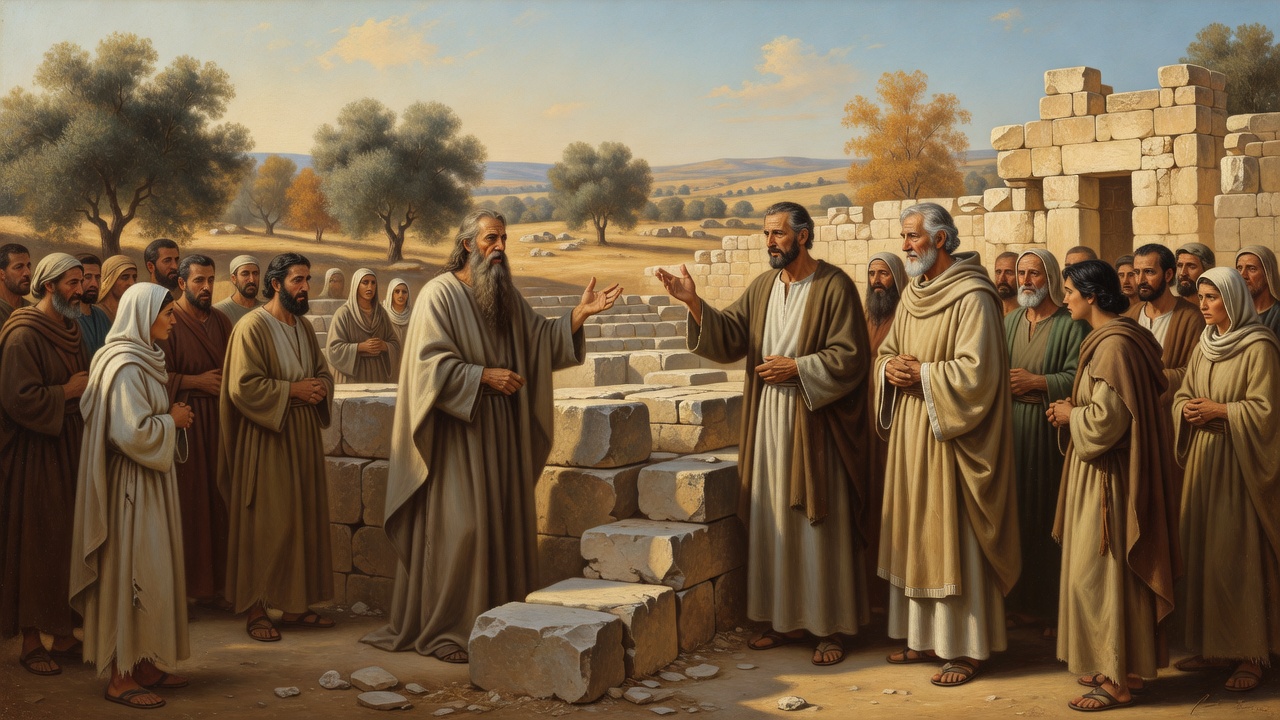
- When the foundation of the second temple was laid after the return from Babylon, older members of the community could still remember the magnificence of the original temple destroyed by Nebuchadnezzar. In response to their discouragement at the modest new structure, Haggai declared that the future glory of this house would surpass its former splendor.Sources: the Bible text itself · Zerubbabel · Haggai
- Haggai consulted the priests on questions of ritual law to illustrate a moral point. According to their rulings, holiness was not easily transmitted through indirect contact, whereas ceremonial defilement—such as from touching a corpse—spread immediately, mirroring how their past neglect had affected their offerings and harvests.Sources: the Bible text itself
- The restoration of the community was led by two key figures: Zerubbabel son of Shealtiel, who served as the civil governor, and Joshua son of Jehozadak, the high priest. At the end of the chapter, Haggai addresses Zerubbabel with the royal imagery of a signet ring, symbolizing divine authority and choice.Sources: the Bible text itself · Zerubbabel · Joshua
Notes written with AI assistance from open sources (Theographic Bible Metadata, CC BY-SA 4.0; Easton’s Bible Dictionary, public domain) and reviewed before publishing.
Places in this chapter
- Egypt · 30.129, 31.308 · verse 5
Only places identified with high confidence are shown (90% or more according to the scholarly sources compiled by OpenBible). Period map: DARE (Digital Atlas of the Roman Empire), CC BY 4.0; modern map: © OpenStreetMap contributors; places: OpenBible.info (CC BY 4.0).
Credits and license for this translation
NET Bible
NET Bible®, New English Translation (NET)
copyright © 1996-2016 Biblical Studies Press, L. L. C.
Please see https://netbible.com/copyright/ for full NET Bible copyright and permissions information. You can also read the NET Bible at http://NETBible.org .
Language: English
Dialect (if applicable): American
Language in English: English
Translation by:
Please see https://netbible.com/copyright/ for full NET Bible copyright and permissions information. You can also read the NET Bible at http://NETBible.org .
The NET Bible (New English Translation) is a completely new translation of the Bible with 58,506 translators’ notes ! It was completed by more than 25 scholars – experts in the original biblical languages – who worked directly from the best currently available Hebrew, Aramaic, and Greek texts. Turn the pages and see the breadth of the translators’ notes, documenting their decisions and choices as they worked.
The translators’ notes make the original languages far more accessible, allowing you to look over the translator’s shoulder at the very process of translation. This level of documentation is a first for a Bible translation, making transparent the textual basis and the rationale for key renderings (including major interpretive options and alternative translations).
This unparalleled level of detail helps connect people to the Bible in the original languages in a way never before possible without years of study of Hebrew, Aramaic, and Greek. It unlocks the riches of the Bible’s truth from entirely new perspectives.
A donation is appreciated. Donate at Bible.org/donations_form so we can continue to provide our material for free for our 16,000+ articles on Bible.org and our world class Bible Study tool at lumina.bible.org .
2026-10-02
Source: http://ebible.org/engnet/ · eBible.org