Ezekiel 46
NET Bible · Tap a verse to see its cross-references.
The Prince’s Offerings
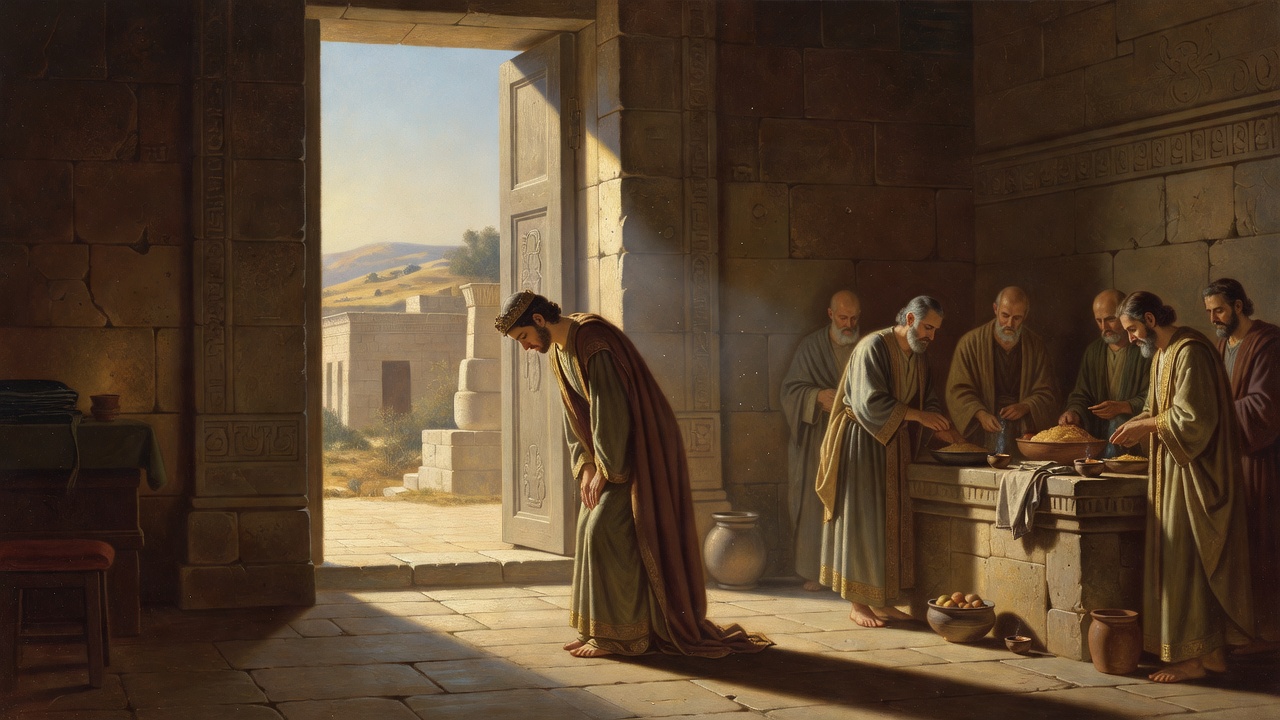
1“‘This is what the sovereign Lord says: The gate of the inner court that faces east will be closed six working days, but on the Sabbath day it will be opened and on the day of the new moon it will be opened. 2The prince will enter by way of the porch of the gate from the outside, and will stand by the doorpost of the gate. The priests will provide his burnt offering and his peace offerings, and he will bow down at the threshold of the gate and then go out. But the gate will not be closed until evening. 3The people of the land will bow down at the entrance of that gate before the Lord on the Sabbaths and on the new moons. 4The burnt offering which the prince will offer to the Lord on the Sabbath day will be six unblemished lambs and one unblemished ram. 5The grain offering will be an ephah with the ram, and the grain offering with the lambs will be as much as he is able to give, and a gallon of olive oil with an ephah. 6On the day of the new moon he will offer an unblemished young bull, and six lambs and a ram, all without blemish. 7He will provide a grain offering: an ephah with the bull and an ephah with the ram, and with the lambs as much as he wishes, and a gallon of olive oil with each ephah of grain. 8When the prince enters, he will come by way of the porch of the gate and will go out the same way.
9“‘When the people of the land come before the Lord at the appointed feasts, whoever enters by way of the north gate to worship will go out by way of the south gate; whoever enters by way of the south gate will go out by way of the north gate. No one will return by way of the gate they entered but will go out straight ahead. 10When they come in, the prince will come in with them, and when they go out, he will go out.
11“‘At the festivals and at the appointed feasts the grain offering will be an ephah with the bull and an ephah with the ram, and with the lambs as much as one is able, and a gallon of olive oil with each ephah of grain. 12When the prince provides a freewill offering, a burnt offering, or peace offerings as a voluntary offering to the Lord, the gate facing east will be opened for him, and he will provide his burnt offering and his peace offerings just as he did on the Sabbath. Then he will go out, and the gate will be closed after he goes out.
13“‘You will provide a lamb a year old without blemish for a burnt offering daily to the Lord; morning by morning he will provide it. 14And you will provide a grain offering with it morning by morning, a sixth of an ephah, and a third of a gallon of olive oil to moisten the choice flour, as a grain offering to the Lord; this is a perpetual statute. 15Thus they will provide the lamb, the grain offering, and the olive oil morning by morning, as a perpetual burnt offering.
16“‘This is what the sovereign Lord says: If the prince should give a gift to one of his sons as his inheritance, it will belong to his sons, it is their property by inheritance. 17But if he gives a gift from his inheritance to one of his servants, it will be his until the year of liberty; then it will revert to the prince. His inheritance will only remain with his sons. 18The prince will not take away any of the people’s inheritance by oppressively removing them from their property. He will give his sons an inheritance from his own possessions so that my people will not be scattered, each from his own property.’”
The Courts for Boiling and Baking
19Then he brought me through the entrance, which was at the side of the gate, into the holy chambers for the priests which faced north. There I saw a place at the extreme western end. 20He said to me, “This is the place where the priests will boil the guilt offering and the sin offering, and where they will bake the grain offering, so that they do not bring them out to the outer court to transmit holiness to the people.”
21Then he brought me out to the outer court and led me past the four corners of the court, and I noticed that in every corner of the court there was a court. 22In the four corners of the court were small courts, 70 feet in length and 52½ feet in width; the four were all the same size. 23There was a row of masonry around each of the four courts, and places for boiling offerings were made under the rows all around. 24Then he said to me, “These are the houses for boiling, where the ministers of the temple boil the sacrifices of the people.”
Did you know?
Worship, Royal Duties, and Temple Kitchens
- The east inner gate of the temple was kept shut during the six working days but opened on the Sabbath and New Moon festivals. The prince was instructed to stand by the gatepost and worship at the threshold while the priests offered his sacrifices, after which the gate stayed open until evening.Sources: the Bible text itself
- To regulate worship during the appointed feasts, worshippers entering by the north gate were required to exit through the south gate, and vice versa. Furthermore, property laws strictly prevented the prince from seizing the land of the people, requiring him to provide inheritances only from his own possessions.Sources: the Bible text itself
- The vision details separate cooking areas in the temple complex: special rooms at the western end for priests to boil guilt and sin offerings to avoid transmitting sacredness to the people, and four large enclosed corner courts in the outer court used by temple ministers to cook communal sacrifices.Sources: the Bible text itself
Notes written with AI assistance from open sources (Theographic Bible Metadata, CC BY-SA 4.0; Easton’s Bible Dictionary, public domain) and reviewed before publishing.
Credits and license for this translation
NET Bible
NET Bible®, New English Translation (NET)
copyright © 1996-2016 Biblical Studies Press, L. L. C.
Please see https://netbible.com/copyright/ for full NET Bible copyright and permissions information. You can also read the NET Bible at http://NETBible.org .
Language: English
Dialect (if applicable): American
Language in English: English
Translation by:
Please see https://netbible.com/copyright/ for full NET Bible copyright and permissions information. You can also read the NET Bible at http://NETBible.org .
The NET Bible (New English Translation) is a completely new translation of the Bible with 58,506 translators’ notes ! It was completed by more than 25 scholars – experts in the original biblical languages – who worked directly from the best currently available Hebrew, Aramaic, and Greek texts. Turn the pages and see the breadth of the translators’ notes, documenting their decisions and choices as they worked.
The translators’ notes make the original languages far more accessible, allowing you to look over the translator’s shoulder at the very process of translation. This level of documentation is a first for a Bible translation, making transparent the textual basis and the rationale for key renderings (including major interpretive options and alternative translations).
This unparalleled level of detail helps connect people to the Bible in the original languages in a way never before possible without years of study of Hebrew, Aramaic, and Greek. It unlocks the riches of the Bible’s truth from entirely new perspectives.
A donation is appreciated. Donate at Bible.org/donations_form so we can continue to provide our material for free for our 16,000+ articles on Bible.org and our world class Bible Study tool at lumina.bible.org .
2026-10-02
Section headings adapted from the Berean Standard Bible (public domain); they are not part of this translation’s text.
Source: http://ebible.org/engnet/ · eBible.org