Esther 2
NET Bible · Tap a verse to see its cross-references.
1When these things had been accomplished and the rage of King Ahasuerus had diminished, he remembered Vashti and what she had done and what had been decided against her. 2The king’s servants who attended him said, “Let a search be conducted in the king’s behalf for attractive young women. 3And let the king appoint officers throughout all the provinces of his kingdom to gather all the attractive young women to Susa the citadel, to the harem under the authority of Hegai, the king’s eunuch who oversees the women, and let him provide whatever cosmetics they desire. 4Let the young woman whom the king finds most attractive become queen in place of Vashti.” This seemed like a good idea to the king, so he acted accordingly.
5Now there happened to be a Jewish man in Susa the citadel whose name was Mordecai. He was the son of Jair, the son of Shimei, the son of Kish, a Benjaminite, 6who had been taken into exile from Jerusalem with the captives who had been carried into exile with Jeconiah king of Judah, whom Nebuchadnezzar king of Babylon had taken into exile. 7Now he was acting as the guardian of Hadassah (that is, Esther), the daughter of his uncle, for neither her father nor her mother was alive. This young woman was very attractive and had a beautiful figure. When her father and mother died, Mordecai had raised her as if she were his own daughter.
8It so happened that when the king’s edict and his law became known many young women were taken to Susa the citadel to be placed under the authority of Hegai. Esther also was taken to the royal palace to be under the authority of Hegai, who was overseeing the women. 9This young woman pleased him, and she found favor with him. He quickly provided her with her cosmetics and her rations; he also provided her with the seven specially chosen young women who were from the palace. He then transferred her and her young women to the best quarters in the harem.
10Now Esther had not disclosed her people or her lineage, for Mordecai had instructed her not to do so. 11And day after day Mordecai used to walk back and forth in front of the court of the harem in order to learn how Esther was doing and what might happen to her.
12At the end of the twelve months that were required for the women, when the turn of each young woman arrived to go to King Ahasuerus – for in this way they had to fulfill their time of cosmetic treatment: six months with oil of myrrh, and six months with perfume and various ointments used by women – 13the woman would go to the king in the following way: Whatever she asked for would be provided for her to take with her from the harem to the royal palace. 14In the evening she went, and in the morning she returned to a separate part of the harem, to the authority of Shaashgaz the king’s eunuch who was overseeing the concubines. She would not go back to the king unless the king was pleased with her and she was requested by name.
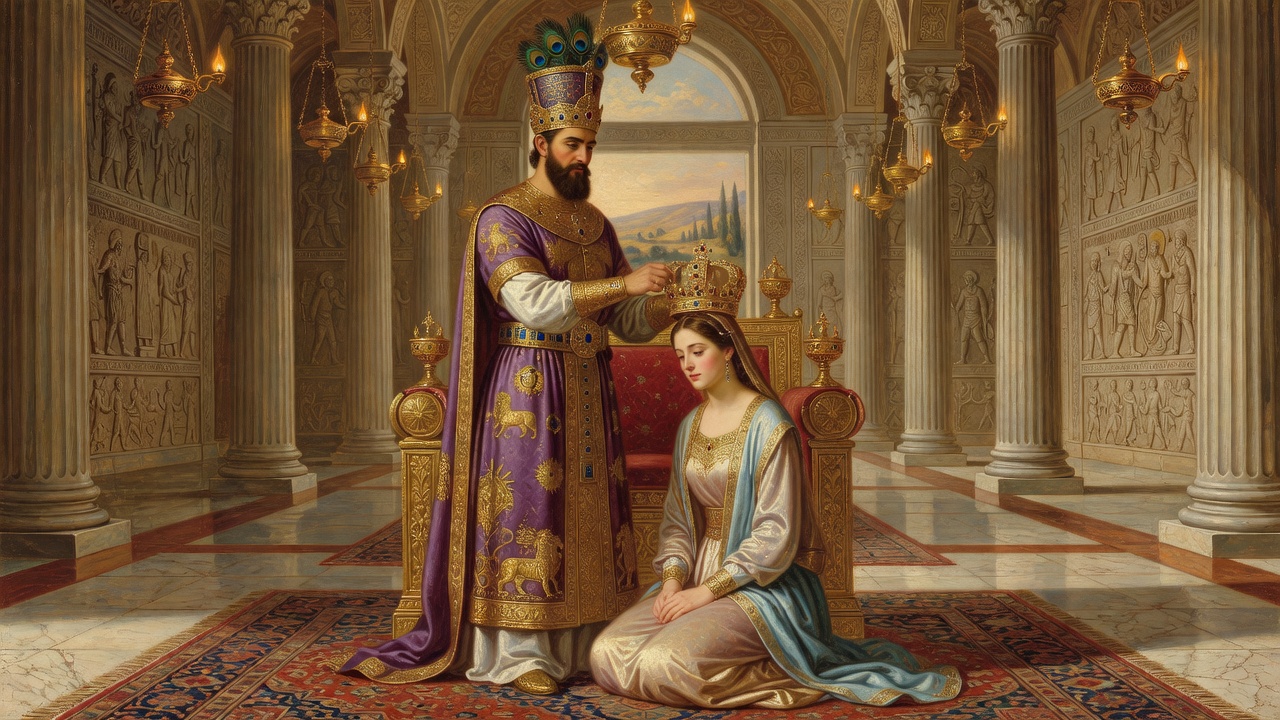
15When it became the turn of Esther daughter of Abihail the uncle of Mordecai (who had raised her as if she were his own daughter ) to go to the king, she did not request anything except what Hegai the king’s eunuch, who was overseer of the women, had recommended. Yet Esther met with the approval of all who saw her. 16Then Esther was taken to King Ahasuerus at his royal residence in the tenth month (that is, the month of Tebeth) in the seventh year of his reign. 17And the king loved Esther more than all the other women, and she met with his loving approval more than all the other young women. So he placed the royal high turban on her head and appointed her queen in place of Vashti. 18Then the king prepared a large banquet for all his officials and his servants – it was actually Esther’s banquet. He also set aside a holiday for the provinces, and he provided for offerings at the king’s expense.
Mordecai Learns of a Plot against the King
19Now when the young women were being gathered again, Mordecai was sitting at the king’s gate. 20Esther was still not divulging her lineage or her people, just as Mordecai had instructed her. Esther continued to do whatever Mordecai said, just as she had done when he was raising her.
21In those days while Mordecai was sitting at the king’s gate, Bigthan and Teresh, two of the king’s eunuchs who protected the entrance, became angry and plotted to assassinate King Ahasuerus. 22When Mordecai learned of the conspiracy, he informed Queen Esther, and Esther told the king in Mordecai’s behalf. 23The king then had the matter investigated and, finding it to be so, had the two conspirators hanged on a gallows. It was then recorded in the daily chronicles in the king’s presence.
Did you know?
Esther's Rise to Queen
- Esther originally bore the Hebrew name Hadassah, meaning "myrtle," but became known as Esther (derived from the Persian word for "star") in the Persian court. An orphaned Benjamite, she was brought up by her cousin Mordecai, who instructed her not to disclose her Jewish heritage.Sources: Esther · the Bible text itself
- Young women brought to the citadel of Susa underwent a strict twelve-month preparation under the royal official Hegai. The regimen required six months of treatments with oil of myrrh followed by six months with perfumes and cosmetics before an audience with the king.Sources: Hegai · the Bible text itself
- While sitting at the palace gate, Mordecai uncovered an assassination plot against King Ahasuerus by two royal guards, Bigthan and Teresh. Queen Esther reported the treason in Mordecai's name, and the event was formally recorded in the king's chronicles.Sources: the Bible text itself
Notes written with AI assistance from open sources (Theographic Bible Metadata, CC BY-SA 4.0; Easton’s Bible Dictionary, public domain) and reviewed before publishing.
Places in this chapter
- Susa · Today: Shush · 32.189, 48.258 · verses 3, 5, 8
- Babylon · 32.543, 44.422 · verse 6
- Jerusalem · 31.777, 35.234 · verse 6
Only places identified with high confidence are shown (90% or more according to the scholarly sources compiled by OpenBible). Period map: DARE (Digital Atlas of the Roman Empire), CC BY 4.0; modern map: © OpenStreetMap contributors; places: OpenBible.info (CC BY 4.0).
Credits and license for this translation
NET Bible
NET Bible®, New English Translation (NET)
copyright © 1996-2016 Biblical Studies Press, L. L. C.
Please see https://netbible.com/copyright/ for full NET Bible copyright and permissions information. You can also read the NET Bible at http://NETBible.org .
Language: English
Dialect (if applicable): American
Language in English: English
Translation by:
Please see https://netbible.com/copyright/ for full NET Bible copyright and permissions information. You can also read the NET Bible at http://NETBible.org .
The NET Bible (New English Translation) is a completely new translation of the Bible with 58,506 translators’ notes ! It was completed by more than 25 scholars – experts in the original biblical languages – who worked directly from the best currently available Hebrew, Aramaic, and Greek texts. Turn the pages and see the breadth of the translators’ notes, documenting their decisions and choices as they worked.
The translators’ notes make the original languages far more accessible, allowing you to look over the translator’s shoulder at the very process of translation. This level of documentation is a first for a Bible translation, making transparent the textual basis and the rationale for key renderings (including major interpretive options and alternative translations).
This unparalleled level of detail helps connect people to the Bible in the original languages in a way never before possible without years of study of Hebrew, Aramaic, and Greek. It unlocks the riches of the Bible’s truth from entirely new perspectives.
A donation is appreciated. Donate at Bible.org/donations_form so we can continue to provide our material for free for our 16,000+ articles on Bible.org and our world class Bible Study tool at lumina.bible.org .
2026-10-02
Source: http://ebible.org/engnet/ · eBible.org