2 Kings 25
NET Bible · Tap a verse to see its cross-references.
1So King Nebuchadnezzar of Babylon came against Jerusalem with his whole army and set up camp outside it. They built siege ramps all around it. He arrived on the tenth day of the tenth month in the ninth year of Zedekiah’s reign. 2The city remained under siege until King Zedekiah’s eleventh year. 3By the ninth day of the fourth month the famine in the city was so severe the residents had no food. 4The enemy broke through the city walls, and all the soldiers tried to escape. They left the city during the night. They went through the gate between the two walls that is near the king’s garden. (The Babylonians were all around the city.) Then they headed for the Jordan Valley. 5But the Babylonian army chased after the king. They caught up with him in the plains of Jericho, and his entire army deserted him. 6They captured the king and brought him up to the king of Babylon at Riblah, where he passed sentence on him. 7Zedekiah’s sons were executed while Zedekiah was forced to watch. The king of Babylon then had Zedekiah’s eyes put out, bound him in bronze chains, and carried him off to Babylon.
Nebuchadnezzar Destroys Jerusalem
8On the seventh day of the fifth month, in the nineteenth year of King Nebuchadnezzar of Babylon, Nebuzaradan, the captain of the royal guard who served the king of Babylon, arrived in Jerusalem. 9He burned down the Lord’s temple, the royal palace, and all the houses in Jerusalem, including every large house. 10The whole Babylonian army that came with the captain of the royal guard tore down the walls that surrounded Jerusalem. 11Nebuzaradan, the captain of the royal guard, deported the rest of the people who were left in the city, those who had deserted to the king of Babylon, and the rest of the craftsmen. 12But he left behind some of the poor of the land and gave them fields and vineyards.
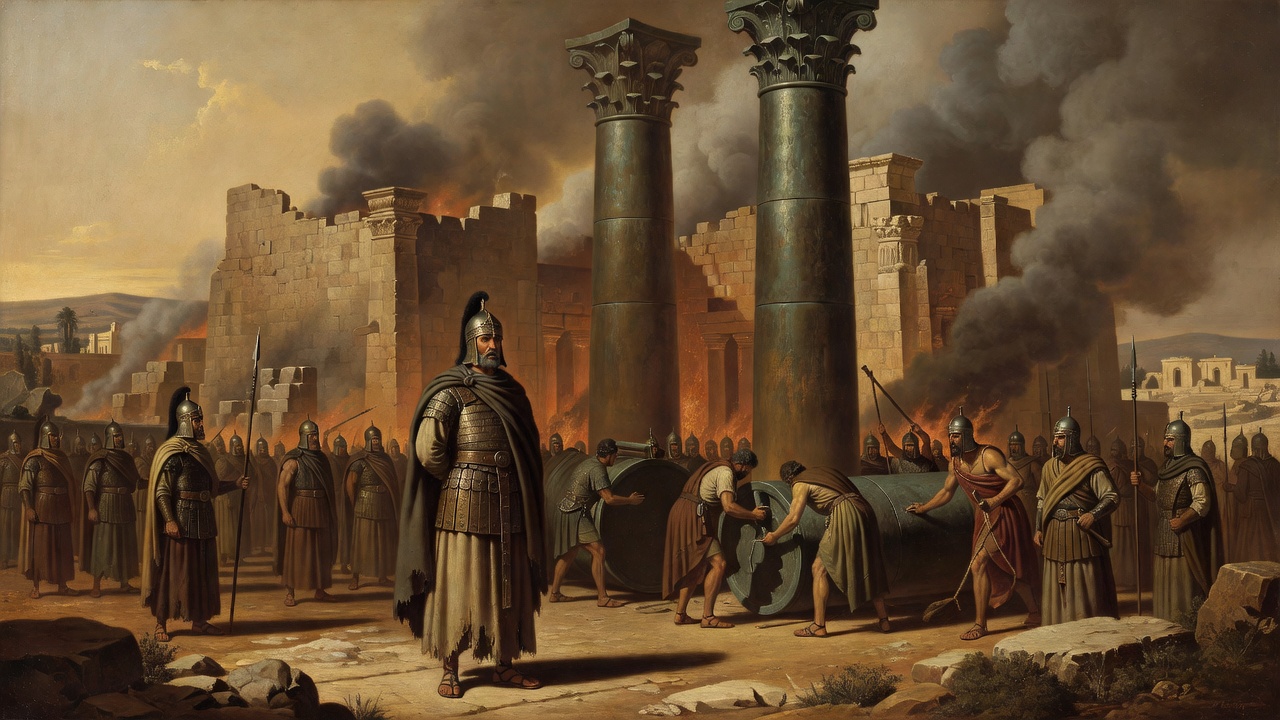
13The Babylonians broke the two bronze pillars in the Lord’s temple, as well as the movable stands and the big bronze basin called the “The Sea.” They took the bronze to Babylon. 14They also took the pots, shovels, trimming shears, pans, and all the bronze utensils used by the priests. 15The captain of the royal guard took the golden and silver censers and basins. 16The bronze of the items that King Solomon made for the Lord’s temple – including the two pillars, the big bronze basin called “The Sea,” the twelve bronze bulls under “The Sea,” and the movable stands – was too heavy to be weighed. 17Each of the pillars was about twenty-seven feet high. The bronze top of one pillar was about four and a half feet high and had bronze latticework and pomegranate shaped ornaments all around it. The second pillar with its latticework was like it.
18The captain of the royal guard took Seraiah the chief priest and Zephaniah, the priest who was second in rank, and the three doorkeepers. 19From the city he took a eunuch who was in charge of the soldiers, five of the king’s advisers who were discovered in the city, an official army secretary who drafted citizens for military service, and sixty citizens from the people of the land who were discovered in the city. 20Nebuzaradan, captain of the royal guard, took them and brought them to the king of Babylon at Riblah. 21The king of Babylon ordered them to be executed at Riblah in the territory of Hamath. So Judah was deported from its land.
Gedaliah Appointed Governor
22Now King Nebuchadnezzar of Babylon appointed Gedaliah son of Ahikam, son of Shaphan, as governor over the people whom he allowed to remain in the land of Judah. 23All of the officers of the Judahite army and their troops heard that the king of Babylon had appointed Gedaliah to govern. So they came to Gedaliah at Mizpah. The officers who came were Ishmael son of Nethaniah, Johanan son of Kareah, Seraiah son of Tanhumeth the Netophathite, and Jaazaniah son of the Maacathite. 24Gedaliah took an oath so as to give them and their troops some assurance of safety. He said, “You don’t need to be afraid to submit to the Babylonian officials. Settle down in the land and submit to the king of Babylon. Then things will go well for you.” 25But in the seventh month Ishmael son of Nethaniah, son of Elishama, who was a member of the royal family, came with ten of his men and murdered Gedaliah, as well as the Judeans and Babylonians who were with him at Mizpah. 26Then all the people, from the youngest to the oldest, as well as the army officers, left for Egypt, because they were afraid of what the Babylonians might do.
Jehoiachin in Babylon
27In the thirty-seventh year of the exile of King Jehoiachin of Judah, on the twenty-seventh day of the twelfth month, King Evil-Merodach of Babylon, in the first year of his reign, pardoned King Jehoiachin of Judah and released him from prison. 28He spoke kindly to him and gave him a more prestigious position than the other kings who were with him in Babylon. 29Jehoiachin took off his prison clothes and ate daily in the king’s presence for the rest of his life. 30He was given daily provisions by the king for the rest of his life until the day he died.
Did you know?
The Fall of Jerusalem and the Exile
- King Nebuchadnezzar directed the campaign against Jerusalem from his headquarters at Riblah, situated in the land of Hamath on the Orontes River. After being captured on the plains of Jericho, King Zedekiah was brought to Riblah, where his sons were slaughtered before him and he was blinded before being carried in bronze shackles to Babylon.Sources: Riblah · Zedekiah · the Bible text itself
- When Nebuzaradan, captain of the guard, burned Jerusalem, the Babylonians broke up the monumental bronze pillars, the movable stands, and the large bronze Sea that King Solomon had made for the temple, carrying the metal off to Babylon.Sources: Nebuzar-adan · Solomon · the Bible text itself
- Following the city's destruction, Nebuchadnezzar appointed Gedaliah son of Ahikam as governor over the remaining population at Mizpah. However, Ishmael son of Nethaniah, a member of the royal family, assassinated Gedaliah, causing the terrified remnant to flee to Egypt.Sources: Gedaliah · Ishmael · Mizpah · the Bible text itself
Notes written with AI assistance from open sources (Theographic Bible Metadata, CC BY-SA 4.0; Easton’s Bible Dictionary, public domain) and reviewed before publishing.
Places in this chapter
- Babylon · 32.543, 44.422 · verses 1, 6, 7, 8, 11, 13, 20, 21, 22, 23, 24, 27, 28, 29
- Jerusalem · 31.777, 35.234 · verses 1, 2, 8, 9, 10
- Arabah · 30.417, 35.151 · verses 4, 5
- Chaldea · 30.962, 46.104 · verses 4, 5, 10, 13, 25, 26
- Jericho · Today: Tell es Sultan · 31.872, 35.445 · verse 5
- Riblah · Today: Rableh · 34.460, 36.573 · verses 6, 20, 21
- Hamath · Today: Hama · 35.136, 36.750 · verse 21
- Egypt · 30.129, 31.308 · verse 26
Only places identified with high confidence are shown (90% or more according to the scholarly sources compiled by OpenBible). Period map: DARE (Digital Atlas of the Roman Empire), CC BY 4.0; modern map: © OpenStreetMap contributors; places: OpenBible.info (CC BY 4.0).
Credits and license for this translation
NET Bible
NET Bible®, New English Translation (NET)
copyright © 1996-2016 Biblical Studies Press, L. L. C.
Please see https://netbible.com/copyright/ for full NET Bible copyright and permissions information. You can also read the NET Bible at http://NETBible.org .
Language: English
Dialect (if applicable): American
Language in English: English
Translation by:
Please see https://netbible.com/copyright/ for full NET Bible copyright and permissions information. You can also read the NET Bible at http://NETBible.org .
The NET Bible (New English Translation) is a completely new translation of the Bible with 58,506 translators’ notes ! It was completed by more than 25 scholars – experts in the original biblical languages – who worked directly from the best currently available Hebrew, Aramaic, and Greek texts. Turn the pages and see the breadth of the translators’ notes, documenting their decisions and choices as they worked.
The translators’ notes make the original languages far more accessible, allowing you to look over the translator’s shoulder at the very process of translation. This level of documentation is a first for a Bible translation, making transparent the textual basis and the rationale for key renderings (including major interpretive options and alternative translations).
This unparalleled level of detail helps connect people to the Bible in the original languages in a way never before possible without years of study of Hebrew, Aramaic, and Greek. It unlocks the riches of the Bible’s truth from entirely new perspectives.
A donation is appreciated. Donate at Bible.org/donations_form so we can continue to provide our material for free for our 16,000+ articles on Bible.org and our world class Bible Study tool at lumina.bible.org .
2026-10-02
Source: http://ebible.org/engnet/ · eBible.org