2 Chronicles 35
NET Bible · Tap a verse to see its cross-references.
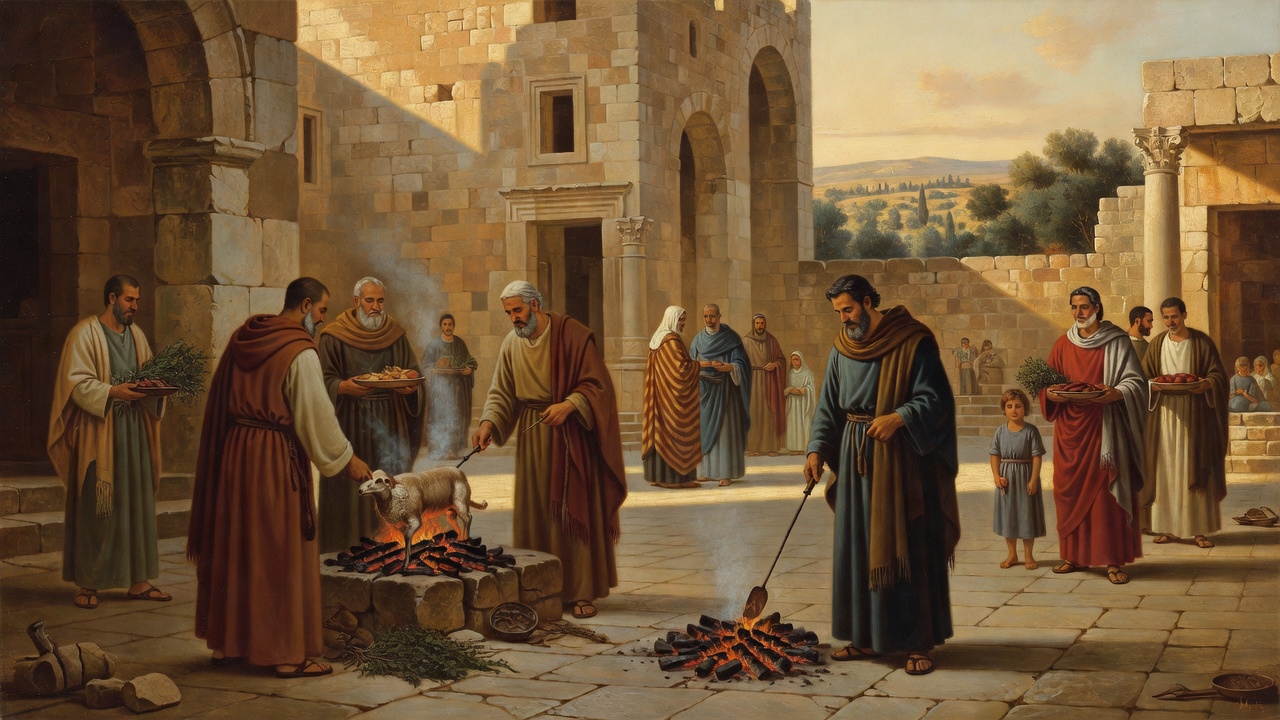
1Josiah observed a Passover festival for the Lord in Jerusalem. They slaughtered the Passover lambs on the fourteenth day of the first month. 2He appointed the priests to fulfill their duties and encouraged them to carry out their service in the Lord’s temple. 3He told the Levites, who instructed all Israel about things consecrated to the Lord, “Place the holy ark in the temple which King Solomon son of David of Israel built. Don’t carry it on your shoulders. Now serve the Lord your God and his people Israel! 4Prepare yourselves by your families according to your divisions, as instructed by King David of Israel and his son Solomon. 5Stand in the sanctuary and, together with the Levites, represent the family divisions of your countrymen. 6Slaughter the Passover lambs, consecrate yourselves, and make preparations for your countrymen to do what the Lord commanded through Moses.”
7From his own royal flocks and herds, Josiah supplied the people with 30,000 lambs and goats for the Passover sacrifice, as well as 3,000 cattle. 8His officials also willingly contributed to the people, priests, and Levites. Hilkiah, Zechariah, and Jehiel, the leaders of God’s temple, supplied 2,600 Passover sacrifices and 300 cattle. 9Konaniah and his brothers Shemaiah and Nethanel, along with Hashabiah, Jeiel, and Jozabad, the officials of the Levites, supplied the Levites with 5,000 Passover sacrifices and 500 cattle. 10Preparations were made, and the priests stood at their posts and the Levites in their divisions as prescribed by the king. 11They slaughtered the Passover lambs and the priests splashed the blood, while the Levites skinned the animals. 12They reserved the burnt offerings and the cattle for the family divisions of the people to present to the Lord, as prescribed in the scroll of Moses. 13They cooked the Passover sacrifices over the open fire as prescribed and cooked the consecrated offerings in pots, kettles, and pans. They quickly served them to all the people. 14Afterward they made preparations for themselves and for the priests, because the priests, the descendants of Aaron, were offering burnt sacrifices and fat portions until evening. The Levites made preparations for themselves and for the priests, the descendants of Aaron. 15The musicians, the descendants of Asaph, manned their posts, as prescribed by David, Asaph, Heman, and Jeduthun the king’s prophet. The guards at the various gates did not need to leave their posts, for their fellow Levites made preparations for them. 16So all the preparations for the Lord’s service were made that day, as the Passover was observed and the burnt sacrifices were offered on the altar of the Lord, as prescribed by King Josiah. 17So the Israelites who were present observed the Passover at that time, as well as the Feast of Unleavened Bread for seven days. 18A Passover like this had not been observed in Israel since the days of Samuel the prophet. None of the kings of Israel had observed a Passover like the one celebrated by Josiah, the priests, the Levites, all the people of Judah and Israel who were there, and the residents of Jerusalem. 19This Passover was observed in the eighteenth year of Josiah’s reign.
Josiah’s Reign Ends
20After Josiah had done all this for the temple, King Necho of Egypt marched up to do battle at Carchemish on the Euphrates River. Josiah marched out to oppose him. 21Necho sent messengers to him, saying, “Why are you opposing me, O king of Judah? I am not attacking you today, but the kingdom with which I am at war. God told me to hurry. Stop opposing God, who is with me, or else he will destroy you.” 22But Josiah did not turn back from him; he disguised himself for battle. He did not take seriously the words of Necho which he had received from God; he went to fight him in the Plain of Megiddo. 23Archers shot King Josiah; the king ordered his servants, “Take me out of this chariot, for I am seriously wounded.” 24So his servants took him out of the chariot, put him in another chariot that he owned, and brought him to Jerusalem, where he died. He was buried in the tombs of his ancestors; all the people of Judah and Jerusalem mourned Josiah. 25Jeremiah composed laments for Josiah which all the male and female singers use to mourn Josiah to this very day. It has become customary in Israel to sing these; they are recorded in the Book of Laments.
26The rest of the events of Josiah’s reign, including the faithful acts he did in obedience to what is written in the law of the Lord 27and his accomplishments, from start to finish, are recorded in the Scroll of the Kings of Israel and Judah.
Did you know?
Josiah's Passover and Final Battle
- Josiah's grand Passover celebration in his eighteenth year of reign was described as unmatched since the days of Samuel the prophet, featuring vast donations of livestock by the king, officials, and Levite leaders.Sources: the Bible text itself · Josiah
- King Josiah instructed the Levites to place the holy ark permanently inside Solomon's temple so it would no longer need to be carried on their shoulders, enabling them to focus entirely on leading worship and preparing sacrifices for the assembly.Sources: the Bible text itself · Solomon
- When Pharaoh Neco of Egypt marched toward Carchemish on the Euphrates, Josiah confronted him on the plain of Megiddo in disguise, where he was fatally wounded by archers and later brought back to Jerusalem to be buried.Sources: the Bible text itself · Carchemish · Megiddo · Pharaoh-nechoh
Notes written with AI assistance from open sources (Theographic Bible Metadata, CC BY-SA 4.0; Easton’s Bible Dictionary, public domain) and reviewed before publishing.
Places in this chapter
- Jerusalem · 31.777, 35.234 · verses 1, 17, 18, 24
- Holy Place · Today: on Mount Moriah · 31.778, 35.236 · verse 5
- Egypt · 30.129, 31.308 · verse 20
- Euphrates · Today: Euphrates River · 31.004, 47.442 · verse 20
- Megiddo · Today: Tel Megiddo · 32.585, 35.184 · verse 22
Only places identified with high confidence are shown (90% or more according to the scholarly sources compiled by OpenBible). Period map: DARE (Digital Atlas of the Roman Empire), CC BY 4.0; modern map: © OpenStreetMap contributors; places: OpenBible.info (CC BY 4.0).
Credits and license for this translation
NET Bible
NET Bible®, New English Translation (NET)
copyright © 1996-2016 Biblical Studies Press, L. L. C.
Please see https://netbible.com/copyright/ for full NET Bible copyright and permissions information. You can also read the NET Bible at http://NETBible.org .
Language: English
Dialect (if applicable): American
Language in English: English
Translation by:
Please see https://netbible.com/copyright/ for full NET Bible copyright and permissions information. You can also read the NET Bible at http://NETBible.org .
The NET Bible (New English Translation) is a completely new translation of the Bible with 58,506 translators’ notes ! It was completed by more than 25 scholars – experts in the original biblical languages – who worked directly from the best currently available Hebrew, Aramaic, and Greek texts. Turn the pages and see the breadth of the translators’ notes, documenting their decisions and choices as they worked.
The translators’ notes make the original languages far more accessible, allowing you to look over the translator’s shoulder at the very process of translation. This level of documentation is a first for a Bible translation, making transparent the textual basis and the rationale for key renderings (including major interpretive options and alternative translations).
This unparalleled level of detail helps connect people to the Bible in the original languages in a way never before possible without years of study of Hebrew, Aramaic, and Greek. It unlocks the riches of the Bible’s truth from entirely new perspectives.
A donation is appreciated. Donate at Bible.org/donations_form so we can continue to provide our material for free for our 16,000+ articles on Bible.org and our world class Bible Study tool at lumina.bible.org .
2026-10-02
Source: http://ebible.org/engnet/ · eBible.org