2 Chronicles 32
NET Bible · Tap a verse to see its cross-references.
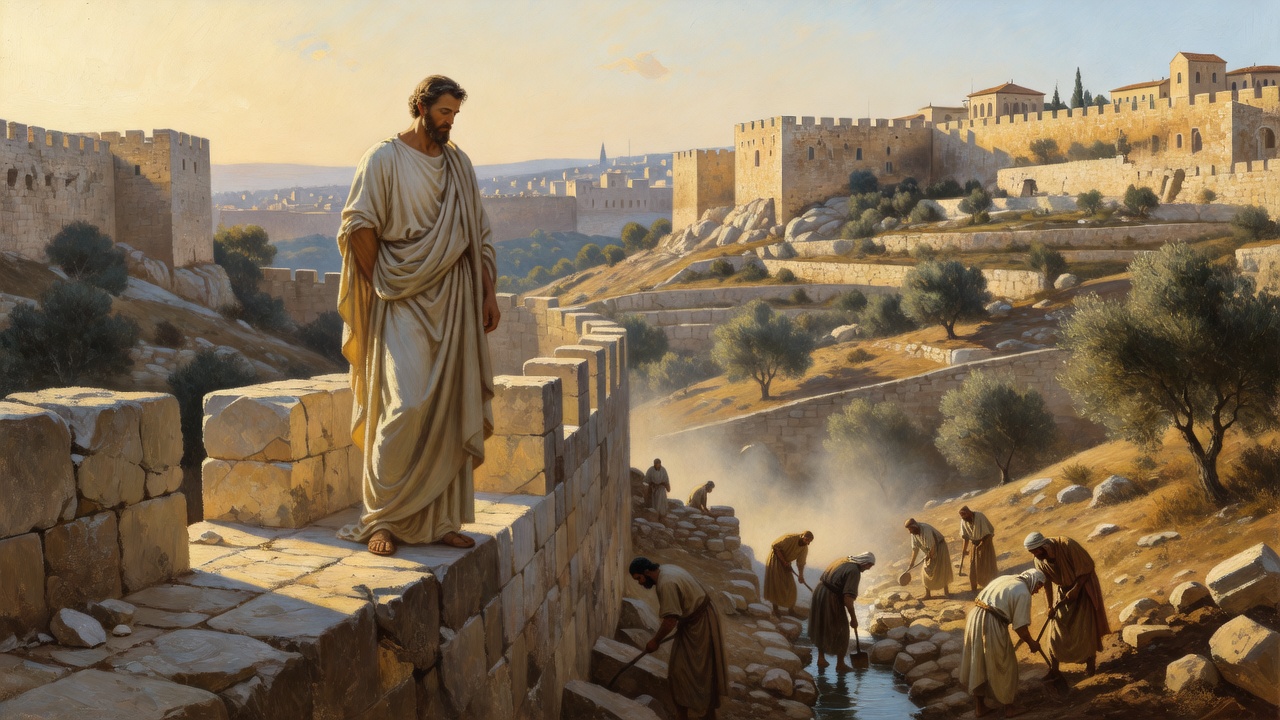
1After these faithful deeds were accomplished, King Sennacherib of Assyria invaded Judah. He besieged the fortified cities, intending to seize them. 2When Hezekiah saw that Sennacherib had invaded and intended to attack Jerusalem, 3he consulted with his advisers and military officers about stopping up the springs outside the city, and they supported him. 4A large number of people gathered together and stopped up all the springs and the stream that flowed through the district. They reasoned, “Why should the kings of Assyria come and find plenty of water?” 5Hezekiah energetically rebuilt every broken wall. He erected towers and an outer wall, and fortified the terrace of the City of David. He made many weapons and shields.
6He appointed military officers over the army and assembled them in the square at the city gate. He encouraged them, saying, 7“Be strong and brave! Don’t be afraid and don’t panic because of the king of Assyria and this huge army that is with him! We have with us one who is stronger than those who are with him. 8He has with him mere human strength, but the Lord our God is with us to help us and fight our battles!” The army was encouraged by the words of King Hezekiah of Judah.
9Afterward King Sennacherib of Assyria, while attacking Lachish with all his military might, sent his messengers to Jerusalem. The message was for King Hezekiah of Judah and all the people of Judah who were in Jerusalem. It read: 10“This is what King Sennacherib of Assyria says: ‘Why are you so confident that you remain in Jerusalem while it is under siege? 11Hezekiah says, “The Lord our God will rescue us from the power of the king of Assyria.” But he is misleading you and you will die of hunger and thirst! 12Hezekiah is the one who eliminated the Lord’s high places and altars and then told Judah and Jerusalem, “At one altar you must worship and offer sacrifices.” 13Are you not aware of what I and my predecessors have done to all the nations of the surrounding lands? Have the gods of the surrounding lands actually been able to rescue their lands from my power? 14Who among all the gods of these nations whom my predecessors annihilated was able to rescue his people from my power? 15Now don’t let Hezekiah deceive you or mislead you like this. Don’t believe him, for no god of any nation or kingdom has been able to rescue his people from my power or the power of my predecessors. So how can your gods rescue you from my power?’”
16Sennacherib’s servants further insulted the Lord God and his servant Hezekiah. 17He wrote letters mocking the Lord God of Israel and insulting him with these words: “The gods of the surrounding nations could not rescue their people from my power. Neither can Hezekiah’s god rescue his people from my power.” 18They called out loudly in the Judahite dialect to the people of Jerusalem who were on the wall, trying to scare and terrify them so they could seize the city. 19They talked about the God of Jerusalem as if he were one of the man-made gods of the nations of the earth.
20King Hezekiah and the prophet Isaiah son of Amoz prayed about this and cried out to heaven. 21The Lord sent a messenger and he wiped out all the soldiers, princes, and officers in the army of the king of Assyria. So Sennacherib returned home humiliated. When he entered the temple of his god, some of his own sons struck him down with the sword. 22The Lord delivered Hezekiah and the residents of Jerusalem from the power of King Sennacherib of Assyria and from all the other nations. He made them secure on every side. 23Many were bringing presents to the Lord in Jerusalem and precious gifts to King Hezekiah of Judah. From that time on he was respected by all the nations.
Hezekiah’s Shortcomings and Accomplishments
24In those days Hezekiah was stricken with a terminal illness. He prayed to the Lord, who answered him and gave him a sign confirming that he would be healed. 25But Hezekiah was ungrateful; he had a proud attitude, provoking God to be angry at him, as well as Judah and Jerusalem. 26But then Hezekiah and the residents of Jerusalem humbled themselves and abandoned their pride, and the Lord was not angry with them for the rest of Hezekiah’s reign.
27Hezekiah was very wealthy and greatly respected. He made storehouses for his silver, gold, precious stones, spices, and all his other valuable possessions. 28He made storerooms for the harvest of grain, wine, and olive oil, and stalls for all his various kinds of livestock and his flocks. 29He built royal cities and owned a large number of sheep and cattle, for God gave him a huge amount of possessions.
30Hezekiah dammed up the source of the waters of the Upper Gihon and directed them down to the west side of the City of David. Hezekiah succeeded in all that he did. 31So when the envoys arrived from the Babylonian officials to visit him and inquire about the sign that occurred in the land, God left him alone to test him, in order to know his true motives.
32The rest of the events of Hezekiah’s reign, including his faithful deeds, are recorded in the vision of the prophet Isaiah son of Amoz, included in the Scroll of the Kings of Judah and Israel. 33Hezekiah passed away and was buried on the ascent of the tombs of the descendants of David. All the people of Judah and the residents of Jerusalem buried him with great honor. His son Manasseh replaced him as king.
Did you know?
Sennacherib's Invasion and Deliverance
- Facing the threat of an Assyrian siege, Hezekiah and his leaders blocked all natural springs outside Jerusalem to deny water to the invaders. The king also redirected the upper waters of the Gihon spring straight down to the west side of the City of David, securing the city's internal water supply.Sources: the Bible text itself · Gihon
- While Sennacherib besieged the Judean fortress of Lachish, he sent emissaries to Jerusalem to demoralize the defenders. The Assyrian messengers called out loudly in Hebrew to the people watching from the city walls, attempting to terrify them into surrender.Sources: the Bible text itself · Lachish · Sennacherib
- In response to the Assyrian threats, King Hezekiah and the prophet Isaiah son of Amoz united in prayer to heaven for deliverance. The biblical record notes that additional details of Hezekiah's deeds and devotion were preserved in the vision of Isaiah within the royal annals.Sources: the Bible text itself · Isaiah · Amoz
Notes written with AI assistance from open sources (Theographic Bible Metadata, CC BY-SA 4.0; Easton’s Bible Dictionary, public domain) and reviewed before publishing.
Places in this chapter
- Assyria · 36.359, 43.153 · verses 1, 4, 7, 9, 10, 11, 13, 21, 22
- Jerusalem · 31.777, 35.234 · verses 2, 9, 10, 12, 18, 19, 22, 23, 25, 26, 33
- City of David · 31.774, 35.236 · verses 5, 30
- Lachish · Today: Tell ed Duweir · 31.565, 34.849 · verse 9
- Gihon · Today: Gihon Spring · 31.773, 35.236 · verse 30
- Babylon · 32.543, 44.422 · verse 31
Only places identified with high confidence are shown (90% or more according to the scholarly sources compiled by OpenBible). Period map: DARE (Digital Atlas of the Roman Empire), CC BY 4.0; modern map: © OpenStreetMap contributors; places: OpenBible.info (CC BY 4.0).
Credits and license for this translation
NET Bible
NET Bible®, New English Translation (NET)
copyright © 1996-2016 Biblical Studies Press, L. L. C.
Please see https://netbible.com/copyright/ for full NET Bible copyright and permissions information. You can also read the NET Bible at http://NETBible.org .
Language: English
Dialect (if applicable): American
Language in English: English
Translation by:
Please see https://netbible.com/copyright/ for full NET Bible copyright and permissions information. You can also read the NET Bible at http://NETBible.org .
The NET Bible (New English Translation) is a completely new translation of the Bible with 58,506 translators’ notes ! It was completed by more than 25 scholars – experts in the original biblical languages – who worked directly from the best currently available Hebrew, Aramaic, and Greek texts. Turn the pages and see the breadth of the translators’ notes, documenting their decisions and choices as they worked.
The translators’ notes make the original languages far more accessible, allowing you to look over the translator’s shoulder at the very process of translation. This level of documentation is a first for a Bible translation, making transparent the textual basis and the rationale for key renderings (including major interpretive options and alternative translations).
This unparalleled level of detail helps connect people to the Bible in the original languages in a way never before possible without years of study of Hebrew, Aramaic, and Greek. It unlocks the riches of the Bible’s truth from entirely new perspectives.
A donation is appreciated. Donate at Bible.org/donations_form so we can continue to provide our material for free for our 16,000+ articles on Bible.org and our world class Bible Study tool at lumina.bible.org .
2026-10-02
Source: http://ebible.org/engnet/ · eBible.org