1 Samuel 13
NET Bible · Tap a verse to see its cross-references.
1Saul was [thirty] years old when he began to reign; he ruled over Israel for [forty] years. 2Saul selected for himself three thousand men from Israel. Two thousand of these were with Saul at Micmash and in the hill country of Bethel; the remaining thousand were with Jonathan at Gibeah in the territory of Benjamin. He sent all the rest of the people back home.
3Jonathan attacked the Philistine outpost that was at Geba and the Philistines heard about it. Then Saul alerted all the land saying, “Let the Hebrews pay attention!” 4All Israel heard this message, “Saul has attacked the Philistine outpost, and now Israel is repulsive to the Philistines!” So the people were summoned to join Saul at Gilgal.
5For the battle with Israel the Philistines had amassed 3,000 chariots, 6,000 horsemen, and an army as numerous as the sand on the seashore. They went up and camped at Micmash, east of Beth Aven. 6The men of Israel realized they had a problem because their army was hard pressed. So the army hid in caves, thickets, cliffs, strongholds, and cisterns. 7Some of the Hebrews crossed over the Jordan River to the land of Gad and Gilead. But Saul stayed at Gilgal; the entire army that was with him was terrified. 8He waited for seven days, the time period indicated by Samuel. But Samuel did not come to Gilgal, and the army began to abandon Saul.
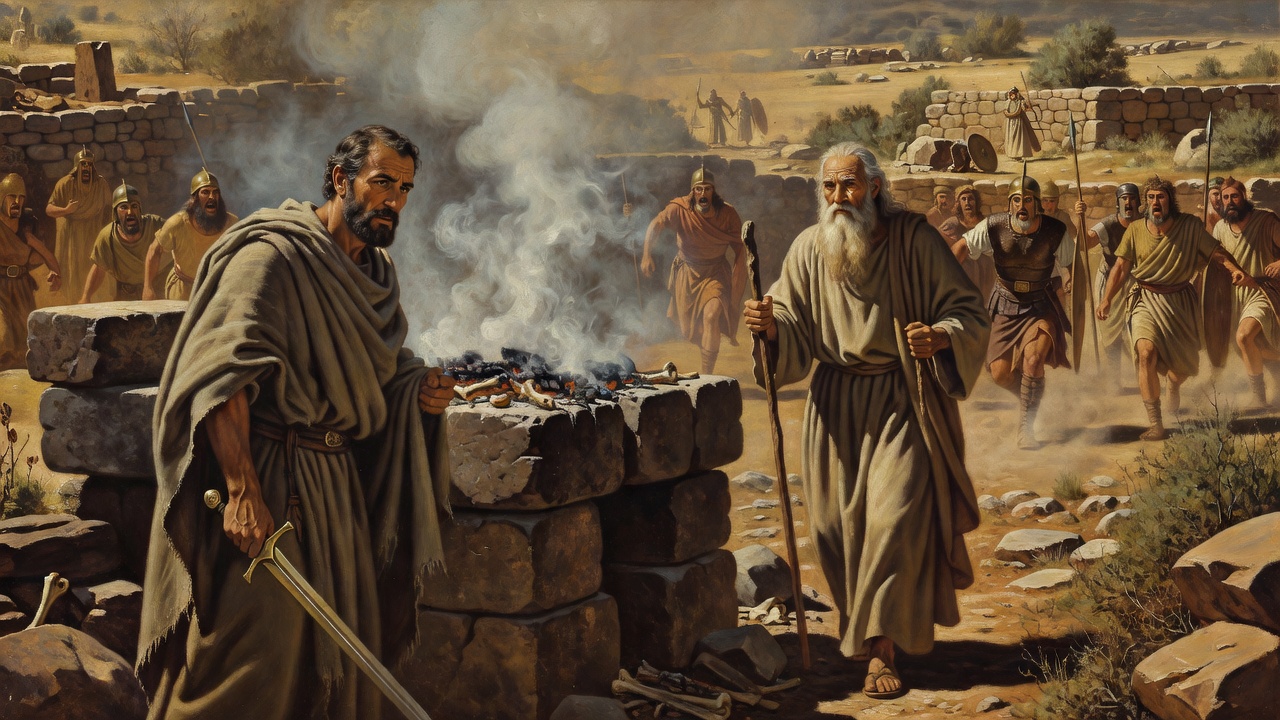
9So Saul said, “Bring me the burnt offering and the peace offerings.” Then he offered a burnt offering. 10Just when he had finished offering the burnt offering, Samuel appeared on the scene. Saul went out to meet him and to greet him.
11But Samuel said, “What have you done?” Saul replied, “When I saw that the army had started to abandon me and that you didn’t come at the appointed time and that the Philistines had assembled at Micmash, 12I thought, ‘Now the Philistines will come down on me at Gilgal and I have not sought the Lord’s favor.’ So I felt obligated to offer the burnt offering.”
13Then Samuel said to Saul, “You have made a foolish choice! You have not obeyed the commandment that the Lord your God gave you. Had you done that, the Lord would have established your kingdom over Israel forever! 14But now your kingdom will not continue! The Lord has sought out for himself a man who is loyal to him and the Lord has appointed him to be leader over his people, for you have not obeyed what the Lord commanded you.”
15Then Samuel set out and went up from Gilgal to Gibeah in the territory of Benjamin. Saul mustered the army that remained with him; there were about six hundred men. 16Saul, his son Jonathan, and the army that remained with them stayed in Gibeah in the territory of Benjamin, while the Philistines camped in Micmash. 17Raiding bands went out from the camp of the Philistines in three groups. One band turned toward the road leading to Ophrah by the land of Shual; 18another band turned toward the road leading to Beth Horon; and yet another band turned toward the road leading to the border that overlooks the valley of Zeboim in the direction of the desert.
19A blacksmith could not be found in all the land of Israel, for the Philistines had said, “This will prevent the Hebrews from making swords and spears.” 20So all Israel had to go down to the Philistines in order to get their plowshares, cutting instruments, axes, and sickles sharpened. 21They charged two-thirds of a shekel to sharpen plowshares and cutting instruments, and a third of a shekel to sharpen picks and axes, and to set ox goads. 22So on the day of the battle no sword or spear was to be found in the hand of anyone in the army that was with Saul and Jonathan. No one but Saul and his son Jonathan had them.
Jonathan Ignites a Battle
23A garrison of the Philistines had gone out to the pass at Micmash.
Did you know?
Saul's Impatience and the Philistine Threat
- The Philistines maintained a monopoly on metalworking to prevent the Israelites from forging weapons. As a result, the Israelites had to travel to Philistine territory and pay fees to sharpen their iron farming tools, leaving only Saul and his son Jonathan equipped with swords or spears.Sources: the Bible text itself
- When facing an overwhelming Philistine force, Saul waited seven days at Gilgal for Samuel to offer sacrifices. As his fearful soldiers began to scatter, Saul offered the burnt offering himself, prompting Samuel to declare that Saul's royal dynasty would not endure.Sources: the Bible text itself · Gilgal
- The military confrontation took place across the rugged hill country of Benjamin, with Philistine forces camped at Michmash and Saul's men stationed at Geba. A steep ravine known as the pass of Michmash separated the two opposing armies.Sources: the Bible text itself · Michmash · Geba
Notes written with AI assistance from open sources (Theographic Bible Metadata, CC BY-SA 4.0; Easton’s Bible Dictionary, public domain) and reviewed before publishing.
Places in this chapter
- Gilead · Today: Gilead 1 · 32.187, 35.692 · verse 7
- Jordan · Today: Jordan River · 31.761, 35.558 · verse 7
- Beth-horon · Today: Beit Ur al Tahta · 31.895, 35.084 · verse 18
Only places identified with high confidence are shown (90% or more according to the scholarly sources compiled by OpenBible). Period map: DARE (Digital Atlas of the Roman Empire), CC BY 4.0; modern map: © OpenStreetMap contributors; places: OpenBible.info (CC BY 4.0).
Credits and license for this translation
NET Bible
NET Bible®, New English Translation (NET)
copyright © 1996-2016 Biblical Studies Press, L. L. C.
Please see https://netbible.com/copyright/ for full NET Bible copyright and permissions information. You can also read the NET Bible at http://NETBible.org .
Language: English
Dialect (if applicable): American
Language in English: English
Translation by:
Please see https://netbible.com/copyright/ for full NET Bible copyright and permissions information. You can also read the NET Bible at http://NETBible.org .
The NET Bible (New English Translation) is a completely new translation of the Bible with 58,506 translators’ notes ! It was completed by more than 25 scholars – experts in the original biblical languages – who worked directly from the best currently available Hebrew, Aramaic, and Greek texts. Turn the pages and see the breadth of the translators’ notes, documenting their decisions and choices as they worked.
The translators’ notes make the original languages far more accessible, allowing you to look over the translator’s shoulder at the very process of translation. This level of documentation is a first for a Bible translation, making transparent the textual basis and the rationale for key renderings (including major interpretive options and alternative translations).
This unparalleled level of detail helps connect people to the Bible in the original languages in a way never before possible without years of study of Hebrew, Aramaic, and Greek. It unlocks the riches of the Bible’s truth from entirely new perspectives.
A donation is appreciated. Donate at Bible.org/donations_form so we can continue to provide our material for free for our 16,000+ articles on Bible.org and our world class Bible Study tool at lumina.bible.org .
2026-10-02
Source: http://ebible.org/engnet/ · eBible.org