1 Kings 7
NET Bible · Tap a verse to see its cross-references.
1Solomon took thirteen years to build his palace. 2He named it “The Palace of the Lebanon Forest”; it was 150 feet long, 75 feet wide, and 45 feet high. It had four rows of cedar pillars and cedar beams above the pillars. 3The roof above the beams supported by the pillars was also made of cedar; there were forty-five beams, fifteen per row. 4There were three rows of windows arranged in sets of three. 5All of the entrances were rectangular in shape and they were arranged in sets of three. 6He made a colonnade 75 feet long and 45 feet wide. There was a porch in front of this and pillars and a roof in front of the porch. 7He also made a throne room, called “The Hall of Judgment,” where he made judicial decisions. It was paneled with cedar from the floor to the rafters. 8The palace where he lived was constructed in a similar way. He also constructed a palace like this hall for Pharaoh’s daughter, whom he had married. 9All of these were built with the best stones, chiseled to the right size and cut with a saw on all sides, from the foundation to the edge of the roof and from the outside to the great courtyard. 10The foundation was made of large valuable stones, measuring either 15 feet or 12 feet. 11Above the foundation the best stones, chiseled to the right size, were used along with cedar. 12Around the great courtyard were three rows of chiseled stones and one row of cedar beams, like the inner courtyard of the Lord’s temple and the hall of the palace.
Solomon Commissions Hiram to Supply the Temple
13King Solomon sent for Hiram of Tyre. 14He was the son of a widow from the tribe of Naphtali, and his father was a craftsman in bronze from Tyre. He had the skill and knowledge to make all kinds of works of bronze. He reported to King Solomon and did all the work he was assigned.
15He fashioned two bronze pillars; each pillar was 27 feet high and 18 feet in circumference. 16He made two bronze tops for the pillars; each was seven-and-a-half feet high. 17The latticework on the tops of the pillars was adorned with ornamental wreaths and chains; the top of each pillar had seven groupings of ornaments. 18When he made the pillars, there were two rows of pomegranate-shaped ornaments around the latticework covering the top of each pillar. 19The tops of the two pillars in the porch were shaped like lilies and were six feet high. 20On the top of each pillar, right above the bulge beside the latticework, there were two hundred pomegranate-shaped ornaments arranged in rows all the way around. 21He set up the pillars on the porch in front of the main hall. He erected one pillar on the right side and called it Jakin; he erected the other pillar on the left side and called it Boaz. 22The tops of the pillars were shaped like lilies. So the construction of the pillars was completed.
23He also made the large bronze basin called “The Sea.” It measured 15 feet from rim to rim, was circular in shape, and stood seven-and-a-half feet high. Its circumference was 45 feet. 24Under the rim all the way around it were round ornaments arranged in settings 15 feet long. The ornaments were in two rows and had been cast with “The Sea.” 25“The Sea” stood on top of twelve bulls. Three faced northward, three westward, three southward, and three eastward. “The Sea” was placed on top of them, and they all faced outward. 26It was four fingers thick and its rim was like that of a cup shaped like a lily blossom. It could hold about 12,000 gallons.
27He also made ten bronze movable stands. Each stand was six feet long, six feet wide, and four-and-a-half feet high. 28The stands were constructed with frames between the joints. 29On these frames and joints were ornamental lions, bulls, and cherubs. Under the lions and bulls were decorative wreaths. 30Each stand had four bronze wheels with bronze axles and four supports. Under the basin the supports were fashioned on each side with wreaths. 31Inside the stand was a round opening that was a foot-and-a-half deep; it had a support that was two and one-quarter feet long. On the edge of the opening were carvings in square frames. 32The four wheels were under the frames and the crossbars of the axles were connected to the stand. Each wheel was two and one-quarter feet high. 33The wheels were constructed like chariot wheels; their crossbars, rims, spokes, and hubs were made of cast metal. 34Each stand had four supports, one per side projecting out from the stand. 35On top of each stand was a round opening three-quarters of a foot deep; there were also supports and frames on top of the stands. 36He engraved ornamental cherubs, lions, and palm trees on the plates of the supports and frames wherever there was room, with wreaths all around. 37He made the ten stands in this way. All of them were cast in one mold and were identical in measurements and shape.
38He also made ten bronze basins, each of which could hold about 240 gallons. Each basin was six feet in diameter; there was one basin for each stand. 39He put five basins on the south side of the temple and five on the north side. He put “The Sea” on the south side, in the southeast corner.
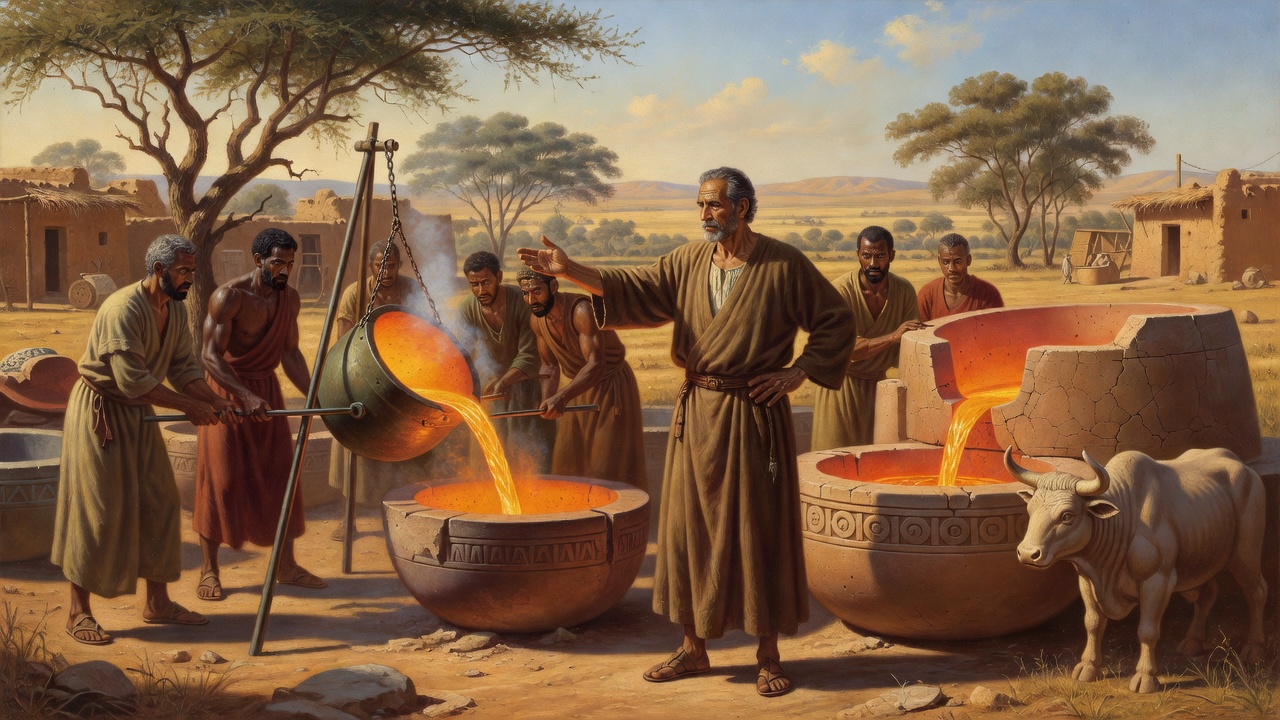
40Hiram also made basins, shovels, and bowls. He finished all the work on the Lord’s temple he had been assigned by King Solomon. 41He made the two pillars, the two bowl-shaped tops of the pillars, the latticework for the bowl-shaped tops of the two pillars, 42the four hundred pomegranate-shaped ornaments for the latticework of the two pillars (each latticework had two rows of these ornaments at the bowl-shaped top of the pillar), 43the ten movable stands with their ten basins, 44the big bronze basin called “The Sea” with its twelve bulls underneath, 45and the pots, shovels, and bowls. All these items King Solomon assigned Hiram to make for the Lord’s temple were made from polished bronze. 46The king had them cast in earth foundries in the region of the Jordan between Succoth and Zarethan. 47Solomon left all these items unweighed; there were so many of them they did not weigh the bronze.
48Solomon also made all these items for the Lord’s temple: the gold altar, the gold table on which was kept the Bread of the Presence, 49the pure gold lampstands at the entrance to the inner sanctuary (five on the right and five on the left), the gold flower-shaped ornaments, lamps, and tongs, 50the pure gold bowls, trimming shears, basins, pans, and censers, and the gold door sockets for the inner sanctuary (the most holy place) and for the doors of the main hall of the temple. 51When King Solomon finished constructing the Lord’s temple, he put the holy items that belonged to his father David (the silver, gold, and other articles) in the treasuries of the Lord’s temple.
Did you know?
Solomon's Palace and Temple Furnishings
- Solomon spent thirteen years completing his royal palace complex. Among its structures was the House of the Forest of Lebanon, named for its extensive rows of cedar pillars and beams, alongside a specialized hall for administering justice and a dedicated residence for Pharaoh's daughter.Sources: the Bible text itself · Daughter of Pharaoh · Lebanon
- To oversee the metalwork for the temple, Solomon employed a master craftsman named Huram from Tyre. Huram was the son of a Tyrian coppersmith and a widowed mother from the Israelite tribe of Naphtali, bringing Phoenician casting expertise to the project.Sources: the Bible text itself · Hiram · Tyre · Naphtali
- The massive bronze furnishings, including the two great pillars Jachin and Boaz and the great basin known as the Sea mounted upon twelve oxen, were cast using clay molds in the Jordan Valley between Succoth and Zarethan.Sources: the Bible text itself · Hiram · Jordan
Notes written with AI assistance from open sources (Theographic Bible Metadata, CC BY-SA 4.0; Easton’s Bible Dictionary, public domain) and reviewed before publishing.
Places in this chapter
- House of the Forest of Lebanon · Today: in Jerusalem · 31.777, 35.234 · verse 2
- Hall of Pillars · Today: in Jerusalem · 31.777, 35.234 · verse 6
- Hall of Judgment · Today: in Jerusalem · 31.777, 35.234 · verse 7
- Hall of the Throne · Today: in Jerusalem · 31.777, 35.234 · verse 7
- Tyre · 33.271, 35.196 · verses 13, 14
- Jordan · Today: Jordan River · 31.761, 35.558 · verse 46
- Most Holy Place · Today: on Mount Moriah · 31.778, 35.236 · verses 49, 50
Only places identified with high confidence are shown (90% or more according to the scholarly sources compiled by OpenBible). Period map: DARE (Digital Atlas of the Roman Empire), CC BY 4.0; modern map: © OpenStreetMap contributors; places: OpenBible.info (CC BY 4.0).
Credits and license for this translation
NET Bible
NET Bible®, New English Translation (NET)
copyright © 1996-2016 Biblical Studies Press, L. L. C.
Please see https://netbible.com/copyright/ for full NET Bible copyright and permissions information. You can also read the NET Bible at http://NETBible.org .
Language: English
Dialect (if applicable): American
Language in English: English
Translation by:
Please see https://netbible.com/copyright/ for full NET Bible copyright and permissions information. You can also read the NET Bible at http://NETBible.org .
The NET Bible (New English Translation) is a completely new translation of the Bible with 58,506 translators’ notes ! It was completed by more than 25 scholars – experts in the original biblical languages – who worked directly from the best currently available Hebrew, Aramaic, and Greek texts. Turn the pages and see the breadth of the translators’ notes, documenting their decisions and choices as they worked.
The translators’ notes make the original languages far more accessible, allowing you to look over the translator’s shoulder at the very process of translation. This level of documentation is a first for a Bible translation, making transparent the textual basis and the rationale for key renderings (including major interpretive options and alternative translations).
This unparalleled level of detail helps connect people to the Bible in the original languages in a way never before possible without years of study of Hebrew, Aramaic, and Greek. It unlocks the riches of the Bible’s truth from entirely new perspectives.
A donation is appreciated. Donate at Bible.org/donations_form so we can continue to provide our material for free for our 16,000+ articles on Bible.org and our world class Bible Study tool at lumina.bible.org .
2026-10-02
Source: http://ebible.org/engnet/ · eBible.org