Psalms 79
Updated Brenton English Septuagint · Tap a verse to see its cross-references.
A Prayer for Deliverance
1For the end, for alternate strains, a testimony for Asaph, a Psalm concerning the Assyrian.
2Attend, O Shepherd of Israel,
Who guidest Joseph like a flock;
Thou who sittest upon the cherubs, manifest thyself;
3Before Ephraim and Benjamin and Manasseh,
Stir up thy power,
And come to deliver us.
4Turn us, O God,
And cause thy face to shine; and we shall be delivered.
5O Lord God of hosts,
How long art thou angry with the prayer of thy servant?
6Thou wilt feed us with bread of tears;
And wilt cause us to drink tears by measure.
7Thou hast made us a strife to our neighbors;
And our enemies have mocked at us.
8Turn us, O Lord God of hosts,
And cause thy face to shine; and we shall be saved. Pause.
9Thou hast transplanted a vine out of Egypt:
Thou hast cast out the heathen, and planted it.
10Thou madest a way before it,
And didst cause its roots to strike, and the land was filled with it.
11Its shadow covered the mountains,
And its shoots equaled the goodly cedars.
12It sent forth its branches to the sea,
And its shoots to the river.
13Wherefore hast thou broken down its hedge,
While all that pass by the way pluck it?
14The boar out of the wood has laid it waste,
And the wild beast has devoured it.
15O God of hosts, turn, we pray thee:
Look on us from heaven,
And behold and visit this vine;
16And restore that which thy right hand has planted:
And look on the son of man whom thou didst strengthen for thyself.
17It is burned with fire and dug up:
They shall perish at the rebuke of thy presence.
18Let thy hand be upon the man of thy right hand,
And upon the son of man whom thou didst strengthen for thyself.
19So will we not depart from thee:
Thou shalt quicken us, and we will call upon thy name.
20Turn us, O Lord God of hosts,
And make thy face to shine; and we shall be saved.
Did you know?
A Lament over the Destruction of Jerusalem
- Psalm 79 is titled a psalm of Asaph, placing it among a collection of psalms (Psalms 50 and 73–83) associated with the Levite musician and seer Asaph. In the biblical record, the title may also refer to the sons of Asaph, a recognized guild of temple singers and poets.Sources: Asaph (Levite) · the Bible text itself
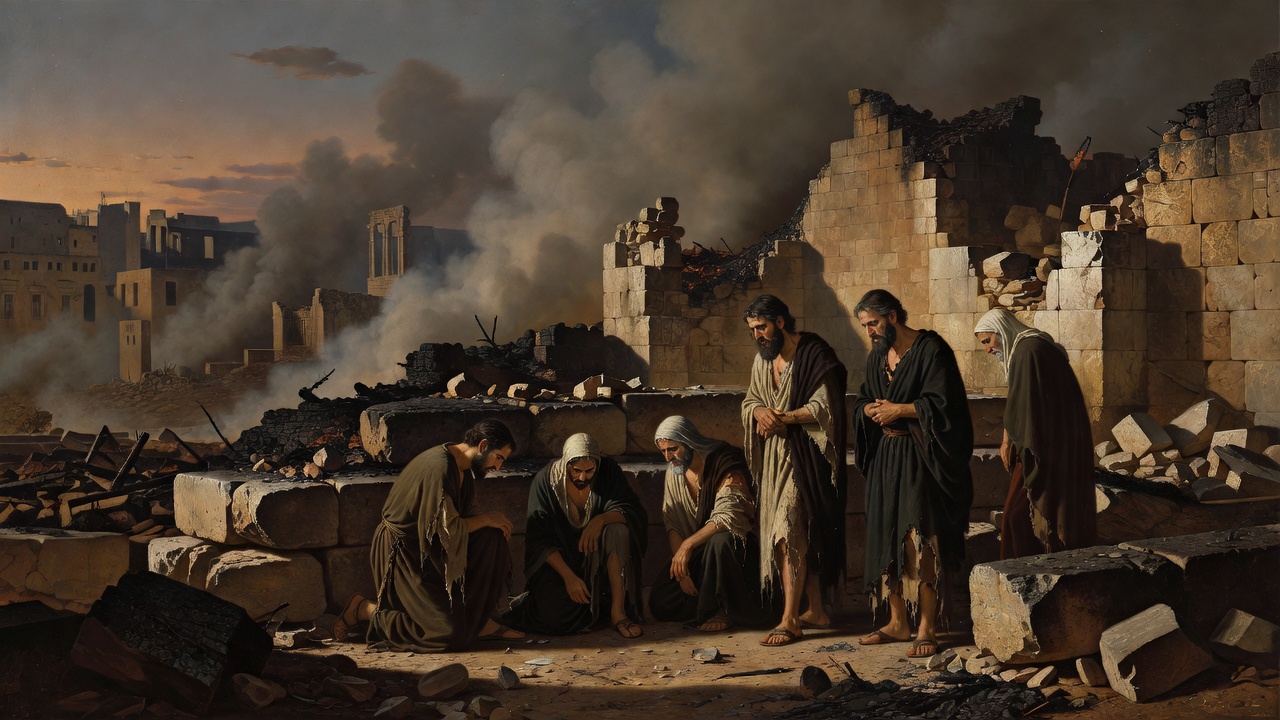
- The psalm laments the defilement of the holy temple, the destruction of Jerusalem into rubble, and the unburied bodies left throughout the city. Jerusalem, known as the holy city and a mountain fastness, is portrayed here as having suffered devastating invasion by surrounding nations.Sources: Jerusalem · the Bible text itself
- The poem calls upon God for help because foreign nations have devoured Jacob and devastated his homeland. In biblical tradition, the name of the patriarch Jacob is frequently used as a poetic collective term for his descendants and their shared homeland.Sources: Jacob (Israel) · the Bible text itself
Notes written with AI assistance from open sources (Theographic Bible Metadata, CC BY-SA 4.0; Easton’s Bible Dictionary, public domain) and reviewed before publishing.
Places in this chapter
Only places identified with high confidence are shown (90% or more according to the scholarly sources compiled by OpenBible). Period map: DARE (Digital Atlas of the Roman Empire), CC BY 4.0; modern map: © OpenStreetMap contributors; places: OpenBible.info (CC BY 4.0).
Credits and license for this translation
Updated Brenton English Septuagint
Spelling and formatting update of the Brenton English Septuagint with Apocrypha
Public Domain
Language: English
Dialect: Mixed
Translation by: Sir Lancelot C. L. Brenton
Contributor: Adam Boyd
Original work was by Sir Lancelot C. L. Brenton in 1851.
CC0 Public Domain dedication on language updates by Adam Boyd in 2020.
2026-02-18
Section headings adapted from the Berean Standard Bible (public domain); they are not part of this translation’s text.
Source: http://ebible.org/englxxup/ · eBible.org