Psalms 59
Updated Brenton English Septuagint · Tap a verse to see its cross-references.
Deliver Me from My Enemies
1For the end, for them that shall yet be changed; for an inscription by David for instruction, 2when he had burned Mesopotamia of Syria, and Syria Zobah, and Joab had returned and smitten in the Valley of Salt twelve thousand.
3O God, thou hast rejected and destroyed us;
Thou hast been angry, yet hast pitied us.
4Thou hast shaken the earth, and troubled it;
Heal its breaches, for it has been shaken.
5Thou hast shown thy people hard things:
Thou hast made us drink the wine of astonishment.
6Thou hast given a token to them that fear thee,
That they might flee from the bow. Pause.
7That thy beloved ones may be delivered;
Save with thy right hand, and hear me.
8God has spoken in his holiness;
I will rejoice, and divide Shechem,
And measure out the Valley of Tents.
9Gilead is mine, and Manasseh is mine;
And Ephraim is the strength of my head;
10Judah is my king;
Moab is the caldron of my hope;
Over Edom will I stretch out my shoe;
The Philistines have been subjected to me.
11Who will lead me into the fortified city?
Who will guide me as far as Edom?
12Wilt not thou, O God, who hast cast us off?
And wilt not thou, O God, go forth with our forces?
13Give us help from trouble:
For vain is the deliverance of man.
14In God will we do valiantly;
And he shall bring to nought them that harass us.
Did you know?
A Song of Deliverance from Ambush
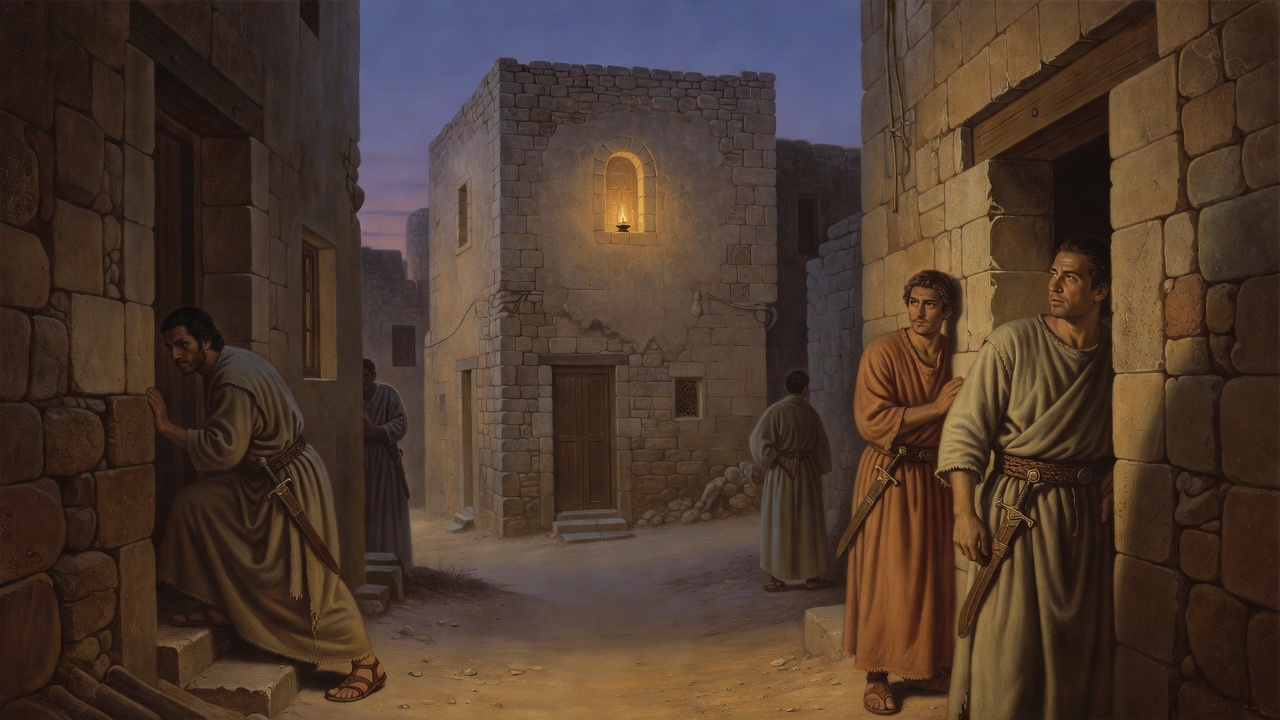
- The superscription links this psalm to the event when King Saul sent armed men to keep watch over David's house in order to kill him, a time when David maintained his innocence of any rebellion.Sources: the Bible text itself
- The psalm repeatedly compares the ambushers to packs of wild, snarling dogs that prowl through city streets at dusk scavenging for food, vividly illustrating the hostility and menace surrounding the author.Sources: the Bible text itself
- The psalm is designated as a Miktam and set to the musical tune 'Do Not Destroy,' directed to the choirmaster for liturgical use.Sources: the Bible text itself
Notes written with AI assistance from open sources (Theographic Bible Metadata, CC BY-SA 4.0; Easton’s Bible Dictionary, public domain) and reviewed before publishing.
Credits and license for this translation
Updated Brenton English Septuagint
Spelling and formatting update of the Brenton English Septuagint with Apocrypha
Public Domain
Language: English
Dialect: Mixed
Translation by: Sir Lancelot C. L. Brenton
Contributor: Adam Boyd
Original work was by Sir Lancelot C. L. Brenton in 1851.
CC0 Public Domain dedication on language updates by Adam Boyd in 2020.
2026-02-18
Section headings adapted from the Berean Standard Bible (public domain); they are not part of this translation’s text.
Source: http://ebible.org/englxxup/ · eBible.org