Psalms 48
Updated Brenton English Septuagint · Tap a verse to see its cross-references.
Broken Bondage
1For the end, a Psalm for the sons of Korah.
2Hear these words, all ye nations,
Hearken, all ye that dwell upon the earth:
3Both the sons of mean men, and sons of great men;
The rich and poor man together.
4My mouth shall speak of wisdom;
And the meditation of my heart shall bring forth understanding.
5I will incline mine ear to a parable:
I will open my riddle on the harp.
6Wherefore should I fear in the evil day?
The iniquity of my heel shall compass me.
7They that trust in their strength,
And boast themselves in the multitude of their wealth—
8A brother does not redeem, shall a man redeem?
He shall not give to God a ransom for himself,
9Or the price of the redemption of his soul,
Though he labor forever, 10and live to the end,
So that he should not see corruption.
11When he shall see wise men dying,
The fool and the senseless one shall perish together;
And they shall leave their wealth to strangers.
12And their sepulchers are their houses forever,
Even their tabernacles to all generations:
They have called their lands after their own names.
13And man being in honor, understands not:
He is compared to the senseless cattle, and is like to them.
14This their way is an offense to them:
Yet afterward men will commend their sayings. Pause.
15They have laid them as sheep in Hades; death shall feed on them;
And the upright shall have dominion over them in the morning,
And their help shall fail in Hades from their glory.
16But God shall deliver my soul
From the power of Hades, when he shall receive me. Pause.
17Fear not when a man is enriched,
And when the glory of his house is increased.
18For he shall take nothing when he dies;
Neither shall his glory descend with him.
19For his soul shall be blessed in his life:
He shall give thanks to thee when thou dost well to him.
20Yet he shall go in to the generation of his fathers;
He shall never see light.
21Man that is in honor, understands not:
He is compared to the senseless cattle, and is like them.
Did you know?
Zion, the City of the Great King
- Mount Zion, originally the fortified southeastern hill of Jerusalem captured by David from the Jebusites, became known as the City of David and the site of his citadel. In Psalm 48, it is celebrated as God's holy mountain, elevated and fortified against advancing enemy kings.Sources: the Bible text itself · Mount Zion · Zion
- The psalm depicts God's power shattering enemy forces like an east wind wrecking the ships of Tarshish. Many scholars identify Tarshish with a distant Phoenician trading port in southwestern Spain, while other ancient traditions proposed locations such as Carthage or ports in the east.Sources: the Bible text itself · Tarshish
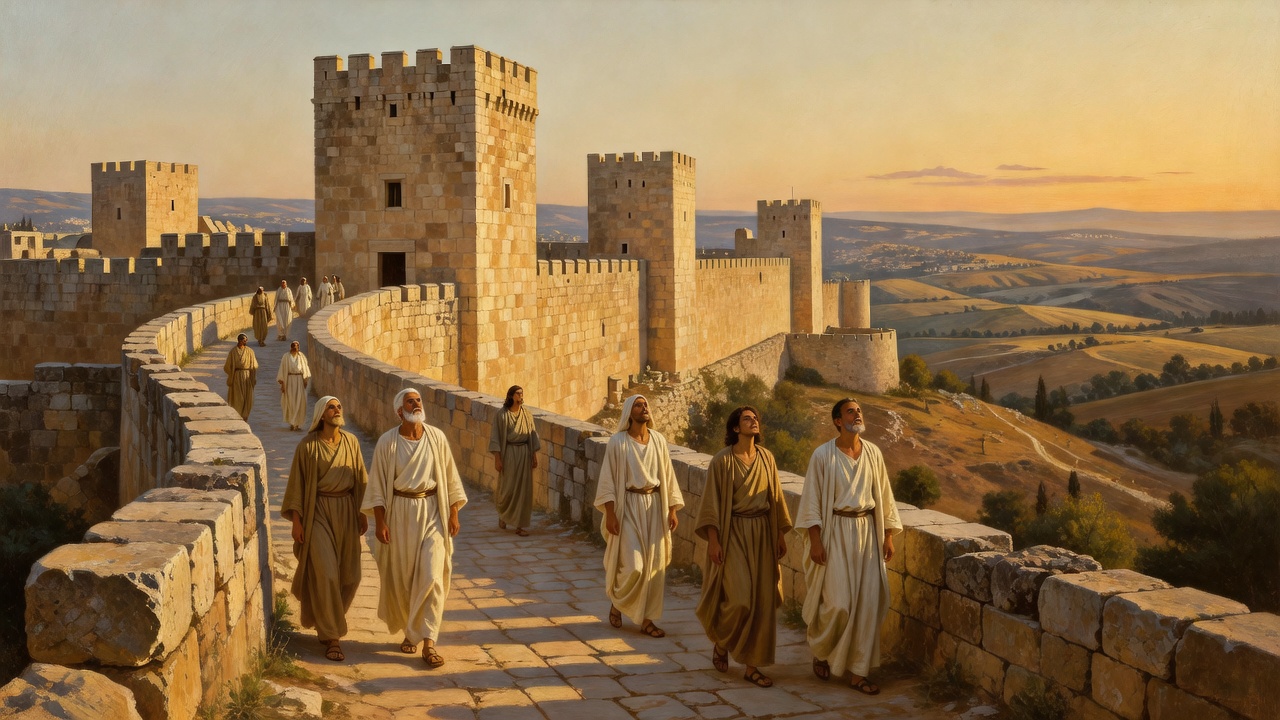
- Worshippers are invited to walk around the perimeter of Zion to inspect its ramparts, count its towers, and view its citadels. This survey of the city's defenses was meant to be recounted to future generations as a witness of God's steadfast protection.Sources: the Bible text itself
Notes written with AI assistance from open sources (Theographic Bible Metadata, CC BY-SA 4.0; Easton’s Bible Dictionary, public domain) and reviewed before publishing.
Places in this chapter
- Mount Zion · 31.772, 35.229 · verses 2, 11
- Zaphon · Today: Jebel Aqra · 35.953, 35.969 · verse 2
- Jerusalem · 31.777, 35.234 · verse 3
- Zion · Today: Jerusalem · 31.777, 35.234 · verse 12
Only places identified with high confidence are shown (90% or more according to the scholarly sources compiled by OpenBible). Period map: DARE (Digital Atlas of the Roman Empire), CC BY 4.0; modern map: © OpenStreetMap contributors; places: OpenBible.info (CC BY 4.0).
Credits and license for this translation
Updated Brenton English Septuagint
Spelling and formatting update of the Brenton English Septuagint with Apocrypha
Public Domain
Language: English
Dialect: Mixed
Translation by: Sir Lancelot C. L. Brenton
Contributor: Adam Boyd
Original work was by Sir Lancelot C. L. Brenton in 1851.
CC0 Public Domain dedication on language updates by Adam Boyd in 2020.
2026-02-18
Section headings adapted from the Berean Standard Bible (public domain); they are not part of this translation’s text.
Source: http://ebible.org/englxxup/ · eBible.org