Job 34
Updated Brenton English Septuagint · Tap a verse to see its cross-references.
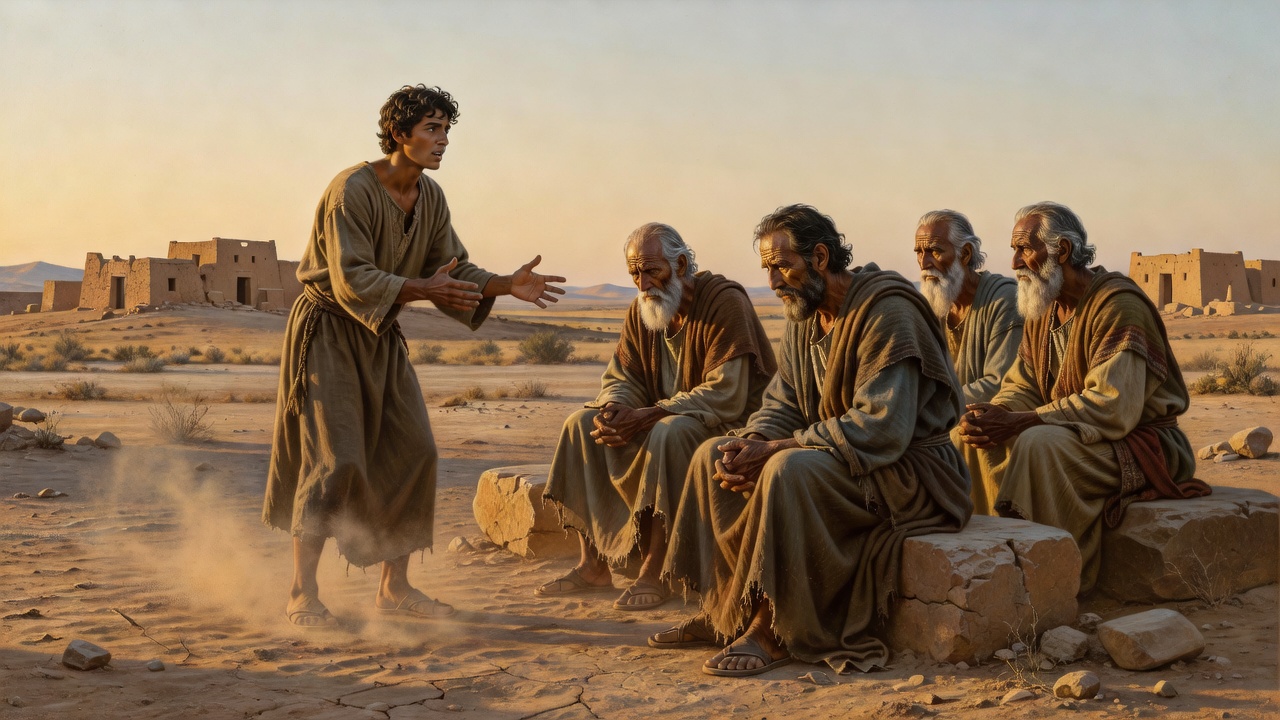
Elihu Confirms God’s Justice
1And Elihu continued, and said,
2Hear me, ye wise men;
Hearken, ye that have knowledge.
3For the ear tries words,
And the mouth tastes meat.
4Let us choose judgment to ourselves:
Let us know among ourselves what is right.
5For Job has said, I am righteous:
The Lord has removed my judgment.
6And he has erred in my judgment:
My wound is severe without unrighteousness of mine.
7What man is as Job,
Drinking scorning like water?
8Saying, I have not sinned, nor committed ungodliness,
Nor had fellowship with workers of iniquity,
To go with the ungodly.
9For thou shouldest not say, There shall be no visitation of a man,
Whereas there is a visitation on him from the Lord.
10Wherefore hear me, ye that are wise in heart:
Far be it from me to sin before the Lord,
And to pervert righteousness before the Almighty.
11Yea, he renders to a man accordingly as each of them does,
And in a man’s path he will find him.
12And thinkest thou that the Lord will do wrong,
Or will the Almighty who made the earth wrest judgment?
13And who is he that made the whole world under heaven,
And all things therein?
14For if he would confine,
And restrain his spirit with himself;
15All flesh would die together,
And every mortal would return to the earth, whence also he was formed.
16Take heed lest he rebuke thee:
Hear this, hearken to the voice of words.
17Behold then the one that hates iniquities,
And that destroys the wicked,
Who is forever just.
18He is ungodly that says to a king, Thou art a transgressor,
That says to princes, O most ungodly one.
19Such a one as would not reverence the face of an honorable man,
Neither knows how to give honor to the great,
So that their persons should be respected.
20But it shall turn out vanity to them, to cry and beseech a man;
For they dealt unlawfully, the poor being turned aside from their right.
21For he surveys the works of men,
And nothing of what they do has escaped him.
22Neither shall there be a place for the workers of iniquity to hide themselves.
23For he will not lay upon a man more than right.
24For the Lord looks down upon all men,
Who comprehends unsearchable things,
Glorious also and excellent things without number.
25Who discovers their works,
And will bring night about upon them, and they shall be brought low.
26And he quite destroys the ungodly,
For they are seen before him.
27Because they turned aside from the law of God,
And did not regard his ordinances,
28So as to bring before him the cry of the needy;
For he will hear the cry of the poor.
29And he will give quiet, and who will condemn?
And he will hide his face, and who shall see him?
Whether it be done against a nation, or against a man also:
30Causing a hypocrite to be king, because of the waywardness of the people.
31For there is one that says to the Mighty One, I have received blessings; I will not take a pledge:
32I will see apart from myself:
Do thou show me if I have done unrighteousness;
I will not do so anymore.
33Will he take vengeance for it on thee,
Whereas thou wilt put it far from thee?
For thou shalt choose, and not I;
And what thou knowest, speak thou.
34Because the wise in heart shall say this,
And a wise man listens to my word.
35But Job has not spoken with understanding,
His words are not uttered with knowledge.
36Howbeit do thou learn, Job:
No longer make answer as the foolish:
37That we add not to our sins:
For iniquity will be reckoned against us,
If we speak many words before the Lord.
Did you know?
Elihu Defends God's Justice
- Elihu, the son of Barachel the Buzite, entered the dialogue after the debate between Job and his three friends had concluded, presenting his own evaluation of the crisis across chapters 32 to 37.Sources: Elihu · the Bible text itself
- In chapter 34, Elihu appeals directly to surrounding listeners and wise men, inviting them to evaluate his reasoning just as the palate tastes food, while he defends God's absolute impartiality toward kings, nobles, and the poor alike.Sources: the Bible text itself
Notes written with AI assistance from open sources (Theographic Bible Metadata, CC BY-SA 4.0; Easton’s Bible Dictionary, public domain) and reviewed before publishing.
Credits and license for this translation
Updated Brenton English Septuagint
Spelling and formatting update of the Brenton English Septuagint with Apocrypha
Public Domain
Language: English
Dialect: Mixed
Translation by: Sir Lancelot C. L. Brenton
Contributor: Adam Boyd
Original work was by Sir Lancelot C. L. Brenton in 1851.
CC0 Public Domain dedication on language updates by Adam Boyd in 2020.
2026-02-18
Section headings adapted from the Berean Standard Bible (public domain); they are not part of this translation’s text.
Source: http://ebible.org/englxxup/ · eBible.org