Genesis 48
Updated Brenton English Septuagint · Tap a verse to see its cross-references.
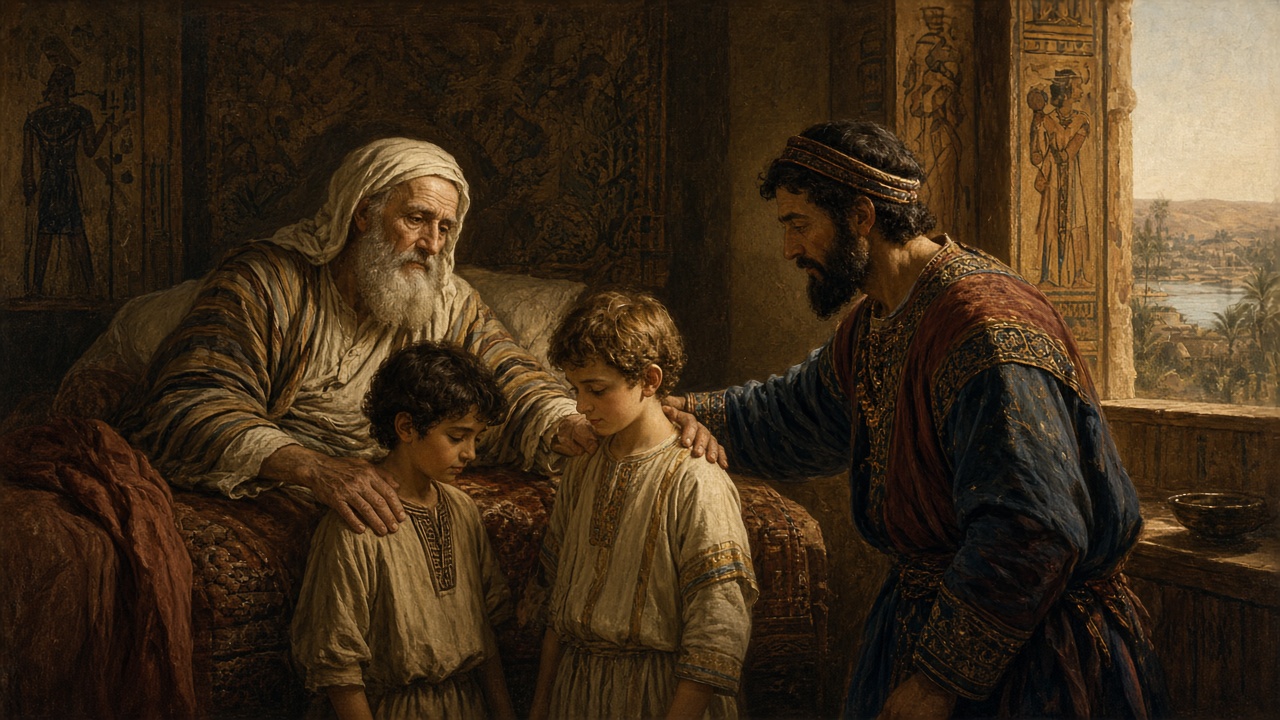
Jacob Blesses Ephraim and Manasseh
1And it came to pass after these things, that it was reported to Joseph, Behold, thy father is ill; and, having taken his two sons, Manasseh and Ephraim, he came to Jacob. 2And it was reported to Jacob, saying, Behold, thy son Joseph cometh to thee; and Israel having strengthened himself, sat upon the bed. 3And Jacob said to Joseph, My God appeared to me in Luz, in the land of Canaan, and blessed me, 4and said to me, Behold, I will increase thee, and multiply thee, and will make of thee multitudes of nations; and I will give this land to thee, and to thy seed after thee, for an everlasting possession. 5Now then thy two sons, who were born to thee in the land of Egypt, before I came to thee into Egypt, are mine; Ephraim and Manasseh, as Reuben and Simeon they shall be mine. 6And the children which thou shalt beget hereafter, shall be in the name of their brethren; they shall be named after their inheritances. 7And as for me, when I came out of Mesopotamia of Syria, Rachel, thy mother, died in the land of Canaan, as I drew nigh to the horse course of Chabratha of the land of Canaan, so as to come to Ephrath; and I buried her in the road of the course; this is Bethlehem.
8And when Israel saw the sons of Joseph, he said, Who are these to thee? 9And Joseph said to his father, They are my sons, whom God gave me here; and Jacob said, Bring me them, that I may bless them. 10Now the eyes of Israel were dim through age, and he could not see; and he brought them near to him, and he kissed them, and embraced them. 11And Israel said to Joseph, Behold, I have not been deprived of seeing thy face, and lo! God has showed me thy seed also. 12And Joseph brought them out from between his knees, and they did reverence to him, with their face to the ground. 13And Joseph took his two sons, both Ephraim in his right hand, but on the left of Israel, and Manasseh on his left hand, but on the right of Israel, and brought them near to him. 14But Israel having stretched out his right hand, laid it on the head of Ephraim, and he was the younger; and his left hand on the head of Manasseh, guiding his hands crosswise.
15And he blessed them and said, The God in whose sight my fathers were well pleasing, even Abraham and Isaac, the God who continues to feed me from my youth until this day; 16the angel who delivers me from all evils, bless these boys, and my name shall be called upon them, and the name of my fathers, Abraham and Isaac; and let them be increased to a great multitude on the earth. 17And Joseph having seen that his father put his right hand on the head of Ephraim—it seemed grievous to him; and Joseph took hold of the hand of his father, to remove it from the head of Ephraim to the head of Manasseh. 18And Joseph said to his father, Not so, father; for this is the firstborn; lay thy right hand upon his head. 19And he would not, but said, I know it, son, I know it; he also shall be a people, and he shall be exalted, but his younger brother shall be greater than he, and his seed shall become a multitude of nations. 20And he blessed them in that day, saying, In you shall Israel be blessed, saying, God make thee as Ephraim and Manasseh; and he set Ephraim before Manasseh. 21And Israel said to Joseph, Behold, I die; and God shall be with you, and restore you to the land of your fathers. 22And I give to thee Shechem, a select portion above thy brethren, which I took out of the hand of the Amorites with my sword and bow.
Did you know?
Adoption and Blessing of Ephraim and Manasseh
- Jacob reckons Joseph’s two sons, born to him in Egypt, as his own, on a level with Reuben and Simeon, Leah’s sons. Children born to Joseph after them were to remain Joseph’s, and were to be called by their brothers’ names in the territory they inherited.Sources: the Bible text itself · Manasseh (son of Joseph) · Reuben · Simeon
- Manasseh was the elder son and Ephraim the younger, born in Egypt. The name Ephraim means double fruitfulness, because God had made him fruitful in the land of his affliction. Though Israel could hardly see for age, he crossed his hands, laid his right hand on Ephraim, and insisted that the younger brother would be greater.Sources: the Bible text itself · Ephraim · Manasseh (son of Joseph)
- Jacob recalls that God Almighty appeared to him at Luz in the land of Canaan and blessed him there. Luz was the ancient name of a royal Canaanite city near Bethel, where Jacob halted and received a prophetic vision. He also remembers Rachel, Joseph’s mother, who died to his sorrow on the way back from Paddan—a name found only in this verse, for Padan-aram—and whom he buried beside the road to Ephrath, that is, Bethlehem.Sources: the Bible text itself · Luz · Paddan · Rachel
Notes written with AI assistance from open sources (Theographic Bible Metadata, CC BY-SA 4.0; Easton’s Bible Dictionary, public domain) and reviewed before publishing.
Places in this chapter
- Canaan · 32.767, 35.333 · verses 3, 4, 7, 21
- Luz · Today: Beitin · 31.923, 35.241 · verse 3
- Egypt · 30.129, 31.308 · verses 5, 9
- Bethlehem · 31.704, 35.208 · verse 7
- Ephrath · Today: Bethlehem · 31.704, 35.208 · verse 7
Only places identified with high confidence are shown (90% or more according to the scholarly sources compiled by OpenBible). Period map: DARE (Digital Atlas of the Roman Empire), CC BY 4.0; modern map: © OpenStreetMap contributors; places: OpenBible.info (CC BY 4.0).
Credits and license for this translation
Updated Brenton English Septuagint
Spelling and formatting update of the Brenton English Septuagint with Apocrypha
Public Domain
Language: English
Dialect: Mixed
Translation by: Sir Lancelot C. L. Brenton
Contributor: Adam Boyd
Original work was by Sir Lancelot C. L. Brenton in 1851.
CC0 Public Domain dedication on language updates by Adam Boyd in 2020.
2026-02-18
Section headings adapted from the Berean Standard Bible (public domain); they are not part of this translation’s text.
Source: http://ebible.org/englxxup/ · eBible.org