Genesis 21
Updated Brenton English Septuagint · Tap a verse to see its cross-references.
The Birth of Isaac
1And the Lord visited Sarah, as he said, and the Lord did to Sarah, as he spoke. 2And she conceived and bore to Abraham a son in old age, at the set time according as the Lord spoke to him. 3And Abraham called the name of his son that was born to him, whom Sarah bore to him, Isaac. 4And Abraham circumcised Isaac on the eighth day, as God commanded him. 5And Abraham was a hundred years old when Isaac his son was born to him. 6And Sarah said, The Lord has made laughter for me, for whoever shall hear shall rejoice with me. 7And she said, Who shall say to Abraham that Sarah suckles a child? for I have born a child in my old age. 8And the child grew and was weaned, and Abraham made a great feast the day that his son Isaac was weaned.
Sarah Turns against Hagar
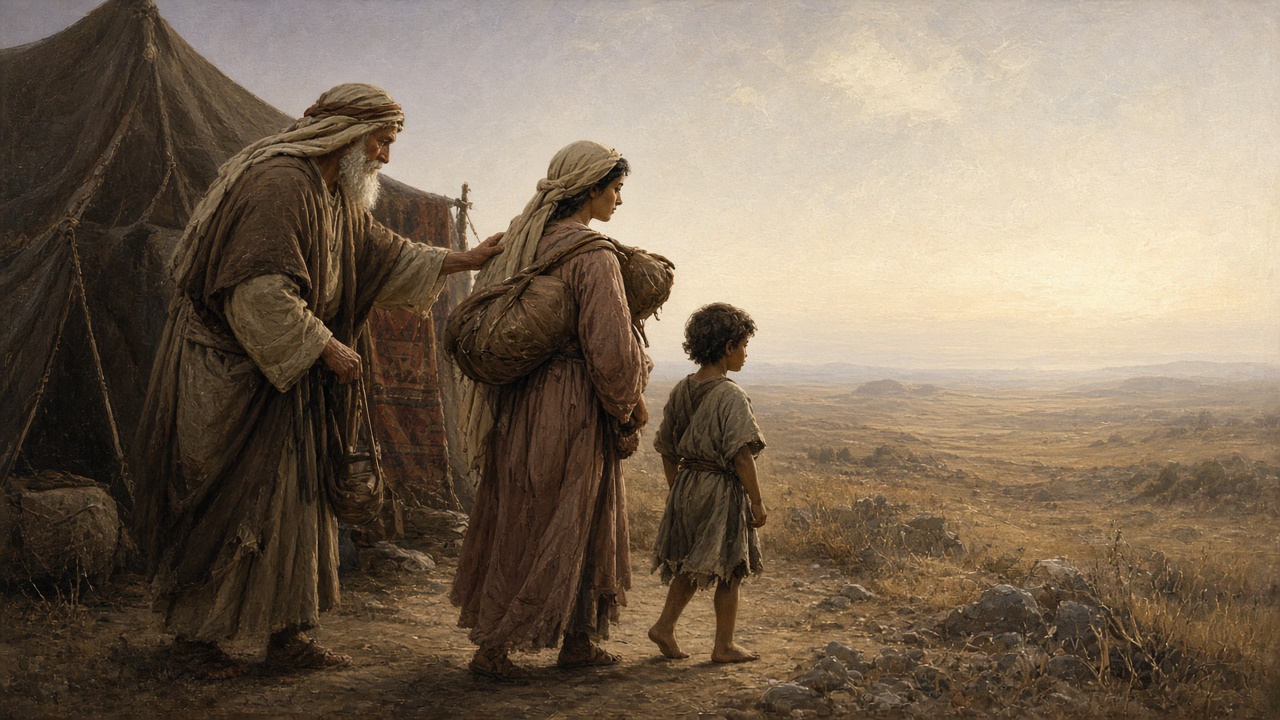
9And Sarah having seen the son of Hagar the Egyptian who was born to Abraham, sporting with Isaac her son, 10then she said to Abraham, Cast out this bondwoman and her son, for the son of this bondwoman shall not inherit with my son Isaac. 11But the word appeared very hard before Abraham concerning his son. 12But God said to Abraham, Let it not be hard before thee concerning the child, and concerning the bondwoman; in all things whatsoever Sarah shall say to thee, hear her voice, for in Isaac shall thy seed be called. 13And moreover I will make the son of this bondwoman a great nation, because he is thy seed. 14And Abraham rose up in the morning and took loaves and a skin of water, and gave them to Hagar, and he put the child on her shoulder, and sent her away, and she having departed wandered in the wilderness near the well of the oath. 15And the water failed out of the skin, and she cast the child under a fir tree. 16And she departed and sat down opposite him at a distance, as it were a bowshot, for she said, Surely I cannot see the death of my child: and she sat opposite him, and the child cried aloud and wept. 17And God heard the voice of the child from the place where he was, and an angel of God called Hagar out of heaven, and said to her, What is it, Hagar? fear not, for God has heard the voice of the child from the place where he is. 18Rise up, and take the child, and hold him in thy hand, for I will make him a great nation. 19And God opened her eyes, and she saw a well of springing water; and she went and filled the skin with water, and gave the child drink. 20And God was with the child, and he grew and dwelt in the wilderness, and became an archer. 21And he dwelt in the wilderness, and his mother took him a wife out of Paran of Egypt.
The Covenant at Beersheba
22And it came to pass at that time that Abimelech spoke, and Ahuzzath his friend, and Phicol the chief captain of his host, to Abraham, saying, God is with thee in all things, whatsoever thou mayest do. 23Now therefore swear to me by God that thou wilt not injure me, nor my seed, nor my name, but according to the righteousness which I have performed with thee thou shalt deal with me, and with the land in which thou hast sojourned. 24And Abraham said, I will swear. 25And Abraham reproved Abimelech because of the wells of water, which the servants of Abimelech took away. 26And Abimelech said to him, I know not who has done this thing to thee, neither didst thou tell it me, neither heard I it but only today. 27And Abraham took sheep and calves, and gave them to Abimelech, and both made a covenant. 28And Abraham set seven ewe lambs by themselves. 29And Abimelech said to Abraham, What are these seven ewe lambs which thou hast set alone? 30And Abraham said, Thou shalt receive the seven ewe lambs of me, that they may be for me as a witness, that I dug this well. 31Therefore he named the name of that place, The Well of the Oath, for there they both swore. 32And they made a covenant at the well of the oath. And there rose up Abimelech, Ahuzzath his friend, and Phicol the commander-in-chief of his army, and they returned to the land of the Philistines. 33And Abraham planted a field at the well of the oath, and called there on the name of the Lord, the everlasting God. 34And Abraham sojourned in the land of the Philistines many days.
Did you know?
Isaac’s birth, Hagar’s departure, and Beersheba
- Abraham was a hundred years old when Sarah bore him Isaac, their only son together, and he circumcised the child at eight days old, as God had commanded. Sarah said that God had made her laugh, and that everyone who heard of this would laugh with her. Easton's Bible Dictionary (1897) notes that a great feast was held when Isaac was weaned, probably when he was about two years old.Sources: the Bible text itself · Isaac
- Hagar, whose name is explained as “flight” or, according to others, “stranger,” was an Egyptian and Sarah’s handmaid, whom Sarah gave to Abraham as a secondary wife. After Isaac’s birth, Abraham sent Hagar and their son Ishmael into the Wilderness of Beersheba with bread and a skin of water. Ishmael later settled in the Wilderness of Paran, a desert tract in the northeastern Sinai Peninsula between the Arabah on the east and the wilderness of Shur on the west, became a great archer, and his mother got him a wife from Egypt.Sources: the Bible text itself · Hagar · Paran
- Beersheba, “well of the oath” or “well of seven,” was named when Abraham and Abimelech swore an oath there over a well that Abraham said he had dug; he set apart seven ewe lambs as a witness, and the two made a covenant. Phicol, chief captain of the army of Abimelech, the Philistine king of Gerar, entered that alliance with Abraham. Abraham then planted a tamarisk at Beersheba and lived for a long time in the land of the Philistines.Sources: the Bible text itself · Beersheba · Phichol
Notes written with AI assistance from open sources (Theographic Bible Metadata, CC BY-SA 4.0; Easton’s Bible Dictionary, public domain) and reviewed before publishing.
Places in this chapter
Only places identified with high confidence are shown (90% or more according to the scholarly sources compiled by OpenBible). Period map: DARE (Digital Atlas of the Roman Empire), CC BY 4.0; modern map: © OpenStreetMap contributors; places: OpenBible.info (CC BY 4.0).
Credits and license for this translation
Updated Brenton English Septuagint
Spelling and formatting update of the Brenton English Septuagint with Apocrypha
Public Domain
Language: English
Dialect: Mixed
Translation by: Sir Lancelot C. L. Brenton
Contributor: Adam Boyd
Original work was by Sir Lancelot C. L. Brenton in 1851.
CC0 Public Domain dedication on language updates by Adam Boyd in 2020.
2026-02-18
Section headings adapted from the Berean Standard Bible (public domain); they are not part of this translation’s text.
Source: http://ebible.org/englxxup/ · eBible.org