Genesis 16
Updated Brenton English Septuagint · Tap a verse to see its cross-references.
Hagar and Ishmael
1And Sarai the wife of Abram bore him no children; and she had an Egyptian maid, whose name was Hagar. 2And Sarai said to Abram, Behold, the Lord has restrained me from bearing, go therefore in to my maid, that I may get children for myself through her. And Abram hearkened to the voice of Sarai. 3So Sarai the wife of Abram having taken Hagar the Egyptian her handmaid, after Abram had dwelt ten years in the land of Canaan, gave her to Abram her husband as a wife to him. 4And he went in to Hagar, and she conceived, and saw that she was with child, and her mistress was dishonored before her. 5And Sarai said to Abram, I am injured by thee; I gave my handmaid into thy bosom, and when I saw that she was with child, I was dishonored before her. The Lord judge between me and thee. 6And Abram said to Sarai, Behold thy handmaid is in thy hands, use her as it may seem good to thee. And Sarai afflicted her, and she fled from her face.
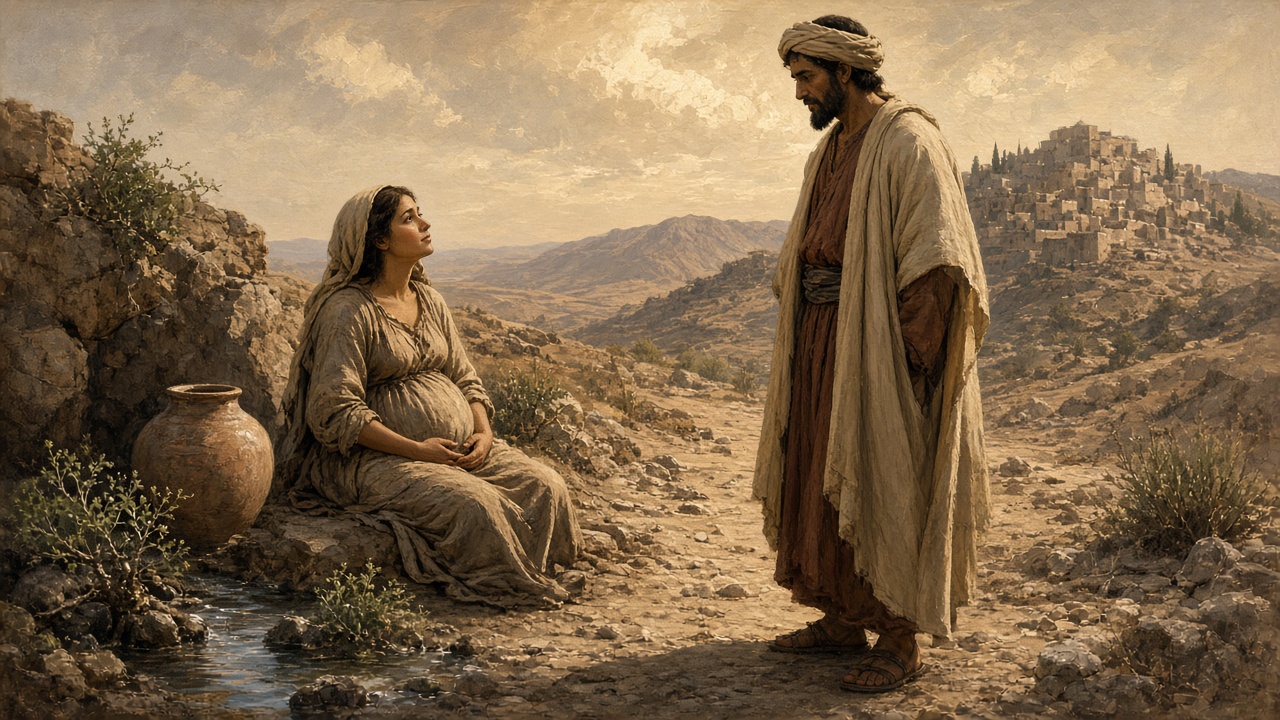
7And an angel of the Lord found her by the fountain of water in the wilderness, by the fountain in the way to Shur. 8And the angel of the Lord said to her, Hagar, Sarai’s maid, whence comest thou, and whither goest thou? and she said, I am fleeing from the face of my mistress Sarai. 9And the angel of the Lord said to her, Return to thy mistress, and submit thyself under her hands. 10And the angel of the Lord said to her, I will surely multiply thy seed, and it shall not be numbered for multitude. 11And the angel of the Lord said to her, Behold, thou art with child, and shalt bear a son, and shalt call his name Ishmael, for the Lord hath hearkened to thy humiliation. 12He shall be a wild man, his hands against all, and the hands of all against him, and he shall dwell in the presence of all his brethren. 13And she called the name of the Lord God who spoke to her, Thou art God who seest me; for she said, For I have openly seen him that appeared to me. 14Therefore she called the well, The well of him whom I have openly seen; behold it is between Kadesh and Bered. 15And Hagar bore a son to Abram; and Abram called the name of his son which Hagar bore to him, Ishmael. 16And Abram was eighty-six years old, when Hagar bore Ishmael to Abram.
Did you know?
Hagar’s Flight and the Birth of Ishmael
- Hagar, an Egyptian maidservant of Sarai, bears a name understood to mean “flight,” or, according to others, “stranger.” After Abram had lived in Canaan for ten years, Sarai gave her to him as a secondary wife, hoping to build a family through her.Sources: Hagar · the Bible text itself
- When Sarai treated her harshly, Hagar fled along the road to Shur, through the desert that lay between her and Egypt, apparently intending to return to her relatives. The angel of the LORD found her by a spring of water there. Shur, meaning “wall,” was a wilderness on Egypt’s north-eastern border, probably named for frontier fortifications running from Pelusium to Heliopolis.Sources: the Bible text itself · Hagar · Shur
- Hagar called the LORD who spoke to her “the God who sees me,” and the well was named Beer-lahai-roi, “the well of the visible God,” between Kadesh and Bered, a town in the south of Palestine in the desert of Shur. She returned to Abram’s tent, and his eldest son, Ishmael, was born at Mamre when Abram was eighty-six; Abram gave him the name the angel had announced, because the LORD had heard her affliction.Sources: the Bible text itself · Hagar · Bered · Ishmael (Son of Hagar)
Notes written with AI assistance from open sources (Theographic Bible Metadata, CC BY-SA 4.0; Easton’s Bible Dictionary, public domain) and reviewed before publishing.
Places in this chapter
- Canaan · 32.767, 35.333 · verse 3
Only places identified with high confidence are shown (90% or more according to the scholarly sources compiled by OpenBible). Period map: DARE (Digital Atlas of the Roman Empire), CC BY 4.0; modern map: © OpenStreetMap contributors; places: OpenBible.info (CC BY 4.0).
Credits and license for this translation
Updated Brenton English Septuagint
Spelling and formatting update of the Brenton English Septuagint with Apocrypha
Public Domain
Language: English
Dialect: Mixed
Translation by: Sir Lancelot C. L. Brenton
Contributor: Adam Boyd
Original work was by Sir Lancelot C. L. Brenton in 1851.
CC0 Public Domain dedication on language updates by Adam Boyd in 2020.
2026-02-18
Section headings adapted from the Berean Standard Bible (public domain); they are not part of this translation’s text.
Source: http://ebible.org/englxxup/ · eBible.org