Ezra 9
Updated Brenton English Septuagint · Tap a verse to see its cross-references.
Intermarriage with Neighboring Peoples
1And when these things were finished, the princes drew near to me, saying, The people of Israel, and the priests, and the Levites, have not separated themselves from the people of the lands in their abominations, even the Canaanite, the Hittite, the Perizzite, the Jebusite, the Ammonite, the Moabite, and the Mizraimite and the Amorite. 2For they have taken of their daughters for themselves and their sons; and the holy seed has passed among the nations of the lands, and the hand of the rulers has been first in this transgression. 3And when I heard this thing, I rent my garments, and trembled, and plucked some of the hairs of my head and of my beard, and sat down mourning. 4Then there assembled to me all that followed the word of the God of Israel, on account of the transgression of the captivity; and I remained mourning until the evening sacrifice.
Ezra’s Prayer of Confession
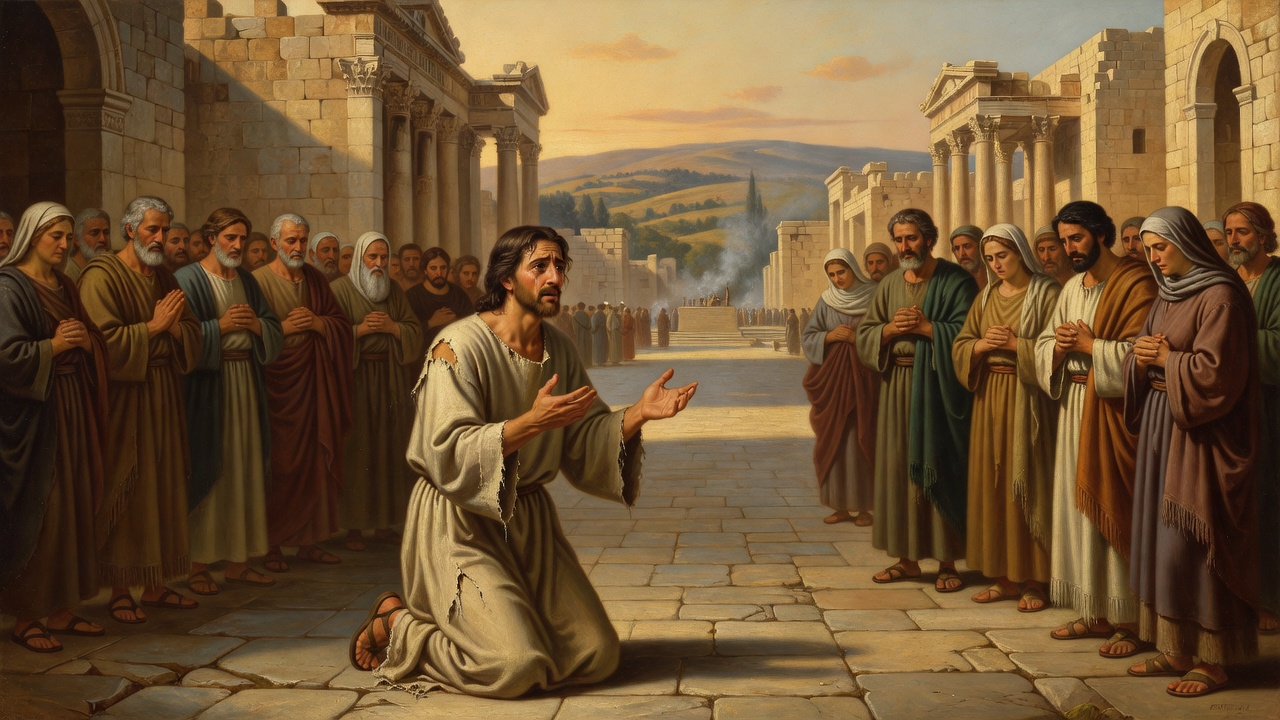
5And at the evening sacrifice I rose up from my humiliation; and when I had rent my garments, then I trembled, and I bow myself on my knees, and spread out my hands to the Lord God, 6and I said, O Lord, I am ashamed and confounded, O my God, to lift up my face to thee: for our transgressions have abounded over our head, and our trespasses have increased even to heaven. 7From the days of our fathers we have been in a great trespass until this day: and because of our iniquities we, and our kings, and our children, have been delivered into the hand of the kings of the Gentiles by the sword, and by captivity, and by spoil, and with shame of our face, as at this day. 8And now our God has dealt mercifully with us, so as to leave us to escape, and to give us an establishment in the place of his sanctuary, to enlighten our eyes, and to give a little quickening in our servitude. 9For we are slaves, yet in our servitude the Lord our God has not deserted us; and he has extended favor to us in the sight of the kings of the Persians, to give us a quickening, that they should raise up the house of our God, and restore the desolate places of it, and to give us a fence in Judah and Jerusalem. 10What shall we say, our God, after this? for we have forsaken thy commandments, 11which thou hast given us by the hand of thy servants the prophets, saying, The land, into which ye go to inherit it, is a land subject to disturbance by the removal of the people of the nations for their abominations, wherewith they have filled it from one end to the other by their uncleannesses.
12And now give not your daughters to their sons, and take not of their daughters for your sons, neither shall ye seek their peace or their good forever: that ye may be strong, and eat the good of the land, and transmit it as an inheritance to your children forever. 13And after all that is come upon us because of our evil deeds, and our great trespass, it is clear that there is none such as our God, for thou hast lightly visited our iniquities, and given us deliverance; 14whereas we have repeatedly broken thy commandments, and intermarried with the people of the lands: be not very angry with us to our utter destruction, so that there should be no remnant or escaping one. 15O Lord God of Israel, thou art righteous; for we remain yet escaped, as at this day: behold, we are before thee in our trespasses: for we cannot stand before thee on this account.
Did you know?
Ezra's Prayer of Confession
- When Ezra learned that the returned exiles and their leaders had intermarried with surrounding peoples, he expressed extreme grief by tearing his tunic and cloak, pulling hair from his head and beard, and sitting in shock until the evening offering.Sources: the Bible text itself
- In his prayer of confession, Ezra recognized that God had extended mercy to the remnant through the kings of the Persian Empire, who allowed the Judeans to rebuild the temple in Jerusalem even while remaining foreign subjects.Sources: the Bible text itself · Persia · Jerusalem
Notes written with AI assistance from open sources (Theographic Bible Metadata, CC BY-SA 4.0; Easton’s Bible Dictionary, public domain) and reviewed before publishing.
Places in this chapter
- Jerusalem · 31.777, 35.234 · verse 9
- Judea · Today: Judea 2 · 31.777, 35.234 · verse 9
- Persia · 34.806, 48.516 · verse 9
Only places identified with high confidence are shown (90% or more according to the scholarly sources compiled by OpenBible). Period map: DARE (Digital Atlas of the Roman Empire), CC BY 4.0; modern map: © OpenStreetMap contributors; places: OpenBible.info (CC BY 4.0).
Credits and license for this translation
Updated Brenton English Septuagint
Spelling and formatting update of the Brenton English Septuagint with Apocrypha
Public Domain
Language: English
Dialect: Mixed
Translation by: Sir Lancelot C. L. Brenton
Contributor: Adam Boyd
Original work was by Sir Lancelot C. L. Brenton in 1851.
CC0 Public Domain dedication on language updates by Adam Boyd in 2020.
2026-02-18
Section headings adapted from the Berean Standard Bible (public domain); they are not part of this translation’s text.
Source: http://ebible.org/englxxup/ · eBible.org