Exodus 9
Updated Brenton English Septuagint · Tap a verse to see its cross-references.
The Fifth Plague: Livestock
1And the Lord said to Moses, Go in to Pharaoh, and thou shalt say to him, These things saith the Lord God of the Hebrews; Send my people away that they may serve me. 2If however thou wilt not send my people away, but yet detainest them: 3behold, the hand of the Lord shall be upon thy cattle in the fields, both on the horses, and on the asses, and on the camels and oxen and sheep, a very great mortality. 4And I will make a marvelous distinction in that time between the cattle of the Egyptians, and the cattle of the children of Israel: nothing shall die of all that is of the children’s of Israel. 5And God fixed a limit, saying, Tomorrow the Lord will do this thing on the land. 6And the Lord did this thing on the next day, and all the cattle of the Egyptians died, but of the cattle of the children of Israel there died not one. 7And when Pharaoh saw, that of all the cattle of the children of Israel there died not one, the heart of Pharaoh was hardened, and he did not let the people go.
The Sixth Plague: Boils
8And the Lord spoke to Moses and Aaron, saying, Take you handfuls of ashes of the furnace, and let Moses scatter it toward heaven before Pharaoh, and before his servants. 9And let it become dust over all the land of Egypt, and there shall be upon men and upon beasts sore blains breaking forth both on men and on beasts, in all the land of Egypt. 10So he took of the ashes of the furnace before Pharaoh, and Moses scattered it toward heaven, and it became sore blains breaking forth both on men and on beasts. 11And the sorcerers could not stand before Moses because of the sores, for the sores were on the sorcerers, and in all the land of Egypt. 12And the Lord hardened Pharaoh’s heart, and he hearkened not to them, as the Lord appointed.
The Seventh Plague: Hail
13And the Lord said to Moses, Rise up early in the morning, and stand before Pharaoh; and thou shalt say to him, These things saith the Lord God of the Hebrews, Send away my people that they may serve me. 14For at this present time do I send forth all my plagues into thy heart, and the heart of thy servants and of thy people; that thou mayest know that there is not another such as I in all the earth. 15For now I will stretch forth my hand and smite thee and kill thy people, and thou shalt be consumed from off the earth. 16And for this purpose hast thou been preserved, that I might display in thee my strength, and that my name might be published in all the earth. 17Dost thou then yet exert thyself to hinder my people, so as not to let them go? 18Behold, tomorrow at this hour I will rain a very great hail, such as has not been in Egypt, from the time it was created until this day. 19Now then hasten to gather thy cattle, and all that thou hast in the fields; for all the men and cattle as many as shall be found in the fields, and shall not enter into a house (but the hail shall fall upon them), shall die. 20He of the servants of Pharaoh that feared the word of the Lord, gathered his cattle into the houses. 21And he that did not attend in his mind to the word of the Lord, left the cattle in the fields.
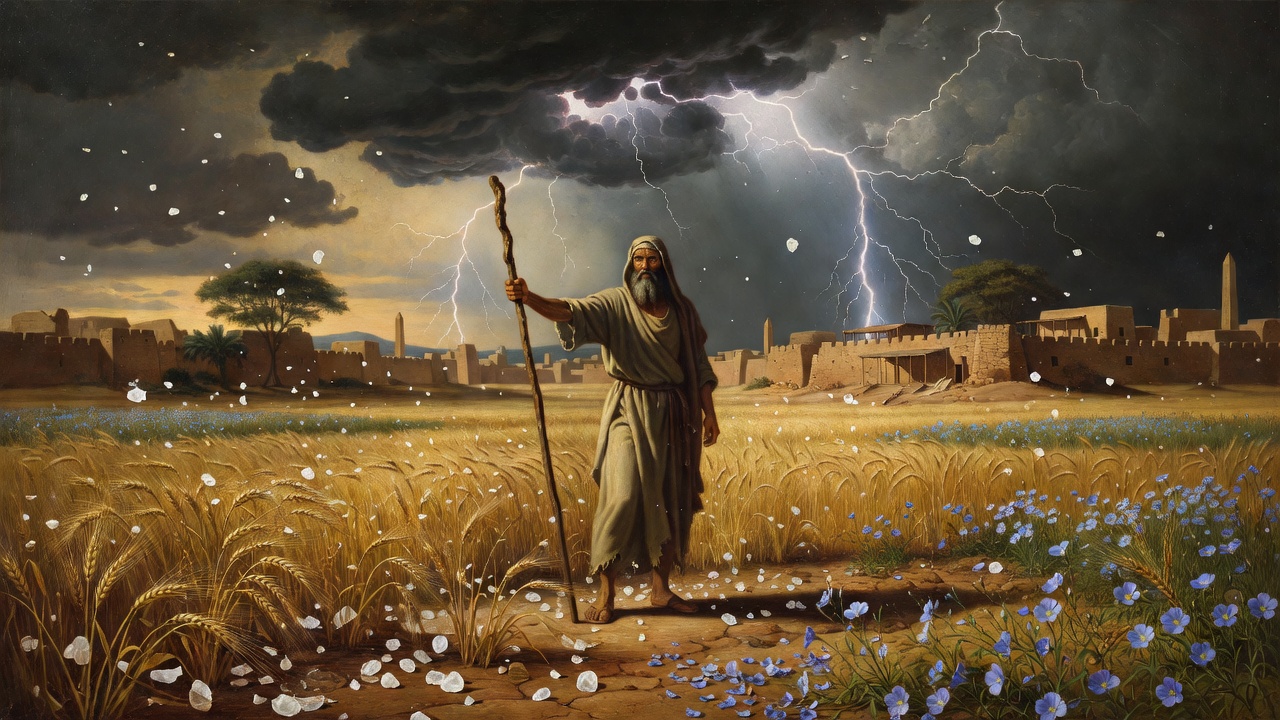
22And the Lord said to Moses, Stretch out thy hand to heaven, and there shall be hail on all the land of Egypt, both on the men and on the cattle, and on all the herbage on the land. 23And Moses stretched forth his hand to heaven, and the Lord sent thunderings and hail; and the fire ran along upon the ground, and the Lord rained hail on all the land of Egypt. 24So there was hail and flaming fire mingled with hail; and the hail was very great, such as was not in Egypt, from the time there was a nation upon it. 25And the hail smote in all the land of Egypt both man and beast, and the hail smote all the grass in the field, and the hail broke in pieces all the trees in the field. 26Only in the land of Goshen where the children of Israel were, the hail was not. 27And Pharaoh sent and called Moses and Aaron, and said to them, I have sinned this time: the Lord is righteous, and I and my people are wicked. 28Pray then for me to the Lord, and let him cause the thunderings of God to cease, and the hail and the fire, and I will send you forth and ye shall remain no longer. 29And Moses said to him, When I shall have departed from the city, I will stretch out my hands to the Lord, and the thunderings shall cease, and the hail and the rain shall be no longer, that thou mayest know that the earth is the Lord’s. 30But as for thee and thy servants, I know that ye have not yet feared the Lord. 31And the flax and the barley were smitten, for the barley was advanced, and the flax was seeding. 32But the wheat and the rye were not smitten, for they were late. 33And Moses went forth from Pharaoh out of the city, and stretched out his hands to the Lord, and the thunders ceased and the hail, and the rain did not drop on the earth. 34And when Pharaoh saw that the rain and the hail and the thunders ceased, he continued to sin; and he hardened his heart, and the heart of his servants. 35And the heart of Pharaoh was hardened, and he did not send forth the children of Israel, as the Lord said to Moses.
Did you know?
Livestock, Boils, and Hail
- This chapter draws a sharp line between Egypt and the Israelites: all the livestock of the Egyptians die, but not one animal belonging to the Israelites dies, and the hail falls on all the land of Egypt except Goshen, where the Israelites lived. Goshen, also called the land of Rameses, lay east of the Nile and apparently not far from the royal residence, and it had been assigned to Jacob’s family as the best of the land.Sources: the Bible text itself · Goshen · Moses
- The Pharaoh whom Moses and Aaron confront is not named in the chapter. Easton's Bible Dictionary (1897) identifies him as probably Menephtah I, a son of Rameses II, who lived at Zoan, where his interviews with Moses and Aaron took place, and notes that some instead favor Seti II. After the hail, Moses leaves the city and spreads out his hands to the LORD until the thunder and hail cease.Sources: the Bible text itself · Pharaoh (of the Exodus)
- The hail destroyed the flax and the barley, but not the wheat and the spelt. The narrative explains the difference: the barley was already ripe and the flax was in bloom, while the wheat and spelt were late crops.Sources: the Bible text itself
Notes written with AI assistance from open sources (Theographic Bible Metadata, CC BY-SA 4.0; Easton’s Bible Dictionary, public domain) and reviewed before publishing.
Places in this chapter
- Egypt · 30.129, 31.308 · verses 4, 6, 9, 18, 22, 23, 24, 25
- Goshen · Today: Goshen 1 · 30.799, 31.834 · verse 26
Only places identified with high confidence are shown (90% or more according to the scholarly sources compiled by OpenBible). Period map: DARE (Digital Atlas of the Roman Empire), CC BY 4.0; modern map: © OpenStreetMap contributors; places: OpenBible.info (CC BY 4.0).
Credits and license for this translation
Updated Brenton English Septuagint
Spelling and formatting update of the Brenton English Septuagint with Apocrypha
Public Domain
Language: English
Dialect: Mixed
Translation by: Sir Lancelot C. L. Brenton
Contributor: Adam Boyd
Original work was by Sir Lancelot C. L. Brenton in 1851.
CC0 Public Domain dedication on language updates by Adam Boyd in 2020.
2026-02-18
Section headings adapted from the Berean Standard Bible (public domain); they are not part of this translation’s text.
Source: http://ebible.org/englxxup/ · eBible.org