Deuteronomy 24
Updated Brenton English Septuagint · Tap a verse to see its cross-references.
Marriage and Divorce Laws
1And if anyone should take a wife, and should dwell with her, then it shall come to pass if she should not have found favor before him, because he has found some unbecoming thing in her, that he shall write for her a bill of divorcement, and give it into her hands, and he shall send her away out of his house. 2And if she should go away and be married to another man; 3and the last husband should hate her, and write for her a bill of divorcement; and should give it into her hands, and send her away out of his house, and the last husband should die, who took her to himself for a wife; 4the former husband who sent her away shall not be able to return and take her to himself for a wife, after she has been defiled; because it is an abomination before the Lord thy God, and ye shall not defile the land, which the Lord thy God gives thee to inherit.
5And if anyone should have recently taken a wife, he shall not go out to war, neither shall anything be laid upon him; he shall be free in his house; for one year he shall cheer his wife whom he has taken.
Additional Laws
6Thou shalt not take for a pledge the under millstone, nor the upper millstone; for he who does so takes life for a pledge. 7And if a man should be caught stealing one of his brethren of the children of Israel, and having overcome him he should sell him, that thief shall die; so shalt thou remove that evil one from yourselves. 8Take heed to thyself in regard of the plague of leprosy: thou shalt take great heed to do according to all the law, which the priests the Levites shall report to you; take heed to do, as I have charged you. 9Remember all that the Lord thy God did to Miriam in the way, when ye were going out of Egypt.
10If thy neighbor owe thee a debt, any debt whatsoever, thou shalt not go into his house to take his pledge: 11thou shalt stand without, and the man who is in thy debt shall bring the pledge out to thee. 12And if the man be poor, thou shalt not sleep with his pledge. 13Thou shalt surely restore his pledge at sunset, and he shall sleep in his garment, and he shall bless thee; and it shall be mercy to thee before the Lord thy God. 14Thou shalt not unjustly withhold the wages of the poor and needy of thy brethren, or of the strangers who are in thy cities. 15Thou shalt pay him his wages the same day, the sun shall not go down upon it, because he is poor and he trusts in it; and he shall cry against thee to the Lord, and it shall be sin in thee. 16The fathers shall not be put to death for the children, and the sons shall not be put to death for the fathers; every one shall be put to death for his own sin. 17Thou shalt not wrest the judgment of the stranger and the fatherless, and widow; thou shalt not take the widow’s garment for a pledge. 18And thou shalt remember that thou wast a bondman in the land of Egypt, and the Lord thy God redeemed thee from thence; therefore I charge thee to do this thing.
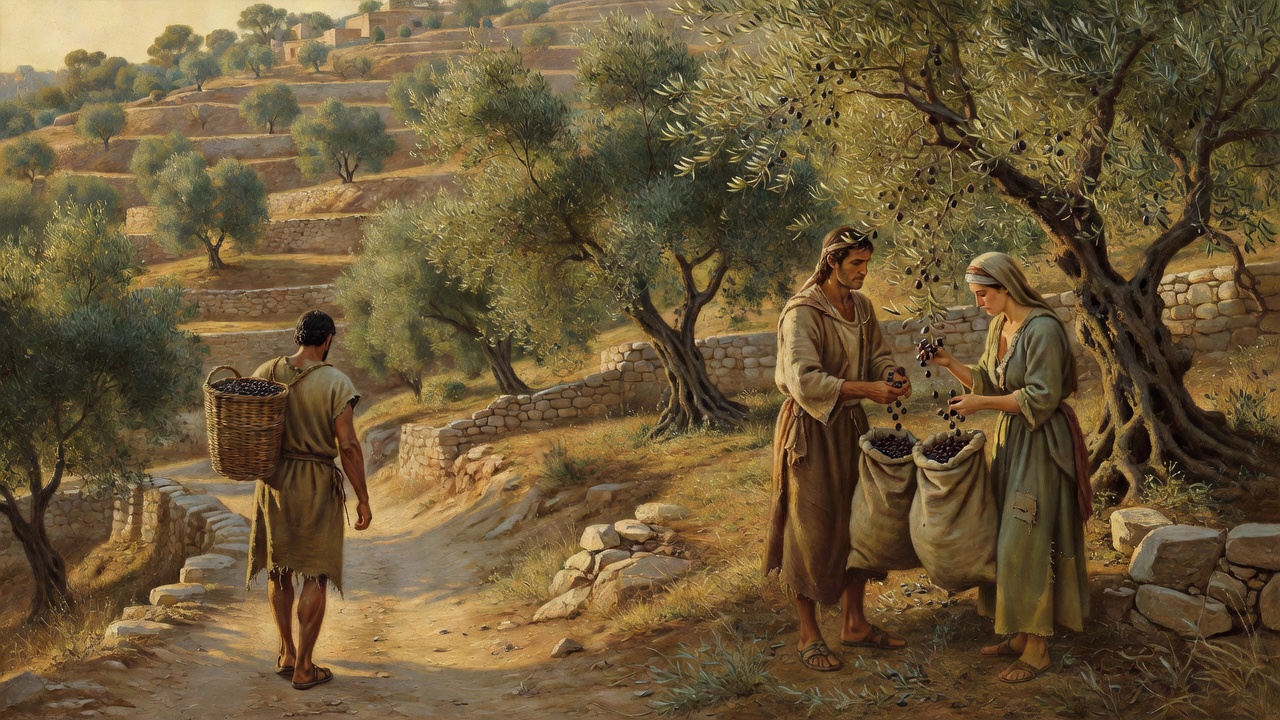
19And when thou shalt have reaped corn in thy field, and shalt have forgotten a sheaf in thy field, thou shalt not return to take it; it shall be for the stranger, and the orphan, and the widow, that the Lord thy God may bless thee in all the works of thy hands. 20And if thou shouldest gather thine olives, thou shalt not return to collect the remainder; it shall be for the stranger, and the fatherless, and the widow, and thou shalt remember that thou wast a bondman in the land of Egypt; therefore I command thee to do this thing. 21And whensoever thou shalt gather the grapes of thy vineyard, thou shalt not glean what thou hast left; it shall be for the stranger, and the orphan, and the widow: 22and thou shalt remember that thou wast a bondman in the land of Egypt; therefore I command thee to do this thing.
Did you know?
Laws of Compassion, Justice, and Social Protection
- Israelite harvesting laws required landowners to leave behind forgotten sheaves of grain, leftover olives, and grape gleanings for vulnerable groups: the resident foreigner, the orphan, and the widow. This social welfare system was grounded in the collective memory that the Israelites had once been oppressed slaves in Egypt.Sources: the Bible text itself · Egypt
- Debtors and hired workers were protected by explicit legal limits. Creditors were forbidden from entering a debtor's house to seize a pledge, taking essential millstones that provided a household's daily bread, or keeping an impoverished person's sleeping cloak past sunset, and day laborers had to be paid before nightfall.Sources: the Bible text itself
- When giving instructions concerning infectious skin diseases and the guidance of Levitical priests, the text points back to the affliction of Miriam, the sister of Moses and Aaron, during the wilderness journey following the Exodus from Egypt.Sources: the Bible text itself · Miriam · Egypt
Notes written with AI assistance from open sources (Theographic Bible Metadata, CC BY-SA 4.0; Easton’s Bible Dictionary, public domain) and reviewed before publishing.
Places in this chapter
Only places identified with high confidence are shown (90% or more according to the scholarly sources compiled by OpenBible). Period map: DARE (Digital Atlas of the Roman Empire), CC BY 4.0; modern map: © OpenStreetMap contributors; places: OpenBible.info (CC BY 4.0).
Credits and license for this translation
Updated Brenton English Septuagint
Spelling and formatting update of the Brenton English Septuagint with Apocrypha
Public Domain
Language: English
Dialect: Mixed
Translation by: Sir Lancelot C. L. Brenton
Contributor: Adam Boyd
Original work was by Sir Lancelot C. L. Brenton in 1851.
CC0 Public Domain dedication on language updates by Adam Boyd in 2020.
2026-02-18
Section headings adapted from the Berean Standard Bible (public domain); they are not part of this translation’s text.
Source: http://ebible.org/englxxup/ · eBible.org