2 Chronicles 13
Updated Brenton English Septuagint · Tap a verse to see its cross-references.
Abijah Reigns in Judah
1In the eighteenth year of the reign of Jeroboam Abijah began to reign over Judah. 2He reigned three years in Jerusalem. And his mother’s name was Micaiah, daughter of Uriel of Gibeon.
And there was war between Abijah and Jeroboam. 3And Abijah set the battle in array with an army, with mighty men of war, even four hundred thousand mighty men: and Jeroboam set the battle in array against him with eight hundred thousand, they were mighty warriors of the host.
Civil War against Jeroboam
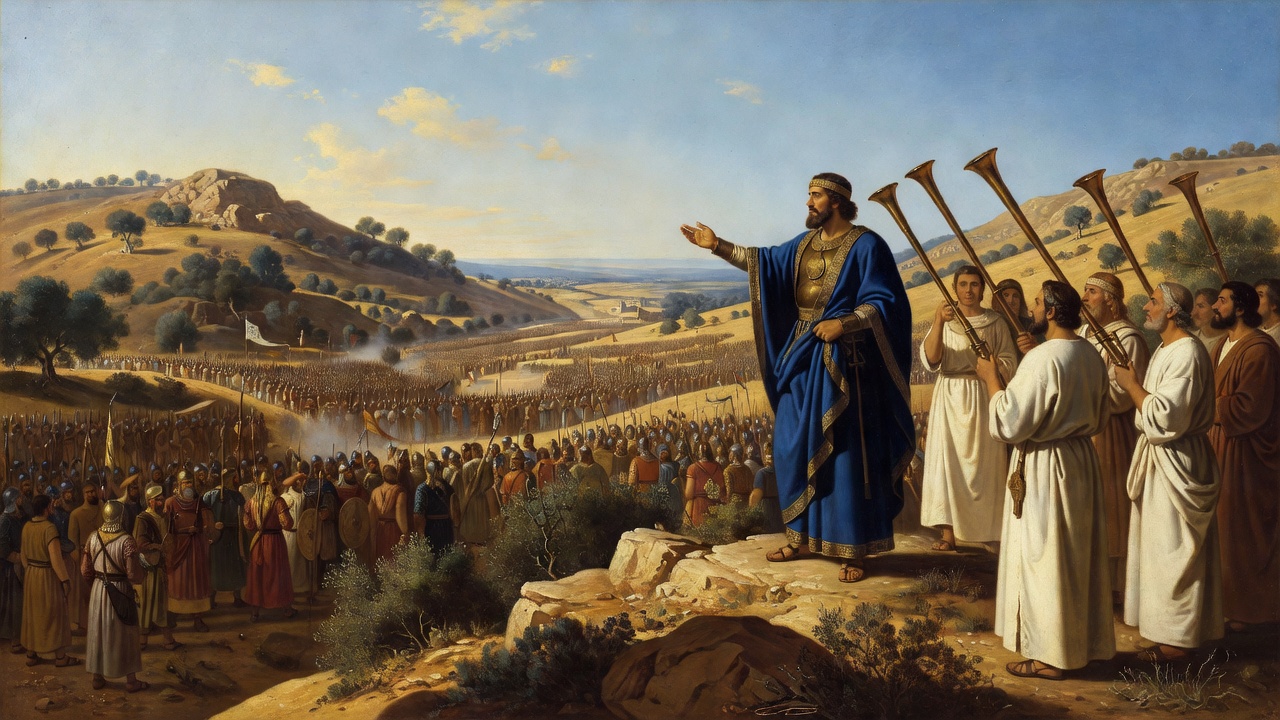
4And Abijah rose up from the Mount Zemaraim, which is in Mount Ephraim, and said, Hear ye, Jeroboam, and all Israel: 5Is it not for you to know that the Lord God of Israel has given a king over Israel forever to David, and to his sons, by a covenant of salt? 6But Jeroboam the son of Nebat, the servant of Solomon the son of David, is risen up, and has revolted from his master: 7and there are gathered to him pestilent men, transgressors, and he has risen up against Rehoboam the son of Solomon, while Rehoboam was young and fearful in heart, and he withstood him not. 8And now ye profess to resist the kingdom of the Lord in the hand of the sons of David; and ye are a great multitude, and with you are golden calves, which Jeroboam made you for gods. 9Did ye not cast out the priests of the Lord, the sons of Aaron, and the Levites, and make to yourselves priests of the people of any other land? whoever came to consecrate himself with a calf of the herd and seven rams, he forthwith became a priest to that which is no god. 10But we have not forsaken the Lord our God, and his priests, the sons of Aaron, and the Levites, minister to the Lord; and in their daily courses 11they sacrifice to the Lord whole burnt offering, morning and evening, and compound incense, and set the showbread on the pure table; and there is the golden candlestick, and the lamps for burning, to light in the evening: for we keep the charge of the Lord God of our fathers; but ye have forsaken him. 12And, behold, the Lord and his priests are with us at our head, and the signal trumpets to sound an alarm over us. Children of Israel, fight not against the Lord God of our fathers; for ye shall not prosper.
13Now Jeroboam had caused an ambush to come round upon him from behind: and he himself was before Judah, and the ambush behind. 14And Judah looked back, and, behold, the battle was against them before and behind: and they cried to the Lord, and the priests sounded with the trumpets. 15And the men of Judah shouted: and it came to pass, when the men of Judah shouted, that the Lord smote Jeroboam and Israel before Abijah and Judah. 16And the children of Israel fled from before Judah; and the Lord delivered them into their hands. 17And Abijah and his people smote them with a great slaughter: and there fell slain of Israel five hundred thousand mighty men. 18So the children of Israel were brought low in that day, and the children of Judah prevailed, because they trusted on the Lord God of their fathers. 19And Abijah pursued after Jeroboam, and he took from him the cities, Bethel and her towns, and Jeshanah and her towns, and Ephron and her towns. 20And Jeroboam did not recover strength again all the days of Abijah: and the Lord smote him, and he died.
21But Abijah strengthened himself, and took to himself fourteen wives, and he begot twenty-two sons, and sixteen daughters.
22And the rest of the acts of Abijah, and his deeds, and his sayings, are written in the book of the prophet Iddo.
23And Abijah died with his fathers, and they buried him in the city of David; and Asa his son reigned in his stead. In the days of Asa the land of Judah had rest ten years.
Did you know?
Abijah’s Victory over Jeroboam
- Before the battle, King Abijah of Judah stood on Mount Zemaraim in the hill country of Ephraim to speak to Jeroboam and Israel, defending the Davidic dynasty by citing an enduring covenant of salt.Sources: the Bible text itself · Mount Zemaraim · Abijah
- Abijah contrasted the religious practices of the two kingdoms, noting that Judah retained the Aaronic priesthood and regular temple rituals, whereas Jeroboam had driven out the Levites and consecrated priests for golden calves.Sources: the Bible text itself · Aaron
- Even though Jeroboam set an ambush behind the army of Judah, Judah prevailed after crying out to God and blowing the sacred trumpets, subsequently taking control of towns such as Bethel, Jeshanah, and Ephron.Sources: the Bible text itself · Bethel (of Palestine) · Jeshanah
Notes written with AI assistance from open sources (Theographic Bible Metadata, CC BY-SA 4.0; Easton’s Bible Dictionary, public domain) and reviewed before publishing.
Places in this chapter
Only places identified with high confidence are shown (90% or more according to the scholarly sources compiled by OpenBible). Period map: DARE (Digital Atlas of the Roman Empire), CC BY 4.0; modern map: © OpenStreetMap contributors; places: OpenBible.info (CC BY 4.0).
Credits and license for this translation
Updated Brenton English Septuagint
Spelling and formatting update of the Brenton English Septuagint with Apocrypha
Public Domain
Language: English
Dialect: Mixed
Translation by: Sir Lancelot C. L. Brenton
Contributor: Adam Boyd
Original work was by Sir Lancelot C. L. Brenton in 1851.
CC0 Public Domain dedication on language updates by Adam Boyd in 2020.
2026-02-18
Section headings adapted from the Berean Standard Bible (public domain); they are not part of this translation’s text.
Source: http://ebible.org/englxxup/ · eBible.org