Acts 13
Literal Standard Version · Tap a verse to see its cross-references.
Paul’s First Missionary Journey Begins
1And there were certain in Antioch, in the assembly there, prophets and teachers: both Barnabas, and Simeon who is called Niger, and Lucius the Cyrenian, Manaen also—Herod the tetrarch’s foster-brother—and Saul; 2and in their ministering to the LORD and fasting, the Holy Spirit said, “Separate to Me both Barnabas and Saul to the work to which I have called them,” 3then having fasted, and having prayed, and having laid the hands on them, they sent [them] away.
On Cyprus
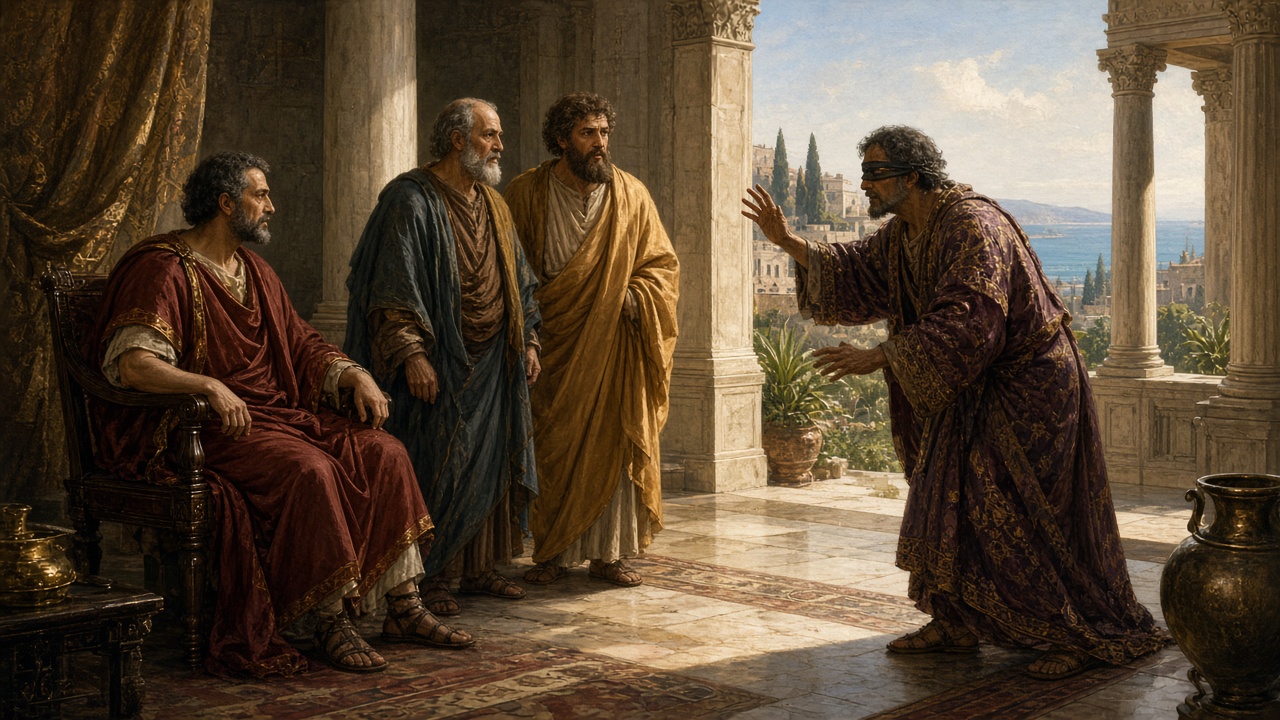
4These, indeed, then, having been sent forth by the Holy Spirit, went down to Seleucia, and from there they sailed to Cyprus, 5and having come to Salamis, they declared the word of God in the synagogues of the Jews, and they also had John [as] a servant; 6and having gone through the island to Paphos, they found a certain magus, a false prophet, a Jew, whose name [is] Bar-Jesus; 7who was with the proconsul Sergius Paulus, an intelligent man; this one having called for Barnabas and Saul, desired to hear the word of God, 8and there withstood them Elymas the magus—for so is his name interpreted—seeking to pervert the proconsul from the faith. 9And Saul—who also [is] Paul—having been filled with the Holy Spirit, and having looked steadfastly on him, 10said, “O full of all guile, and all recklessness, son of a devil, enemy of all righteousness, will you not cease perverting the right ways of the LORD? 11And now, behold, a hand of the LORD [is] on you, and you will be blind, not seeing the sun for a season”; and instantly there fell on him a mist and darkness, and he, going around, was seeking some to lead [him] by the hand; 12then the proconsul having seen what has come to pass, believed, being astonished at the teaching of the LORD.
In Pisidian Antioch
13And those around Paul having set sail from Paphos, came to Perga of Pamphylia, and John having departed from them, turned back to Jerusalem, 14and they having gone through from Perga, came to Antioch of Pisidia, and having gone into the synagogue on the day of the Sabbaths, they sat down, 15and after the reading of the Law and of the Prophets, the chief men of the synagogue sent to them, saying, “Men, brothers, if there be a word in you of exhortation to the people—say on.” 16And Paul having risen, and having beckoned with the hand, said, “Men, Israelites, and those fearing God, listen: 17the God of this people Israel chose our fathers, and He exalted the people in their sojourning in the land of Egypt, and He brought them out of it with a high arm; 18and about a period of forty years He endured their conduct in the wilderness, 19and having destroyed seven nations in the land of Canaan, He divided their land to them by lot. 20And after these things, about four hundred and fifty years, He gave judges—until Samuel the prophet; 21and thereafter they asked for a king, and God gave to them Saul, son of Kish, a man of the tribe of Benjamin, for forty years; 22and having removed him, He raised up to them David for king, to whom also having testified, He said, I found David, the [son] of Jesse, a man according to My heart, who will do all My will. 23Of this one’s seed, God, according to promise, raised to Israel a Savior—Jesus, 24John having first preached, before His coming, an immersion of conversion to all the people of Israel; 25and as John was fulfilling the course, he said, Whom do you suppose I am? I am not [He], but behold, He comes after me, of whom I am not worthy to loose the sandal of [His] feet. 26Men, brothers, sons of the race of Abraham, and those among you fearing God, to you was the word of this salvation sent, 27for those dwelling in Jerusalem, and their chiefs, having not known this One, also the voices of the Prophets, which are being read every Sabbath—having judged [Him]—fulfilled, 28and having found no cause of death, they asked of Pilate that He should be slain, 29and when they fulfilled all the things written about Him, having taken [Him] down from the tree, they laid Him in a tomb; 30and God raised Him out of the dead, 31and He was seen for many days of those who came up with Him from Galilee to Jerusalem, who are His witnesses to the people. 32And we proclaim good news to you—that the promise made to the fathers, 33God has completed this in full to us their children, having raised up Jesus, as also in the second Psalm it has been written: You are My Son—I have begotten You today. 34And that He raised Him up out of the dead, to no longer return to corruption, He has said this: I will give to You the holy [blessings] of David [that are] faithful; 35for what reason He also says in another [place]: You will not give Your Holy One to see corruption; 36for David, indeed, having served his own generation by the will of God, fell asleep, and was added to his fathers, and saw corruption, 37but He whom God raised up, did not see corruption. 38Let it therefore be known to you, men, brothers, that the forgiveness of sins is declared to you through this One, 39and from all things in the Law of Moses from which you were not able to be declared righteous, everyone who is believing in this One is declared righteous; 40see, therefore, it may not come on you that has been spoken in the Prophets: 41See, you despisers, and wonder, and perish, because I work a work in your days, a work in which you may not believe, though anyone may declare [it] to you.”
A Light for the Gentiles
42And having gone forth out of the synagogue of the Jews, the nations were calling on [them] that on the next Sabbath these sayings may be spoken to them, 43and the synagogue having been dismissed, many of the Jews and of the devout proselytes followed Paul and Barnabas, who, speaking to them, were persuading them to remain in the grace of God. 44And on the coming Sabbath, almost all the city was gathered together to hear the word of God, 45and the Jews having seen the multitudes, were filled with zeal, and contradicted the things spoken by Paul—contradicting and slandering. 46And speaking boldly, Paul and Barnabas said, “It was necessary that the word of God be first spoken to you, and seeing you thrust it away, and do not judge yourselves worthy of the continuous life, behold, we turn to the nations; 47for so the LORD has commanded us: I have set you for a light of nations—for your being for salvation to the end of the earth.” 48And the nations hearing were glad, and were glorifying the word of the LORD, and believed—as many as were appointed to continuous life; 49and the word of the LORD was spread abroad through all the region. 50And the Jews stirred up the devout and honorable women, and the first men of the city, and raised persecution against Paul and Barnabas, and put them out from their borders; 51and having shaken off the dust of their feet against them, they came to Iconium, 52and the disciples were filled with joy and the Holy Spirit.
Did you know?
The mission sent from Antioch
- Easton's Bible Dictionary (1897) describes Antioch in Syria as ranking third, after Rome and Alexandria, among the cities of the Roman empire; the church there set Barnabas and Saul apart. Among its prophets and teachers were Simeon called Niger, a surname meaning black, perhaps from a dark complexion, and Lucius of Cyrene, in North Africa.Sources: Antioch (Syria) · the Bible text itself · Simeon · Lucius
- At Paphos, the capital of Cyprus and the residence of the Roman governor, a Jewish sorcerer named Bar-Jesus, also called Elymas, an Arabic name meaning magician or sorcerer, tried to turn the proconsul Sergius Paulus from the faith. It is here that Saul is also called Paul; Easton's Bible Dictionary (1897) says the name Paul was probably given to him in infancy for use in the Gentile world, while Saul was his Hebrew home-name.Sources: Paphos · Elymas · Paul · the Bible text itself
- Sent from Antioch, they went down to Seleucia, the city's seaport near the mouth of the Orontes, and sailed to Cyprus; later they landed at Perga, the capital of Pamphylia, on the river Cestrus. There John left them and returned to Jerusalem; his Roman name, Mark, gradually came to replace his Jewish name, and he was a cousin of Barnabas.Sources: Seleucia · Perga · John Mark · the Bible text itself
Notes written with AI assistance from open sources (Theographic Bible Metadata, CC BY-SA 4.0; Easton’s Bible Dictionary, public domain) and reviewed before publishing.
Places in this chapter
- Antioch · Today: Antioch on the Orontes · 36.227, 36.172 · verse 1
- Cyrene · 32.821, 21.851 · verse 1
- Cyprus · 35.000, 33.000 · verse 4
- Seleucia · Today: Seleucia Pieria · 36.124, 35.922 · verse 4
- Salamis · 35.185, 33.902 · verse 5
- Paphos · Today: New Paphos · 34.756, 32.404 · verses 6, 13
- Jerusalem · 31.777, 35.234 · verses 13, 27, 31
- Pamphylia · 37.000, 31.000 · verse 13
- Perga · 36.960, 30.854 · verses 13, 14
- Antioch · Today: Antioch in Pisidia · 38.306, 31.189 · verse 14
- Pisidia · 38.306, 31.189 · verse 14
- Egypt · 30.129, 31.308 · verse 17
- Canaan · 32.767, 35.333 · verse 19
- Galilee · 32.760, 35.527 · verse 31
- Iconium · Today: Konya · 37.872, 32.492 · verse 51
Only places identified with high confidence are shown (90% or more according to the scholarly sources compiled by OpenBible). Period map: DARE (Digital Atlas of the Roman Empire), CC BY 4.0; modern map: © OpenStreetMap contributors; places: OpenBible.info (CC BY 4.0).
Credits and license for this translation
Literal Standard Version
The Holy Bible in English, Literal Standard Version
copyright © 2020 Covenant Press
Language: English
Dialect: American
Contributor: Covenant Press
The Literal Standard Version of the Holy Bible is a registered copyright of Covanet Press and the Covenant Christian Coalition (© 2020). Covenant Press is soliciting partnerships with Bible publishers that are interested in the LSV project. For queries about partnering with us, please email the translation team at [email protected]. To learn more, visit lsvbible.com. The purpose behind the LSV is to provide readers with a modern, easy-to-read, literal, and accurate translation of the Bible that is free to read, distribute, and translate from. We pray that God will use the LSV to illuminate the hearts and minds of multitudes with the good news that His Son Jesus Christ came in the flesh, died for our sins as a substitutionary sacrifice, rose bodily from the dead, and is coming back again.
This translation is made available to you under the terms of the
Creative Commons Attribution Share-Alike license 4.0.
You have permission to share and redistribute this Bible translation in any format and to make reasonable revisions and adaptations of this translation, provided that:
You include the above copyright and source information.
If you make any changes to the text, you must indicate that you did so in a way that makes it clear that the original licensor is not necessarily endorsing your changes.
If you redistribute this text, you must distribute your contributions under the same license as the original.
Pictures included with Scriptures and other documents on this site are licensed just for use with those Scriptures and documents.
For other uses, please contact the respective copyright owners.
Note that in addition to the rules above, revising and adapting God's Word involves a great responsibility to be true to God's Word. See Revelation 22:18-19.
2026-10-02
Section headings adapted from the Berean Standard Bible (public domain); they are not part of this translation’s text.
Source: http://eBible.org/englsv/ · eBible.org