Song of Songs 6
Isaac Leeser Tanakh · Tap a verse to see its cross-references.
Together in the Garden
The Friends
1Whither is thy friend gone, O fairest of women? whither hath thy friend turned himself? that we may seek him with thee?—
The Bride
2My beloved is gone down to his garden, to the beds of spices, to feed in the gardens, and to gather lilies. 3I am my friend's, and my friend is mine: he that feedeth among the lilies.—
The Bridegroom
4Thou art beautiful, O my beloved, like Thirzah, comely like Jerusalem, terrible as armies encamped round their banners. 5Turn away thy eyes from me, for they have excited me: thy hair is like a flock of goats that come quietly down from mount Gil'ad. 6Thy teeth are like a flock of ewes which are come up from the washing, all of which bear twins, and there is not one among them that is deprived of her young. 7Like the half of the pomegranate is the upper part of thy cheek behind thy vail. 8Sixty are the queens, and eighty the concubines, and the young women without number; 9But one alone is my dove, my guiltless one; she is the only one of her mother, she is the chosen of her that bore her: maidens see her, and call her happy; yea, queens and concubines, and praise her.
The Friends
10Who is this that shineth forth like the morning-dawn, beautiful as the moon, bright as the sun, terrible as armies encamped round their banners?
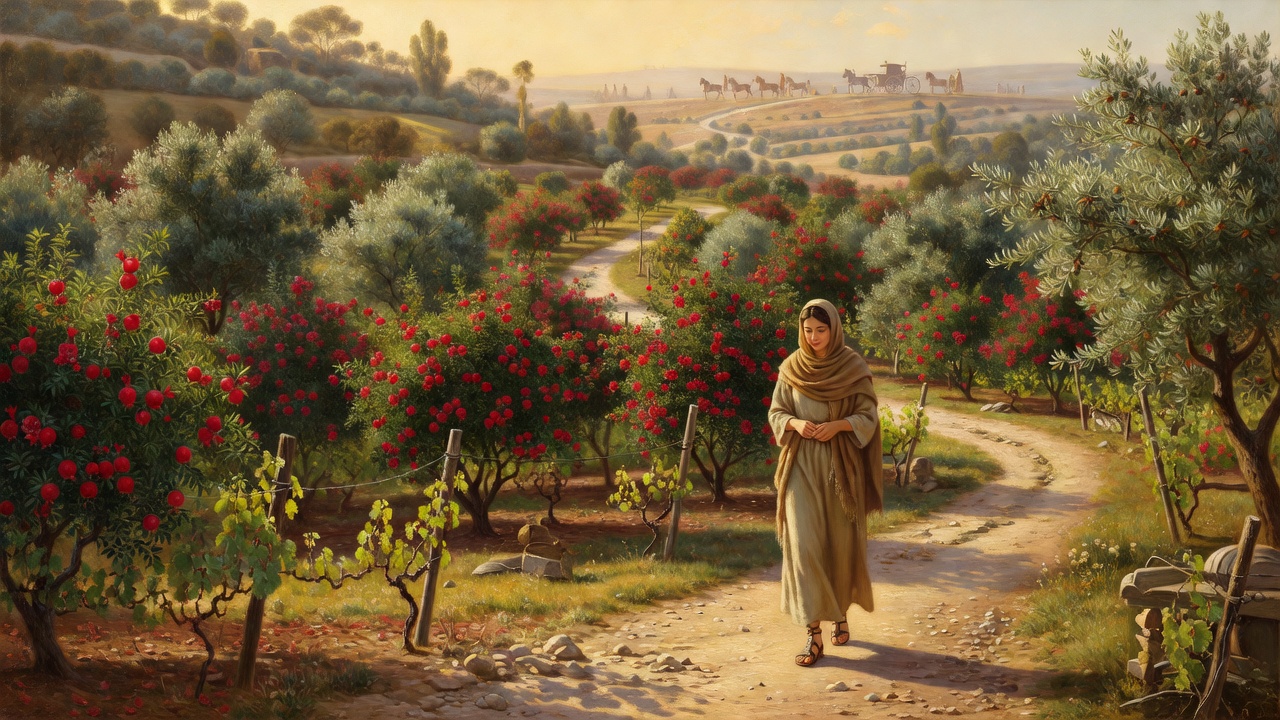
The Bridegroom
11Into the nut-garden was I gone down, to look about among the plants of the valley, to see whether the vine had blossomed, whether the pomegranates had budded. 12I knew not [how it was], my soul made me [like] the chariots of my noble people.
The Friends
13(7:1) Return, return, O Shulammith; return, return, that we may look upon thee. “What will ye see in the Shulammith?” As though it were the dance of a double company.
Did you know?
Beauty and Royal Splendor
- The poem praises the woman's beauty by comparing her to Tirzah and Jerusalem, two prominent royal centers. Tirzah was an ancient Canaanite city celebrated for its charm that later served as an early capital of the northern kingdom of Israel, while Jerusalem stood as the mountain capital of Judah.Sources: Tirzah · Jerusalem · the Bible text itself
- The description of hair streaming down like a flock of goats from Gilead evokes the rugged, mountainous territory east of the Jordan River, where herds grazed along the steep slopes.Sources: Gilead · the Bible text itself
Notes written with AI assistance from open sources (Theographic Bible Metadata, CC BY-SA 4.0; Easton’s Bible Dictionary, public domain) and reviewed before publishing.
Places in this chapter
Only places identified with high confidence are shown (90% or more according to the scholarly sources compiled by OpenBible). Period map: DARE (Digital Atlas of the Roman Empire), CC BY 4.0; modern map: © OpenStreetMap contributors; places: OpenBible.info (CC BY 4.0).
Credits and license for this translation
Isaac Leeser Tanakh
The Isaac Leeser Tanakh (Jewish Bible)
Public Domain
Language: English
Dialect: archaic British
Translation by: Isaac Leeser
2020-10-14
Section headings adapted from the Berean Standard Bible (public domain); they are not part of this translation’s text.
Source: http://ebible.org/englee/ · eBible.org