Psalms 53
Isaac Leeser Tanakh · Tap a verse to see its cross-references.
The Fool Says There Is No God
1“To the chief musician upon Machalath, a Maskil of David.” (53:2) The worthless fool saith in his heart, There is no God. They are corrupt, and they are abominable [in their] injustice: there is none that doth good. 2(53:3) God looketh down from heaven upon the children of men, to see if there be one intelligent, one who seeketh for God. 3(53:4) Every one [of them] hath departed [from righteousness]; altogether are they become corrupt: there is none that doth good, no, not one. 4(53:5) Is there no knowledge in the workers of wickedness? who eat up my people as they eat bread: [while] they do not call on God. 5(53:6) There were they terrified with terror where there was no terror; for God had scattered the bones of those that encamped against thee: thou didst put them to shame, because God had rejected them. 6(53:7) Oh that some one might bring the salvation of Israel out of Zion! When God bringeth back the captivity of his people, [then] will Jacob be glad, [and] Israel will rejoice.
Did you know?
A Reflection on Folly and Deliverance
- The psalm depicts God observing humanity from heaven to see if any seek Him, observing that all have turned aside and become corrupt.Sources: the Bible text itself
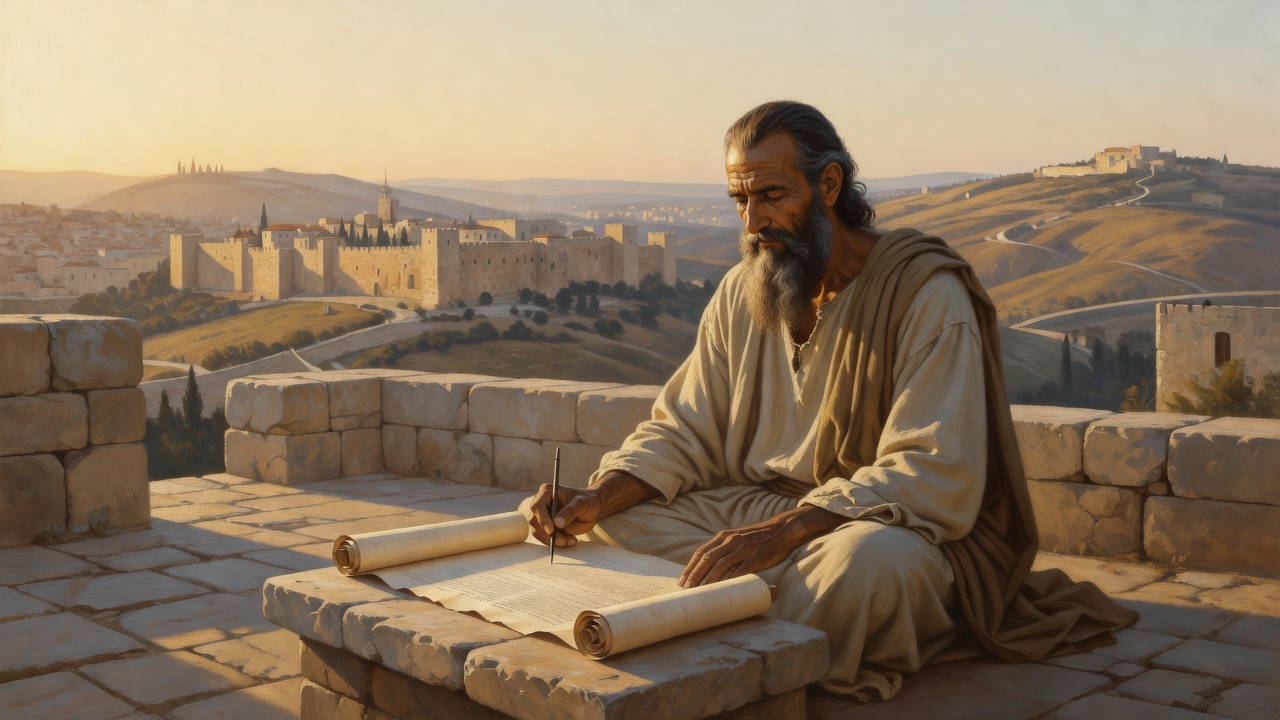
- The closing verse calls for salvation to come from Zion, the south-eastern hill of Jerusalem where David established his citadel and palace after capturing it from the Jebusites.Sources: the Bible text itself · Zion
- The poem concludes by pairing the names Jacob and Israel in a call for rejoicing, recalling the patriarch Jacob, the son of Isaac, who also bore the name Israel.Sources: the Bible text itself · Jacob (Israel)
Notes written with AI assistance from open sources (Theographic Bible Metadata, CC BY-SA 4.0; Easton’s Bible Dictionary, public domain) and reviewed before publishing.
Places in this chapter
- Zion · Today: Jerusalem · 31.777, 35.234 · verse 6
Only places identified with high confidence are shown (90% or more according to the scholarly sources compiled by OpenBible). Period map: DARE (Digital Atlas of the Roman Empire), CC BY 4.0; modern map: © OpenStreetMap contributors; places: OpenBible.info (CC BY 4.0).
Credits and license for this translation
Isaac Leeser Tanakh
The Isaac Leeser Tanakh (Jewish Bible)
Public Domain
Language: English
Dialect: archaic British
Translation by: Isaac Leeser
2020-10-14
Section headings adapted from the Berean Standard Bible (public domain); they are not part of this translation’s text.
Source: http://ebible.org/englee/ · eBible.org