Jeremiah 47
Isaac Leeser Tanakh · Tap a verse to see its cross-references.
Judgment on the Philistines
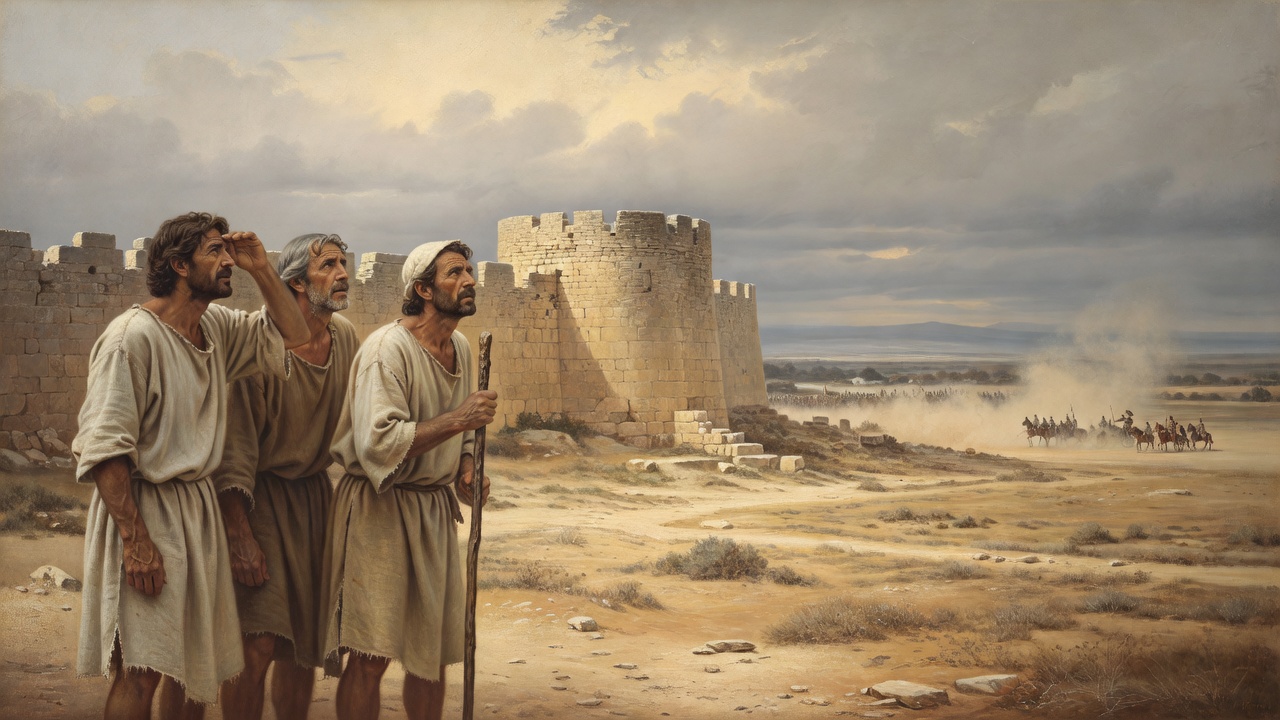
1The word of the Lord that came to Jeremiah the prophet against the Philistines, before the time that Pharaoh smote Gazzah. 2Thus hath said the Lord, Behold, waters are coming up out of the north, and they shall become an overflowing stream, and shall overflow the land, and what filleth it; the city, and those that dwell therein: and the men shall cry aloud, and every inhabitant of the land shall wail. 3Because of the noise of the stamping of the hoofs of his stud-horses, because of the rushing sound of his chariots, the rumbling of his wheels, fathers do not turn round to their children from their feebleness of hands; 4Because of the day that cometh to devastate all the Philistines, to cut off from Tyre and Zidon every helper that remaineth; for the Lord devastateth the Philistines, the remnant of the isle of Caphthor. 5Baldness is come upon Gazzah; ruined is Ashkelon with the remnant of their valley: how long yet wilt thou cut thyself? 6Woe! thou sword of the Lord, how long yet wilt thou not be quiet? withdraw thyself into thy scabbard, take thee rest, and be still. 7Yet how canst thou be quiet? When the Lord hath given it a charge, against Ashkelon, and against the sea-coast—thither hath he destined it.
Did you know?
Judgment on the Philistines
- Jeremiah refers to the Philistines as the remnant from the coasts of Caphtor. Biblical traditions identify Caphtor as the place of origin of the Philistines, a location widely associated by scholars with Crete or parts of the eastern Mediterranean coast.Sources: the Bible text itself · Caphtor
- The chapter directs its warnings against Gaza and Ashkelon, two of the five prominent Philistine cities along the Mediterranean coast. Both were ancient centers known for their strategic position and trade links connecting Egypt and the surrounding regions.Sources: the Bible text itself · Gaza · Ashkelon
- The prophecy notes that the coming destruction would cut off every remaining ally from Tyre and Sidon. These two major Phoenician ports to the north were key maritime centers whose interests were closely intertwined with the coastal region.Sources: the Bible text itself · Tyre · Sidon
Notes written with AI assistance from open sources (Theographic Bible Metadata, CC BY-SA 4.0; Easton’s Bible Dictionary, public domain) and reviewed before publishing.
Places in this chapter
- Gaza · Today: Tell Harube · 31.504, 34.464 · verses 1, 5
- Sidon · Today: Sandikli archaeological site in Sidon · 33.561, 35.372 · verse 4
- Tyre · 33.271, 35.196 · verse 4
- Ashkelon · Today: Tel Ashkelon · 31.664, 34.546 · verses 5, 7
- Great Sea · Today: Mediterranean Sea · 31.805, 34.170 · verse 5
- Philistia · 31.664, 34.546 · verse 5
Only places identified with high confidence are shown (90% or more according to the scholarly sources compiled by OpenBible). Period map: DARE (Digital Atlas of the Roman Empire), CC BY 4.0; modern map: © OpenStreetMap contributors; places: OpenBible.info (CC BY 4.0).
Credits and license for this translation
Isaac Leeser Tanakh
The Isaac Leeser Tanakh (Jewish Bible)
Public Domain
Language: English
Dialect: archaic British
Translation by: Isaac Leeser
2020-10-14
Section headings adapted from the Berean Standard Bible (public domain); they are not part of this translation’s text.
Source: http://ebible.org/englee/ · eBible.org