Isaiah 11
Isaac Leeser Tanakh · Tap a verse to see its cross-references.
The Root of Jesse
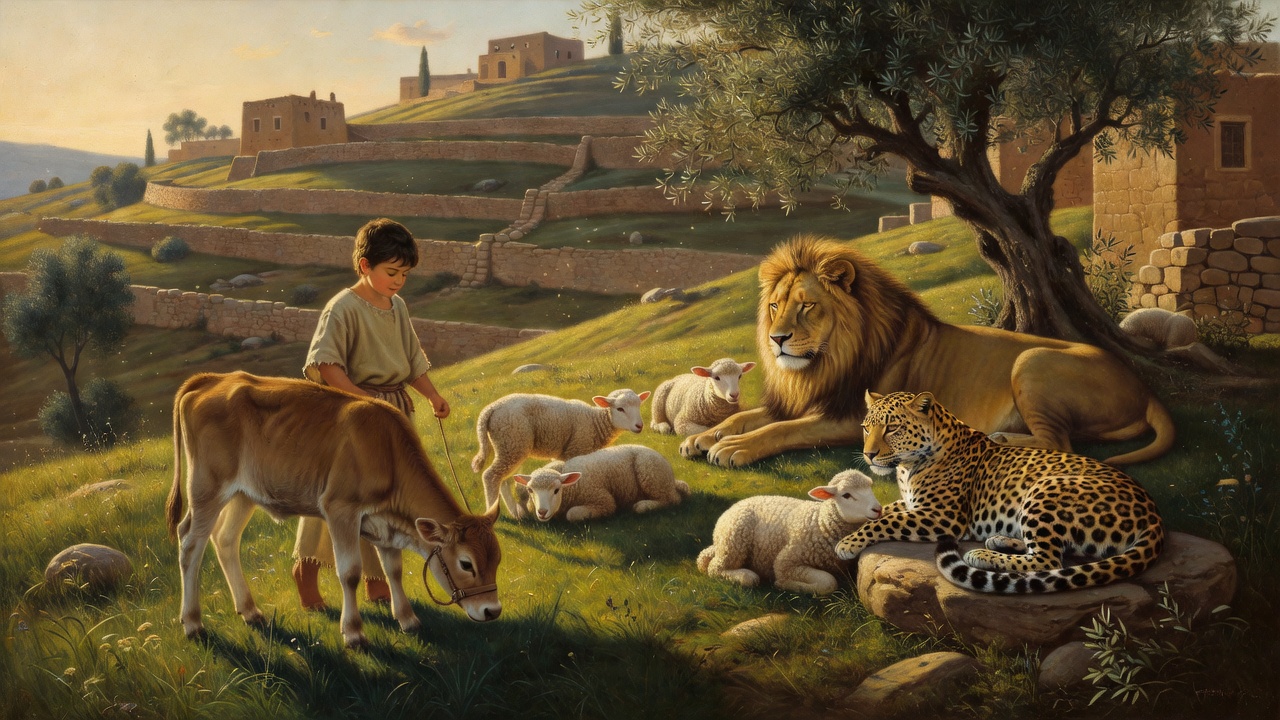
1And there shall come forth a shoot out of the stem of Jesse, and a sprout shall spring out of his roots. 2And there shall rest upon him the spirit of the Lord, the spirit of wisdom and understanding, the spirit of counsel and might, the spirit of knowledge and of the fear of the Lord; 3And he shall be animated by the fear of the Lord; and not after the sight of his eyes shall he judge, and not after the hearing of his ears shall he decide; 4But he shall judge with righteousness the poor, and decide with equity for the suffering ones of the earth; and he shall smite the earth with the rod of his mouth, and with the breath of his lips shall he slay the wicked. 5And righteousness shall be the girdle of his loins, and faithfulness the girdle of his hips. 6And the wolf shall dwell with the sheep, and the leopard shall lie down with the kid; and the calf and the young lion and the fatling [shall be] together, and a little boy shall lead them. 7And the cow and the she-bear shall feed, together shall their young ones lie down: and the lion shall like the ox eat straw. 8And the sucking child shall play on the hole of the asp, and on the basilisk's den shall the weaned child stretch out his hand. 9They shall not do hurt nor destroy on all my holy mountain: for the earth shall be full of the knowledge of the Lord, as the waters cover the sea. 10And it shall happen on that day, that [he of] the root of Jesse, who shall stand as an ensign of the people, to him shall nations [come to] inquire: and his resting-place shall be glorious. 11And it shall happen on that day, that the Lord will put forth his hand again the second time to acquire the remnant of his people, which shall remain, from Asshur and from Egypt, and from Pathros, and from Cush, and from 'Elam, and from Shin'ar, and from Chamath, and from the islands of the sea. 12And he will lift up an ensign unto the nations, and will assemble the outcasts of Israel; and the dispersed of Judah will he collect together from the four corners of the earth. 13And then shall depart the envy of Ephraim, and the adversaries of Judah shall be cut off: Ephraim shall not envy Judah, and Judah shall not assail Ephraim. 14But they shall fly upon the shoulders of the Philistines toward the west; together shall they spoil the children of the east: upon Edom and Moab shall they lay their hands; and the children of 'Ammon shall obey them. 15And the Lord will destroy the tongue of the Egyptian sea; and swing his hand over the river with his mighty wind, and will smite it into seven streams, and render it passable with shoes. 16And there shall be a highway for the remnant of his people, which shall remain from Asshur, like as it was to Israel on the day that they came up out of the land of Egypt.
Did you know?
The Peaceful Kingdom and the Restored Remnant
- Jesse of Bethlehem was the father of King David. By describing the coming ruler as a shoot from the stump of Jesse and as the root of Jesse, the prophecy points to a renewal of the Davidic line even after the royal house appeared cut down.Sources: Jesse · the Bible text itself
- The places listed for the gathering of the remnant reflect the ancient Near Eastern world: Pathros designates Upper Egypt, Shinar is an ancient name for Babylonia in southern Mesopotamia, and Elam was a highland territory east of Babylon.Sources: Pathros · Shinar · Elam · the Bible text itself
- Ephraim, named for the second son of Joseph, was often used in prophetic literature to represent the northern kingdom of Israel. Isaiah foresees a time of lasting reconciliation that ends the long-standing jealousy and conflict between the northern tribes and Judah.Sources: Ephraim · the Bible text itself
Notes written with AI assistance from open sources (Theographic Bible Metadata, CC BY-SA 4.0; Easton’s Bible Dictionary, public domain) and reviewed before publishing.
Places in this chapter
- Assyria · 36.359, 43.153 · verses 11, 16
- Cush · Today: Cush 1 · 16.935, 33.751 · verse 11
- Egypt · 30.129, 31.308 · verses 11, 16
- Elam · 32.189, 48.258 · verse 11
- Great Sea · Today: Mediterranean Sea · 31.805, 34.170 · verse 11
- Hamath · Today: Hama · 35.136, 36.750 · verse 11
- Pathros · Today: Upper Egypt · 24.100, 32.700 · verse 11
- Shinar · Today: Babylonia · 32.543, 44.422 · verse 11
- Ammon · 31.955, 35.934 · verse 14
- East · Today: region around Amman · 31.955, 35.934 · verse 14
- Edom · 30.746, 35.604 · verse 14
- Moab · Today: Moab 1 · 31.181, 35.701 · verse 14
- Philistia · 31.664, 34.546 · verse 14
- Euphrates · Today: Euphrates River · 31.004, 47.442 · verse 15
Only places identified with high confidence are shown (90% or more according to the scholarly sources compiled by OpenBible). Period map: DARE (Digital Atlas of the Roman Empire), CC BY 4.0; modern map: © OpenStreetMap contributors; places: OpenBible.info (CC BY 4.0).
Credits and license for this translation
Isaac Leeser Tanakh
The Isaac Leeser Tanakh (Jewish Bible)
Public Domain
Language: English
Dialect: archaic British
Translation by: Isaac Leeser
2020-10-14
Section headings adapted from the Berean Standard Bible (public domain); they are not part of this translation’s text.
Source: http://ebible.org/englee/ · eBible.org