Genesis 10
Isaac Leeser Tanakh · Tap a verse to see its cross-references.
The Table of Nations
1Now these are the generations of the sons of Noah: Shem, Ham, and Japheth; and unto them were sons born after the flood.
The Japhethites
2The sons of Japheth: Gomer, and Magog, and Madai and Javan, and Tubal, and Meshech, and Tirass. 3And the sons of Gomer: Ashkenaz, Riphath, and Togarmah. 4And Javan's sons: Elishah, Tarshish, Kittim, and Dodanim. 5From these were separated the isles of the nations in their lands, every one after his tongue: after their families, in their nations.
The Hamites
6And the sons of Ham: Cush and Mizrayim, Put and Canaan. 7And the sons of Cush: Seba and Havilah, Sabtah and Raamah, and Sabtecha; and the sons of Raamah: Sheba and Dedan. 8And Cush begat Nimrod; he began to be a mighty man on the earth. 9He was a mighty hunter before the Lord: wherefore it is said, Even as Nimrod, a mighty hunter before the Lord. 10And the beginning of his kingdom was Babel, and Erech, and Accad, and Calneh, in the land of Shinar. 11Out of that land went forth Asshur, and built Nineveh, and the city of Rechoboth, and Calach. 12And Ressen between Nineveh and Calach: the same is the great city. 13And Mizrayim begat the Ludim, and Anamim, and Lehabim, and Naphtuchim. 14And the Pethrussim, and Casluchin, [out of whom came the Pelishtim,] and the Caphtorim. 15And Canaan begat Sidon his first-born, and Heth, 16And the Jebusite, and the Emorite, and the Girgashite, 17And the Hivite, and the Arkite, and the Sinite, 18And the Arvadite, and the Zemarite, and the Hamathite; and afterward were the families of the Canaanites spread abroad. 19And the border of the Canaanites was from Sidon, as thou comest to Gerar, unto Gazzah; as thou goest unto Sodom and Gomorrah, and Admah, and Zeboyim, even unto Lesha. 20These are the sons of Ham, after their families, after their tongues, in their countries, in their nations.
The Semites
21But unto Shem also, the father of all the children of Eber, the brother of Japheth the elder, were children born. 22The sons of Shem: Elam, and Asshur, and Arpachshad, and Lud, and Aram. 23And the children of Aram: Uz, and Hul, and Gether, and Mash. 24And Arpachshad begat Shelach; and Shelach begat Eber. 25And unto Eber were born two sons; the name of one was Peleg, for in his days was the earth divided; and his brother's name was Joktan. 26And Joktan begat Almodad, and Sheleph, and Hazarmaveth, and Jerach, 27And Hadoram, and Uzal, and Diklah, 28And Obal, and Abimael, and Sheba. 29And Ophir, and Havilah, and Jobab; all these were the sons of Joktan. 30And their dwelling was from Mesha, as thou goest unto Sephar, the mount of the east. 31These are the sons of Shem, after their families, after their tongues, in their lands, after their nations. 32These are the families of the sons of Noah, after their generations, in their nations; and from these were the nations separated on the earth after the flood.
Did you know?
The Nations after the Flood
- Genesis 10 follows the families of Noah’s three sons, Shem, Ham, and Japheth, and says that after the flood the nations of the earth spread out from them, grouped by clans, languages, lands, and nations. Japheth’s line is linked with peoples of eastern Europe and northern Asia: Gomer is generally regarded as an ancestor of the Celts and the Cimmerians, who in early times settled north of the Black Sea, and Javan became the Hebrew name that the peoples of the East used for the Greeks, especially those of Ionia.Sources: the Bible text itself · Japheth · Gomer (son of Japheth) · Javan
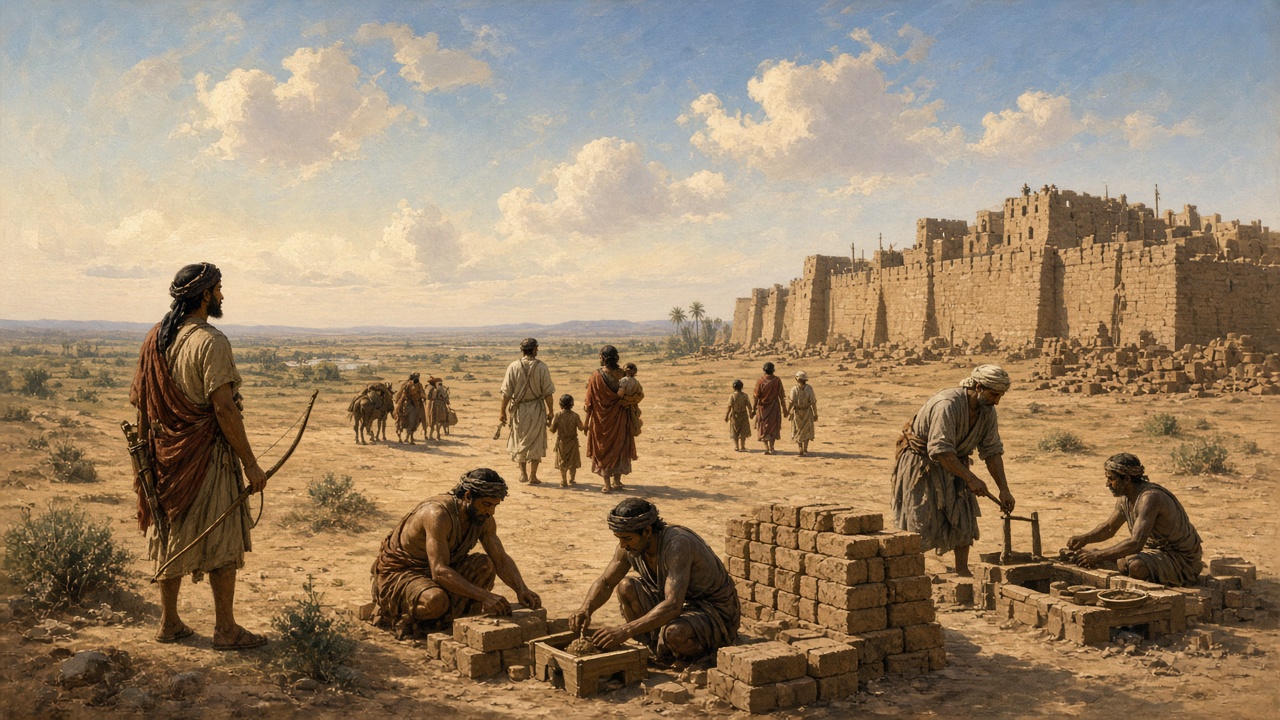
- Cush, a son of Ham, was the father of Nimrod, remembered as a mighty hunter before the Lord, whose kingdom began at Babylon, Erech, Accad, and Calneh in the land of Shinar, probably Babylonia or southern Mesopotamia. From that land he went into Assyria and built Nineveh, Rehoboth-Ir, Calah, and Resen; Calah’s site is probably the Nimrud ruins on the left bank of the Tigris.Sources: the Bible text itself · Shinar · Nineveh · Calah
- Mizraim, the dual form of a Hebrew word for a mound or fortress, may point to Upper and Lower Egypt and is the name the Hebrews usually gave that country; Arabic still calls it Muzr. Shem is called the older brother of Japheth and the forefather of all the sons of Eber, regarded as the founder of the Hebrew people, while an Arab tradition remembers Eber’s son Joktan, Kahtan in Arabic, as the ancestor of tribes of central and southern Arabia.Sources: the Bible text itself · Mizraim · Eber (Heber) · Joktan
Notes written with AI assistance from open sources (Theographic Bible Metadata, CC BY-SA 4.0; Easton’s Bible Dictionary, public domain) and reviewed before publishing.
Places in this chapter
- Erech · Today: Uruk · 31.322, 45.636 · verse 10
- Shinar · Today: Babylonia · 32.543, 44.422 · verse 10
- Assyria · 36.359, 43.153 · verse 11
- Calah · Today: Nimrud · 36.098, 43.329 · verses 11, 12
- Nineveh · 36.359, 43.153 · verses 11, 12
- Canaan · 32.767, 35.333 · verse 19
- Gaza · Today: Tell Harube · 31.504, 34.464 · verse 19
- Sidon · Today: Sandikli archaeological site in Sidon · 33.561, 35.372 · verse 19
Only places identified with high confidence are shown (90% or more according to the scholarly sources compiled by OpenBible). Period map: DARE (Digital Atlas of the Roman Empire), CC BY 4.0; modern map: © OpenStreetMap contributors; places: OpenBible.info (CC BY 4.0).
Credits and license for this translation
Isaac Leeser Tanakh
The Isaac Leeser Tanakh (Jewish Bible)
Public Domain
Language: English
Dialect: archaic British
Translation by: Isaac Leeser
2020-10-14
Section headings adapted from the Berean Standard Bible (public domain); they are not part of this translation’s text.
Source: http://ebible.org/englee/ · eBible.org