Deuteronomy 20
Isaac Leeser Tanakh · Tap a verse to see its cross-references.
Laws of Warfare
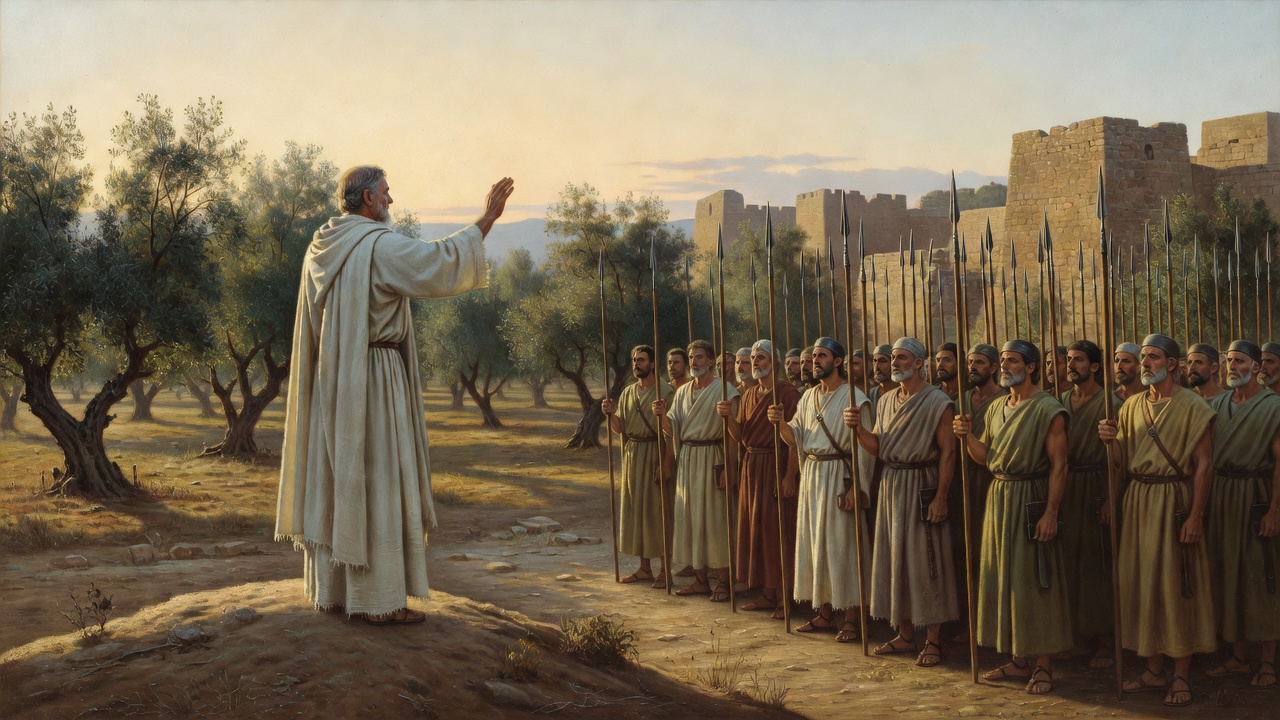
1When thou goest out to battle against thy enemies, and thou seest horse, and chariot, people more in number than thou: be not afraid of them; for the Lord thy God is with thee, who brought thee up out of the land of Egypt. 2And it shall be, when ye come nigh unto the battle, that the priest shall approach and speak unto the people; 3And he shall say unto them, Hear, O Israel, ye come nigh this day unto the battle against your enemies: let not your hearts faint, fear not, and be not downcast, and do not tremble because of them: 4For the Lord your God it is who goeth with you, to fight for you against your enemies, to help you. 5And the officers shall speak unto the people, saying, What man is there who hath built a new house, and hath not dedicated it? let him go and return unto his house, lest he die in the battle, and another man dedicate it. 6And what man is there who hath planted a vineyard, and hath not redeemed it? let him go and return unto his house, lest he die in the battle, and another man redeem it. 7And what man is there that hath betrothed a wife, and hath not taken her? let him go and return unto his house, lest he die in the battle, and another man take her. 8And the officers shall speak yet farther unto the people, and they shall say, What man is there that is fearful and faint-hearted? let him go and return unto his house, that the heart of his brethren become not as faint as his heart. 9And it shall be, when the officers have made an end of speaking unto the people, that they shall appoint captains of the armies at the head of the people. 10When thou comest nigh unto a city to make war against it, then summon it with words of peace. 11And it shall be, if it make thee an answer of peace, and open [its gates] unto thee: then shall it be, that all the people that are found therein shall be tributaries unto thee, and they shall serve thee. 12But if it will not make peace with thee, and wageth war against thee; then shalt thou besiege it; 13And when the Lord thy God hath delivered it into thy hands, thou shalt smite every male thereof with the edge of the sword; 14But the women, and the little ones, and the cattle, and all that may be in the city, all the spoil thereof, shalt thou take as booty unto thyself; and thou shalt enjoy the spoil of thy enemies, which the Lord thy God hath given thee. 15Thus shalt thou do unto all the cities which are very far off from thee, which are not of the cities of these nations. 16But of the cities of these people, which the Lord thy God doth give thee for an inheritance, shalt thou not let live a single soul. 17But thou shalt utterly devote them; namely, the Hittites, and the Emorites, the Canaanites, and the Perizzites, and the Hivites, and the Jebusites; as the Lord thy God hath commanded thee; 18In order that they may not teach you to do in accordance with all their abominations, which they have done unto their gods; and ye would thus sin against the Lord your God. 19When thou besiegest a city a long time, to make war against it to capture it, thou shalt not destroy the trees thereof by forcing an axe against them; for of them thou mayest eat, and thou shalt not cut them down, [for man liveth of the trees of the field,] to employ them in thy siege; 20Only those trees of which thou knowest that they are not fruit-trees, thou mayest destroy and cut down; and [thus] thou canst build bulwarks against the city that wageth war with thee, until it be subdued.
Did you know?
Laws Concerning Warfare
- Before entering combat, Israelite officers announced specific exemptions from military duty, releasing men who had built a house not yet dedicated, planted a vineyard not yet harvested, become engaged to be married, or felt afraid.Sources: the Bible text itself
- The law established different warfare policies for distant cities compared to cities within the Promised Land; distant cities were first offered terms of peace, whereas the inhabitants of nearby nations were marked for complete destruction to avoid idolatry.Sources: the Bible text itself
- During long sieges, Israelite forces were forbidden from cutting down fruit-bearing trees to construct siege works, limiting their timber harvesting only to trees known not to produce food.Sources: the Bible text itself
Notes written with AI assistance from open sources (Theographic Bible Metadata, CC BY-SA 4.0; Easton’s Bible Dictionary, public domain) and reviewed before publishing.
Places in this chapter
- Egypt · 30.129, 31.308 · verse 1
Only places identified with high confidence are shown (90% or more according to the scholarly sources compiled by OpenBible). Period map: DARE (Digital Atlas of the Roman Empire), CC BY 4.0; modern map: © OpenStreetMap contributors; places: OpenBible.info (CC BY 4.0).
Credits and license for this translation
Isaac Leeser Tanakh
The Isaac Leeser Tanakh (Jewish Bible)
Public Domain
Language: English
Dialect: archaic British
Translation by: Isaac Leeser
2020-10-14
Section headings adapted from the Berean Standard Bible (public domain); they are not part of this translation’s text.
Source: http://ebible.org/englee/ · eBible.org