Psalms 79
JPS TaNaKH 1917 · Tap a verse to see its cross-references.
A Prayer for Deliverance
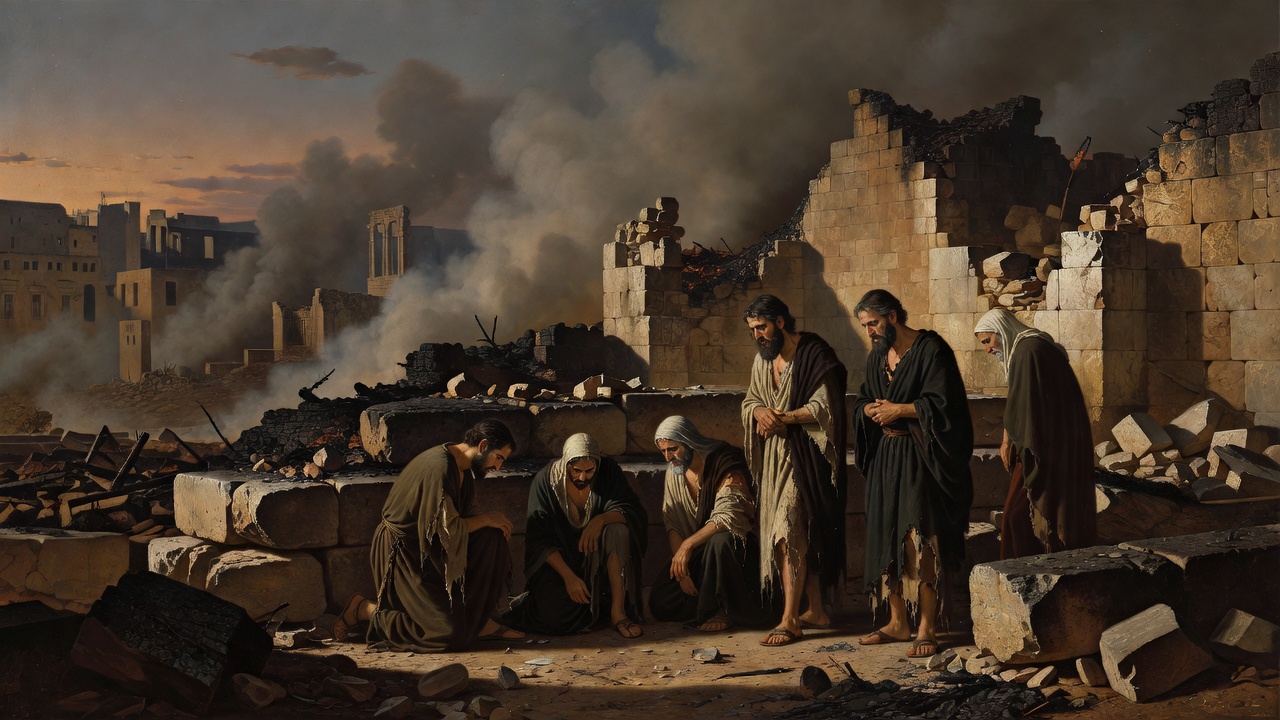
1A Psalm of Asaph. O God, the heathen are come into Thine inheritance; they have defiled Thy holy temple; they have made Jerusalem into heaps. 2They have given the dead bodies of Thy servants to be food unto the fowls of the heaven, the flesh of Thy saints unto the beasts of the earth. 3They have shed their blood like water round about Jerusalem, with none to bury them. 4We are become a taunt to our neighbours, a scorn and derision to them that are round about us. 5How long, O LORD, wilt Thou be angry for ever? How long will Thy jealousy burn like fire? 6Pour out Thy wrath upon the nations that know Thee not, and upon the kingdoms that call not upon Thy name. 7For they have devoured Jacob, and laid waste his habitation. 8Remember not against us the iniquities of our forefathers; let Thy compassions speedily come to meet us; for we are brought very low. 9Help us, O God of our salvation, for the sake of the glory of Thy name; and deliver us, and forgive our sins, for Thy name's sake. 10Wherefore should the nations say: 'Where is their God?' Let the avenging of Thy servants' blood that is shed be made known among the nations in our sight. 11Let the groaning of the prisoner come before Thee; according to the greatness of Thy power set free those that are appointed to death; 12And render unto our neighbours sevenfold into their bosom their reproach, wherewith they have reproached Thee, O Lord. 13So we that are Thy people and the flock of Thy pasture will give Thee thanks for ever; we will tell of Thy praise to all generations.
Did you know?
A Lament over the Destruction of Jerusalem
- Psalm 79 is titled a psalm of Asaph, placing it among a collection of psalms (Psalms 50 and 73–83) associated with the Levite musician and seer Asaph. In the biblical record, the title may also refer to the sons of Asaph, a recognized guild of temple singers and poets.Sources: Asaph (Levite) · the Bible text itself
- The psalm laments the defilement of the holy temple, the destruction of Jerusalem into rubble, and the unburied bodies left throughout the city. Jerusalem, known as the holy city and a mountain fastness, is portrayed here as having suffered devastating invasion by surrounding nations.Sources: Jerusalem · the Bible text itself
- The poem calls upon God for help because foreign nations have devoured Jacob and devastated his homeland. In biblical tradition, the name of the patriarch Jacob is frequently used as a poetic collective term for his descendants and their shared homeland.Sources: Jacob (Israel) · the Bible text itself
Notes written with AI assistance from open sources (Theographic Bible Metadata, CC BY-SA 4.0; Easton’s Bible Dictionary, public domain) and reviewed before publishing.
Places in this chapter
Only places identified with high confidence are shown (90% or more according to the scholarly sources compiled by OpenBible). Period map: DARE (Digital Atlas of the Roman Empire), CC BY 4.0; modern map: © OpenStreetMap contributors; places: OpenBible.info (CC BY 4.0).
Credits and license for this translation
JPS TaNaKH 1917
The Jewish Bible (Old Testament) in English, published by the Jewish Publication Society in 1917
Public Domain
Language: English
Dialect: American
Translation by: Jewish Publication Society
This copy of the Old JPS TaNaKH by the Jewish Publication Society is brought to you courtesy of eBible.org . For the new JPS TaNaKH (1972, 1978, 1980), please see jps.org .
2023-09-19
Section headings adapted from the Berean Standard Bible (public domain); they are not part of this translation’s text.
Source: http://ebible.org/engjps/ · eBible.org