Numbers 19
JPS TaNaKH 1917 · Tap a verse to see its cross-references.
The Red Heifer
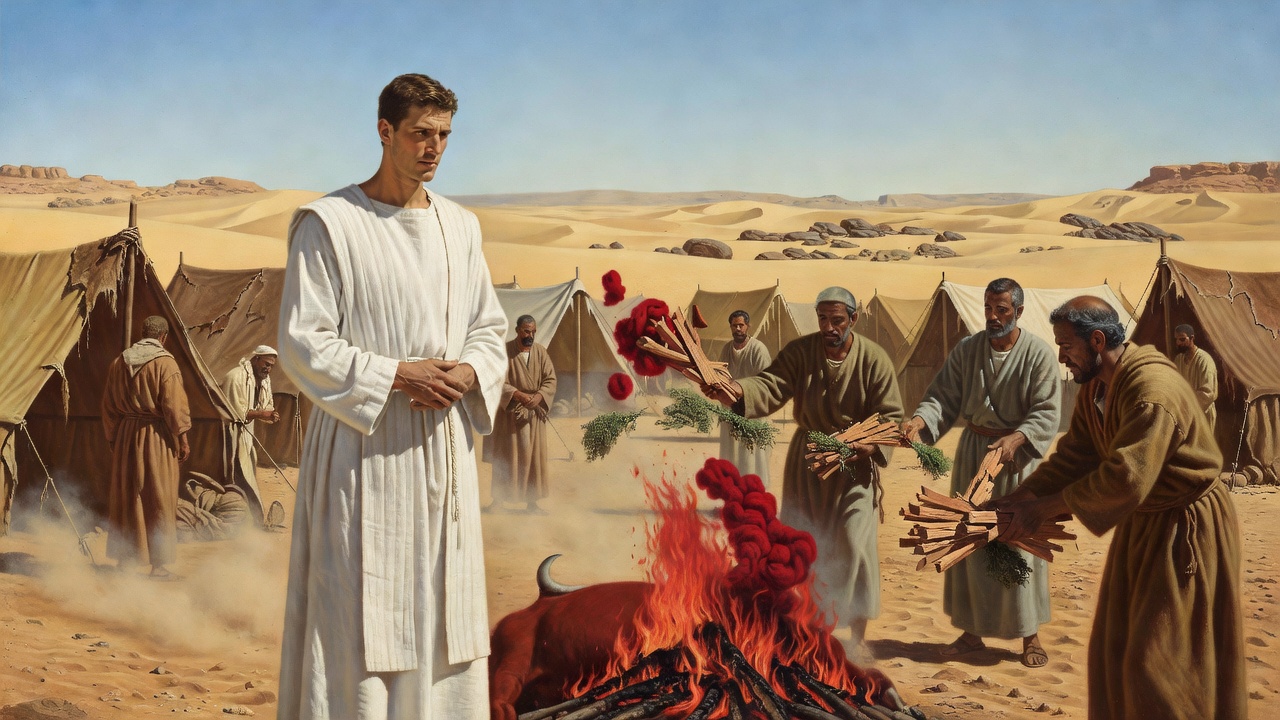
1And the LORD spoke unto Moses and unto Aaron, saying: 2This is the statute of the law which the LORD hath commanded, saying: Speak unto the children of Israel, that they bring thee a red heifer, faultless, wherein is no blemish, and upon which never came yoke. 3And ye shall give her unto Eleazar the priest, and she shall be brought forth without the camp, and she shall be slain before his face. 4And Eleazar the priest shall take of her blood with his finger, and sprinkle of her blood toward the front of the tent of meeting seven times. 5And the heifer shall be burnt in his sight; her skin, and her flesh, and her blood, with her dung, shall be burnt. 6And the priest shall take cedar-wood, and hyssop, and scarlet, and cast it into the midst of the burning of the heifer. 7Then the priest shall wash his clothes, and he shall bathe his flesh in water, and afterward he may come into the camp, and the priest shall be unclean until the even. 8And he that burneth her shall wash his clothes in water, and bathe his flesh in water, and shall be unclean until the even. 9And a man that is clean shall gather up the ashes of the heifer, and lay them up without the camp in a clean place, and it shall be kept for the congregation of the children of Israel for a water of sprinkling; it is a purification from sin. 10And he that gathereth the ashes of the heifer shall wash his clothes, and be unclean until the even; and it shall be unto the children of Israel, and unto the stranger that sojourneth among them, for a statute for ever.
Purification of the Unclean
11He that toucheth the dead, even any man's dead body, shall be unclean seven days; 12the same shall purify himself therewith on the third day and on the seventh day, and he shall be clean; but if he purify not himself the third day and the seventh day, he shall not be clean. 13Whosoever toucheth the dead, even the body of any man that is dead, and purifieth not himself — he hath defiled the tabernacle of the LORD — that soul shall be cut off from Israel; because the water of sprinkling was not dashed against him, he shall be unclean; his uncleanness is yet upon him. 14This is the law: when a man dieth in a tent, every one that cometh into the tent, and every thing that is in the tent, shall be unclean seven days. 15And every open vessel, which hath no covering close-bound upon it, is unclean. 16And whosoever in the open field toucheth one that is slain with a sword, or one that dieth of himself, or a bone of a man, or a grave, shall be unclean seven days. 17And for the unclean they shall take of the ashes of the burning of the purification from sin, and running water shall be put thereto in a vessel. 18And a clean person shall take hyssop, and dip it in the water, and sprinkle it upon the tent, and upon all the vessels, and upon the persons that were there, and upon him that touched the bone, or the slain, or the dead, or the grave. 19And the clean person shall sprinkle upon the unclean on the third day, and on the seventh day; and on the seventh day he shall purify him; and he shall wash his clothes, and bathe himself in water, and shall be clean at even. 20But the man that shall be unclean, and shall not purify himself, that soul shall be cut off from the midst of the assembly, because he hath defiled the sanctuary of the LORD; the water of sprinkling hath not been dashed against him: he is unclean. 21And it shall be a perpetual statute unto them; and he that sprinkleth the water of sprinkling shall wash his clothes; and he that toucheth the water of sprinkling shall be unclean until even. 22And whatsoever the unclean person toucheth shall be unclean; and the soul that toucheth him shall be unclean until even.
Did you know?
The Red Heifer and Purification from Death
- Unlike typical sacrifices offered at the tabernacle altar, the unblemished red heifer that had never worn a yoke was taken outside the camp. There it was slaughtered in the presence of the priest Eleazar and burned whole along with cedar wood, hyssop, and scarlet wool.Sources: the Bible text itself · Eleazar
- The ashes of the heifer were stored outside the camp to prepare the water of purification. Paradoxically, while this mixture purified individuals who were defiled by death, everyone who handled the burning heifer, gathered its ashes, or sprinkled the water became temporarily unclean until evening.Sources: the Bible text itself
- Contact with a corpse, a human bone, a grave, or merely being inside a tent where someone died caused seven days of ceremonial uncleanness. To be restored, the person had to be sprinkled with the purification water on the third and seventh days and wash their clothes and body.Sources: the Bible text itself
Notes written with AI assistance from open sources (Theographic Bible Metadata, CC BY-SA 4.0; Easton’s Bible Dictionary, public domain) and reviewed before publishing.
Credits and license for this translation
JPS TaNaKH 1917
The Jewish Bible (Old Testament) in English, published by the Jewish Publication Society in 1917
Public Domain
Language: English
Dialect: American
Translation by: Jewish Publication Society
This copy of the Old JPS TaNaKH by the Jewish Publication Society is brought to you courtesy of eBible.org . For the new JPS TaNaKH (1972, 1978, 1980), please see jps.org .
2023-09-19
Section headings adapted from the Berean Standard Bible (public domain); they are not part of this translation’s text.
Source: http://ebible.org/engjps/ · eBible.org