Job 5
JPS TaNaKH 1917 · Tap a verse to see its cross-references.
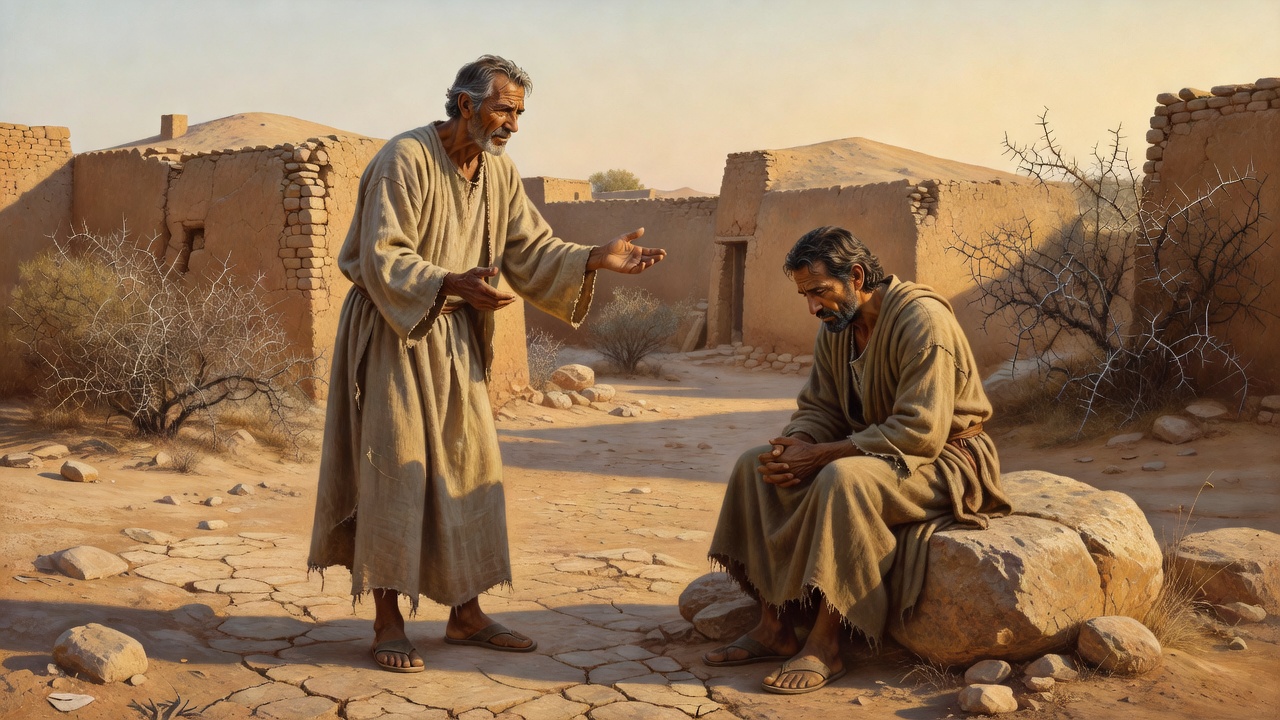
Eliphaz Continues: God Blesses those Who Seek Him
1Call now; is there any that will answer thee? And to which of the holy ones wilt thou turn? 2For anger killeth the foolish man, and envy slayeth the silly one. 3I have seen the foolish taking root; but suddenly I beheld his habitation cursed. 4His children are far from safety, and are crushed in the gate, with none to deliver them. 5Whose harvest the hungry eateth up, and taketh it even out of the thorns, and the snare gapeth for their substance. 6For affliction cometh not forth from the dust, neither doth trouble spring out of the ground; 7But man is born unto trouble, as the sparks fly upward. 8But as for me, I would seek unto God, and unto God would I commit my cause; 9Who doeth great things and unsearchable, marvellous things without number; 10Who giveth rain upon the earth, and sendeth waters upon the fields; 11So that He setteth up on high those that are low, and those that mourn are exalted to safety. 12He frustrateth the devices of the crafty, so that their hands can perform nothing substantial. 13He taketh the wise in their own craftiness; and the counsel of the wily is carried headlong. 14They meet with darkness in the day-time, and grope at noonday as in the night. 15But He saveth from the sword of their mouth, even the needy from the hand of the mighty. 16So the poor hath hope, and iniquity stoppeth her mouth. 17Behold, happy is the man whom God correcteth; therefore despise not thou the chastening of the Almighty. 18For He maketh sore, and bindeth up; He woundeth, and His hands make whole. 19He will deliver thee in six troubles; yea, in seven there shall no evil touch thee. 20In famine He will redeem thee from death; and in war from the power of the sword. 21Thou shalt be hid from the scourge of the tongue; neither shalt thou be afraid of destruction when it cometh. 22At destruction and famine thou shalt laugh; neither shalt thou be afraid of the beasts of the earth. 23For thou shalt be in league with the stones of the field; and the beasts of the field shall be at peace with thee. 24And thou shalt know that thy tent is in peace; and thou shalt visit thy habitation, and shalt miss nothing. 25Thou shalt know also that thy seed shall be great, and thine offspring as the grass of the earth. 26Thou shalt come to thy grave in a ripe age, like as a shock of corn cometh in in its season. 27Lo this, we have searched it, so it is; hear it, and know thou it for thy good.
Did you know?
Eliphaz's Counsel on Suffering and Divine Correction
- Eliphaz portrays suffering as purposeful divine discipline rather than arbitrary misfortune, asserting that trouble does not arise without cause from the soil. He urges Job not to despise the correction of the Almighty, who wounds only to heal and restore.Sources: the Bible text itself
- In promising deliverance from six calamities and even seven, Eliphaz employs a traditional poetic formula known as graded numerical parallelism. This rhetorical pattern, common in ancient Near Eastern wisdom poetry, builds emphasis to express comprehensive and complete protection.Sources: the Bible text itself
- Eliphaz describes ultimate restoration in vivid agricultural and pastoral terms, depicting a life where wild beasts and stony soil cease to be hostile. He envisions a peaceful death occurring in full vigor, likened to a sheaf of grain harvested at the proper season.Sources: the Bible text itself
Notes written with AI assistance from open sources (Theographic Bible Metadata, CC BY-SA 4.0; Easton’s Bible Dictionary, public domain) and reviewed before publishing.
Credits and license for this translation
JPS TaNaKH 1917
The Jewish Bible (Old Testament) in English, published by the Jewish Publication Society in 1917
Public Domain
Language: English
Dialect: American
Translation by: Jewish Publication Society
This copy of the Old JPS TaNaKH by the Jewish Publication Society is brought to you courtesy of eBible.org . For the new JPS TaNaKH (1972, 1978, 1980), please see jps.org .
2023-09-19
Section headings adapted from the Berean Standard Bible (public domain); they are not part of this translation’s text.
Source: http://ebible.org/engjps/ · eBible.org