Job 31
JPS TaNaKH 1917 · Tap a verse to see its cross-references.
Job’s Final Appeal
1I made a covenant with mine eyes; how then should I look upon a maid? 2For what would be the portion of God from above, and the heritage of the Almighty from on high? 3Is it not calamity to the unrighteous, and disaster to the workers of iniquity? 4Doth not He see my ways, and count all my steps? 5If I have walked with vanity, and my foot hath hasted to deceit — 6Let me be weighed in a just balance, that God may know mine integrity — 7If my step hath turned out of the way, and my heart walked after mine eyes, and if any spot hath cleaved to my hands; 8Then let me sow, and let another eat; yea, let the produce of my field be rooted out. 9If my heart have been enticed unto a woman, and I have lain in wait at my neighbour's door; 10Then let my wife grind unto another, and let others bow down upon her. 11For that were a heinous crime; yea, it were an iniquity to be punished by the judges. 12For it is a fire that consumeth unto destruction, and would root out all mine increase. 13If I did despise the cause of my man-servant, or of my maid-servant, when they contended with me — 14What then shall I do when God riseth up? And when He remembereth, what shall I answer Him? 15Did not He that made me in the womb make him? And did not One fashion us in the womb? 16If I have withheld aught that the poor desired, or have caused the eyes of the widow to fail; 17Or have eaten my morsel myself alone, and the fatherless hath not eaten thereof — 18Nay, from my youth he grew up with me as with a father, and I have been her guide from my mother's womb. 19If I have seen any wanderer in want of clothing, or that the needy had no covering; 20If his loins have not blessed me, and if he were not warmed with the fleece of my sheep; 21If I have lifted up my hand against the fatherless, because I saw my help in the gate; 22Then let my shoulder fall from the shoulder-blade, and mine arm be broken from the bone. 23For calamity from God was a terror to me, and by reason of His majesty I could do nothing. 24If I have made gold my hope, and have said to the fine gold: 'Thou art my confidence'; 25If I rejoiced because my wealth was great, and because my hand had gotten much; 26If I beheld the sun when it shined, or the moon walking in brightness; 27And my heart hath been secretly enticed, and my mouth hath kissed my hand; 28This also were an iniquity to be punished by the judges; for I should have lied to God that is above. 29If I rejoiced at the destruction of him that hated me, or exulted when evil found him — 30Yea, I suffered not my mouth to sin by asking his life with a curse. 31If the men of my tent said not: 'Who can find one that hath not been satisfied with his meat?' 32The stranger did not lodge in the street; my doors I opened to the roadside. 33If after the manner of men I covered my transgressions, by hiding mine iniquity in my bosom — 34Because I feared the great multitude, and the most contemptible among families terrified me, so that I kept silence, and went not out of the door. 35Oh that I had one to hear me! — Lo, here is my signature, let the Almighty answer me — and that I had the indictment which mine adversary hath written! 36Surely I would carry it upon my shoulder; I would bind it unto me as a crown. 37I would declare unto him the number of my steps; as a prince would I go near unto him. 38If my land cry out against me, and the furrows thereof weep together; 39If I have eaten the fruits thereof without money, or have caused the tillers thereof to be disappointed — 40Let thistles grow instead of wheat, and noisome weeds instead of barley. The words of Job are ended.
Did you know?
Job's Final Oath of Innocence
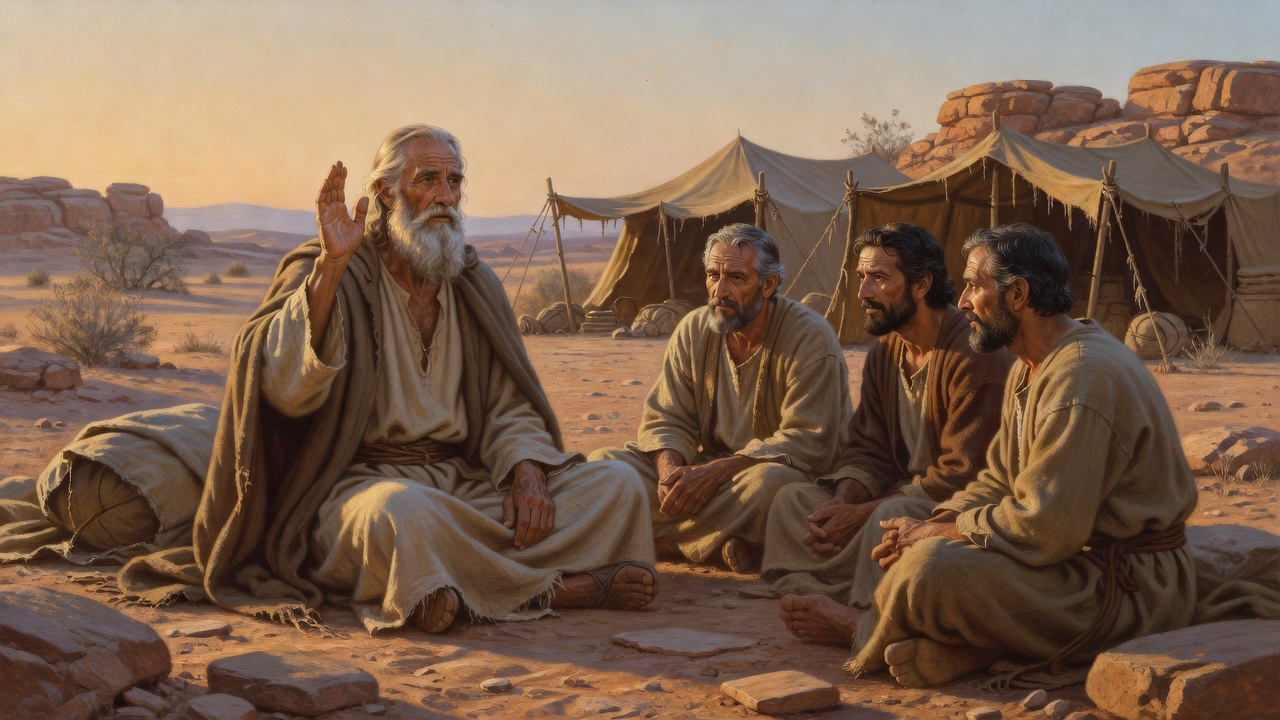
- Job frames his defense using a series of conditional self-curses, swearing that if he has committed specific moral or social sins, severe punishments should fall upon him. His ethical code extends beyond external deeds to internal motives, demanding fairness even for his servants because both master and slave were formed by the same God in the womb.Sources: the Bible text itself
- Job disavows the ancient practice of throwing a kiss with his hand toward the radiant sun or the moon in splendor. In the ancient Near East, kissing one's hand toward celestial bodies was a widespread form of astral worship, which Job regards as an offense that denies God on high.Sources: the Bible text itself
- The chapter marks the conclusion of Job's speeches with a formal legal appeal. He presents his written mark or signature, asking the Almighty to answer him and declaring that he would proudly carry any formal indictment on his shoulder like a crown, approaching God with the dignity of a prince.Sources: the Bible text itself · Job
Notes written with AI assistance from open sources (Theographic Bible Metadata, CC BY-SA 4.0; Easton’s Bible Dictionary, public domain) and reviewed before publishing.
Credits and license for this translation
JPS TaNaKH 1917
The Jewish Bible (Old Testament) in English, published by the Jewish Publication Society in 1917
Public Domain
Language: English
Dialect: American
Translation by: Jewish Publication Society
This copy of the Old JPS TaNaKH by the Jewish Publication Society is brought to you courtesy of eBible.org . For the new JPS TaNaKH (1972, 1978, 1980), please see jps.org .
2023-09-19
Section headings adapted from the Berean Standard Bible (public domain); they are not part of this translation’s text.
Source: http://ebible.org/engjps/ · eBible.org