Genesis 8
JPS TaNaKH 1917 · Tap a verse to see its cross-references.
The Ark Rests on Ararat
1And God remembered Noah, and every living thing, and all the cattle that were with him in the ark; and God made a wind to pass over the earth, and the waters assuaged; 2the fountains also of the deep and the windows of heaven were stopped, and the rain from heaven was restrained. 3And the waters returned from off the earth continually; and after the end of a hundred and fifty days the waters decreased. 4And the ark rested in the seventh month, on the seventeenth day of the month, upon the mountains of Ararat. 5And the waters decreased continually until the tenth month; in the tenth month, on the first day of the month, were the tops of the mountains seen.
Noah Sends a Raven and a Dove
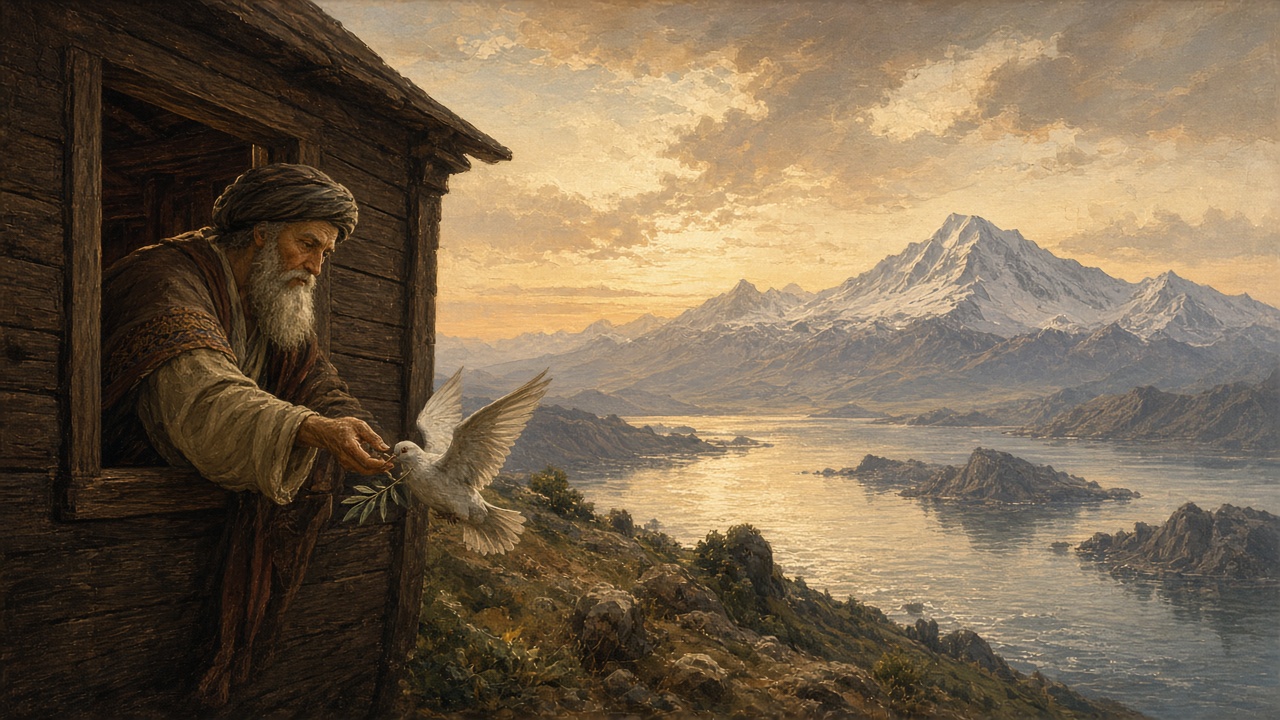
6And it came to pass at the end of forty days, that Noah opened the window of the ark which he had made. 7And he sent forth a raven, and it went forth to and fro, until the waters were dried up from off the earth. 8And he sent forth a dove from him, to see if the waters were abated from off the face of the ground. 9But the dove found no rest for the sole of her foot, and she returned unto him to the ark, for the waters were on the face of the whole earth; and he put forth his hand, and took her, and brought her in unto him into the ark. 10And he stayed yet other seven days; and again he sent forth the dove out of the ark. 11And the dove came in to him at eventide; and lo in her mouth an olive-leaf freshly plucked; so Noah knew that the waters were abated from off the earth. 12And he stayed yet other seven days; and sent forth the dove; and she returned not again unto him any more.
Exiting the Ark
13And it came to pass in the six hundred and first year, in the first month, the first day of the month, the waters were dried up from off the earth; and Noah removed the covering of the ark, and looked, and behold, the face of the ground was dried. 14And in the second month, on the seven and twentieth day of the month, was the earth dry. 15And God spoke unto Noah, saying: 16'Go forth from the ark, thou, and thy wife, and thy sons, and thy sons' wives with thee. 17Bring forth with thee every living thing that is with thee of all flesh, both fowl, and cattle, and every creeping thing that creepeth upon the earth; that they may swarm in the earth, and be fruitful, and multiply upon the earth.' 18And Noah went forth, and his sons, and his wife, and his sons' wives with him; 19every beast, every creeping thing, and every fowl, whatsoever moveth upon the earth, after their families; went forth out of the ark.
Noah Builds an Altar
20And Noah builded an altar unto the LORD; and took of every clean beast, and of every clean fowl, and offered burnt-offerings on the altar. 21And the LORD smelled the sweet savour; and the LORD said in His heart: 'I will not again curse the ground any more for man's sake; for the imagination of man's heart is evil from his youth; neither will I again smite any more every thing living, as I have done. 22While the earth remaineth, seedtime and harvest, and cold and heat, and summer and winter, and day and night shall not cease.'
Did you know?
The Waters Recede
- The ark came to rest on the mountains of Ararat, a name meaning “sacred land” or “high land” for a country on whose mountains the ark settled after the flood. Easton's Bible Dictionary (1897) suggests those mountains were probably the Kurdish range of southern Armenia, though the name is also commonly applied to a high, almost inaccessible peak rising from the plain of the Araxes. In 2 Kings 19:37 and Isaiah 37:38 the Authorized Version renders the name “Armenia” and the Revised Version “land of Ararat,” while Jeremiah 51:27 uses it for central or southern Armenia.Sources: Ararat · the Bible text itself
- Noah’s Hebrew name means “rest,” and in this chapter the ark itself comes to rest as the waters go down. He was the son of Lamech and the grandson of Methuselah, and the father of Shem, Ham, and Japheth. Easton's Bible Dictionary describes him as the connecting link between the old world and the new, and as a second great progenitor of the human family.Sources: Noah · the Bible text itself
- Chronological notes place the Great Flood in 2347 BC, lasting one year; the subsiding of the waters in 2346 BC, over 220 days; and the leaving of the ark in 2346 BC, as a single day. In the chapter itself, the waters have gone down after 150 days and the ark rests on the seventeenth day of the seventh month; on the first day of the first month of Noah’s six hundred and first year the waters have dried up, and by the twenty-seventh day of the second month the earth is fully dry.Sources: The Great Flood · The flood subsides · Leaving the Ark · the Bible text itself
Notes written with AI assistance from open sources (Theographic Bible Metadata, CC BY-SA 4.0; Easton’s Bible Dictionary, public domain) and reviewed before publishing.
Places in this chapter
- Ararat · Today: Urartu · 39.703, 44.300 · verse 4
Only places identified with high confidence are shown (90% or more according to the scholarly sources compiled by OpenBible). Period map: DARE (Digital Atlas of the Roman Empire), CC BY 4.0; modern map: © OpenStreetMap contributors; places: OpenBible.info (CC BY 4.0).
Credits and license for this translation
JPS TaNaKH 1917
The Jewish Bible (Old Testament) in English, published by the Jewish Publication Society in 1917
Public Domain
Language: English
Dialect: American
Translation by: Jewish Publication Society
This copy of the Old JPS TaNaKH by the Jewish Publication Society is brought to you courtesy of eBible.org . For the new JPS TaNaKH (1972, 1978, 1980), please see jps.org .
2023-09-19
Section headings adapted from the Berean Standard Bible (public domain); they are not part of this translation’s text.
Source: http://ebible.org/engjps/ · eBible.org