Exodus 8
JPS TaNaKH 1917 · Tap a verse to see its cross-references.
The Second Plague: Frogs
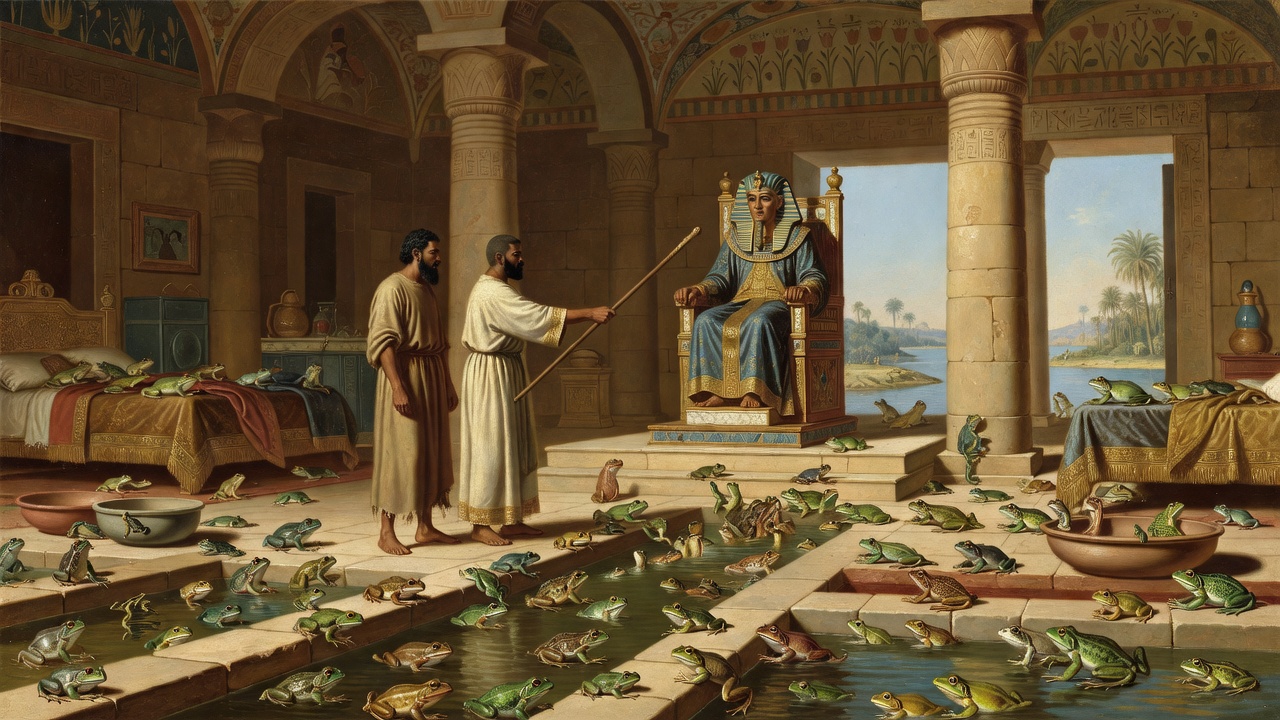
1(7-26) And the LORD spoke unto Moses: 'Go in unto Pharaoh, and say unto him: Thus saith the LORD: Let My people go, that they may serve Me. 2(7-27) And if thou refuse to let them go, behold, I will smite all thy borders with frogs. 3(7-28) And the river shall swarm with frogs, which shall go up and come into thy house, and into thy bed-chamber, and upon thy bed, and into the house of thy servants, and upon thy people, and into thine ovens, and into thy kneading-troughs. 4(7-29) And the frogs shall come up both upon thee, and upon thy people, and upon all thy servants.' 5(8-1) And the LORD said unto Moses: 'Say unto Aaron: Stretch forth thy hand with thy rod over the rivers, over the canals, and over the pools, and cause frogs to come up upon the land of Egypt.' 6(8-2) And Aaron stretched out his hand over the waters of Egypt; and the frogs came up, and covered the land of Egypt. 7(8-3) And the magicians did in like manner with their secret arts, and brought up frogs upon the land of Egypt. 8(8-4) Then Pharaoh called for Moses and Aaron, and said: 'Entreat the LORD, that He take away the frogs from me, and from my people; and I will let the people go, that they may sacrifice unto the LORD.' 9(8-5) And Moses said unto Pharaoh: 'Have thou this glory over me; against what time shall I entreat for thee, and for thy servants, and for thy people, that the frogs be destroyed from thee and thy houses, and remain in the river only?' 10(8-6) And he said: 'Against to-morrow.' And he said: 'Be it according to thy word; that thou mayest know that there is none like unto the LORD our God. 11(8-7) And the frogs shall depart from thee, and from thy houses, and from thy servants, and from thy people; they shall remain in the river only.' 12(8-8) And Moses and Aaron went out from Pharaoh; and Moses cried unto the LORD concerning the frogs, which He had brought upon Pharaoh. 13(8-9) And the LORD did according to the word of Moses; and the frogs died out of the houses, out of the courts, and out of the fields. 14(8-10) And they gathered them together in heaps; and the land stank. 15(8-11) But when Pharaoh saw that there was respite, he hardened his heart, and hearkened not unto them; as the LORD had spoken.
The Third Plague: Gnats
16(8-12) And the LORD said unto Moses: 'Say unto Aaron: Stretch out thy rod, and smite the dust of the earth, that it may become gnats throughout all the land of Egypt.' 17(8-13) And they did so; and Aaron stretched out his hand with his rod, and smote the dust of the earth, and there were gnats upon man, and upon beast; all the dust of the earth became gnats throughout all the land of Egypt. 18(8-14) And the magicians did so with their secret arts to bring forth gnats, but they could not; and there were gnats upon man, and upon beast. 19(8-15) Then the magicians said unto Pharaoh: 'This is the finger of God'; and Pharaoh's heart was hardened, and he hearkened not unto them; as the LORD had spoken.
The Fourth Plague: Flies
20(8-16) And the LORD said unto Moses: 'Rise up early in the morning, and stand before Pharaoh; lo, he cometh forth to the water; and say unto him: Thus saith the LORD: Let My people go, that they may serve Me. 21(8-17) Else, if thou wilt not let My people go, behold, I will send swarms of flies upon thee, and upon thy servants, and upon thy people, and into thy houses; and the houses of the Egyptians shall be full of swarms of flies, and also the ground whereon they are. 22(8-18) And I will set apart in that day the land of Goshen, in which My people dwell, that no swarms of flies shall be there; to the end that thou mayest know that I am the LORD in the midst of the earth. 23(8-19) And I will put a division between My people and thy people — by to-morrow shall this sign be.' 24(8-20) And the LORD did so; and there came grievous swarms of flies into the house of Pharaoh, and into his servants' houses; and in all the land of Egypt the land was ruined by reason of the swarms of flies. 25(8-21) And Pharaoh called for Moses and for Aaron, and said: 'Go ye, sacrifice to your God in the land.' 26(8-22) And Moses said: 'It is not meet so to do; for we shall sacrifice the abomination of the Egyptians to the LORD our God; lo, if we sacrifice the abomination of the Egyptians before their eyes, will they not stone us? 27(8-23) We will go three days' journey into the wilderness, and sacrifice to the LORD our God, as He shall command us.' 28(8-24) And Pharaoh said: 'I will let you go, that ye may sacrifice to the LORD your God in the wilderness; only ye shall not go very far away; entreat for me.' 29(8-25) And Moses said: 'Behold, I go out from thee, and I will entreat the LORD that the swarms of flies may depart from Pharaoh, from his servants, and from his people, tomorrow; only let not Pharaoh deal deceitfully any more in not letting the people go to sacrifice to the LORD.' 30(8-26) And Moses went out from Pharaoh, and entreated the LORD. 31(8-27) And the LORD did according to the word of Moses; and He removed the swarms of flies from Pharaoh, from his servants, and from his people; there remained not one. 32(8-28) And Pharaoh hardened his heart this time also, and he did not let the people go.
Did you know?
Three Plagues on Egypt
- The frogs of this chapter swarm up from the Nile, a name the Old Testament does not use. Easton's Bible Dictionary says the river appears as Sihor, “the black stream,” or simply “the river,” and that the White Nile and the Blue Nile unite at Khartoum, then run 1,800 miles and enter the Mediterranean through two branches. Aaron stretches his staff over the rivers, canals, and ponds, and the frogs cover the land of Egypt.Sources: Nile · the Bible text itself
- When flies fill the houses of the Egyptians and ruin the land, the chapter says none will be found in Goshen, where the Israelites live, as a distinction between the two peoples. Easton's Bible Dictionary describes Goshen as a district east of the Nile, apparently not far from the royal residence, also called the land of Rameses because Pithom and Rameses lay within its borders, and it also links the district with Zoan, or Tanis. The same entry calls it “the best of the land.”Sources: Goshen · the Bible text itself
- Moses and Aaron speak with Pharaoh in person. Easton's Bible Dictionary (1897) places the Pharaoh of the Exodus at Zoan, the setting of his interviews with them recorded in Exodus, but leaves his identity an open question between Menephtah, called there the fourteenth and eldest surviving son of Rameses II, and Seti II, adding that some think the evidence favors Seti II.Sources: Pharaoh (of the Exodus) · the Bible text itself
Notes written with AI assistance from open sources (Theographic Bible Metadata, CC BY-SA 4.0; Easton’s Bible Dictionary, public domain) and reviewed before publishing.
Places in this chapter
- Nile · Today: Nile River · 31.465, 30.367 · verses 3, 9, 11
- Egypt · 30.129, 31.308 · verses 5, 6, 7, 16, 17, 21, 24
- Goshen · Today: Goshen 1 · 30.799, 31.834 · verse 22
Only places identified with high confidence are shown (90% or more according to the scholarly sources compiled by OpenBible). Period map: DARE (Digital Atlas of the Roman Empire), CC BY 4.0; modern map: © OpenStreetMap contributors; places: OpenBible.info (CC BY 4.0).
Credits and license for this translation
JPS TaNaKH 1917
The Jewish Bible (Old Testament) in English, published by the Jewish Publication Society in 1917
Public Domain
Language: English
Dialect: American
Translation by: Jewish Publication Society
This copy of the Old JPS TaNaKH by the Jewish Publication Society is brought to you courtesy of eBible.org . For the new JPS TaNaKH (1972, 1978, 1980), please see jps.org .
2023-09-19
Section headings adapted from the Berean Standard Bible (public domain); they are not part of this translation’s text.
Source: http://ebible.org/engjps/ · eBible.org