Song of Songs 2
Geneva Bible 1599 · Tap a verse to see its cross-references.
The Bride’s Admiration
The Bride
1I am the rose of the fielde, and the lilie of the valleys.
The Bridegroom
2Like a lilie amog the thornes, so is my loue among the daughters.
The Bride
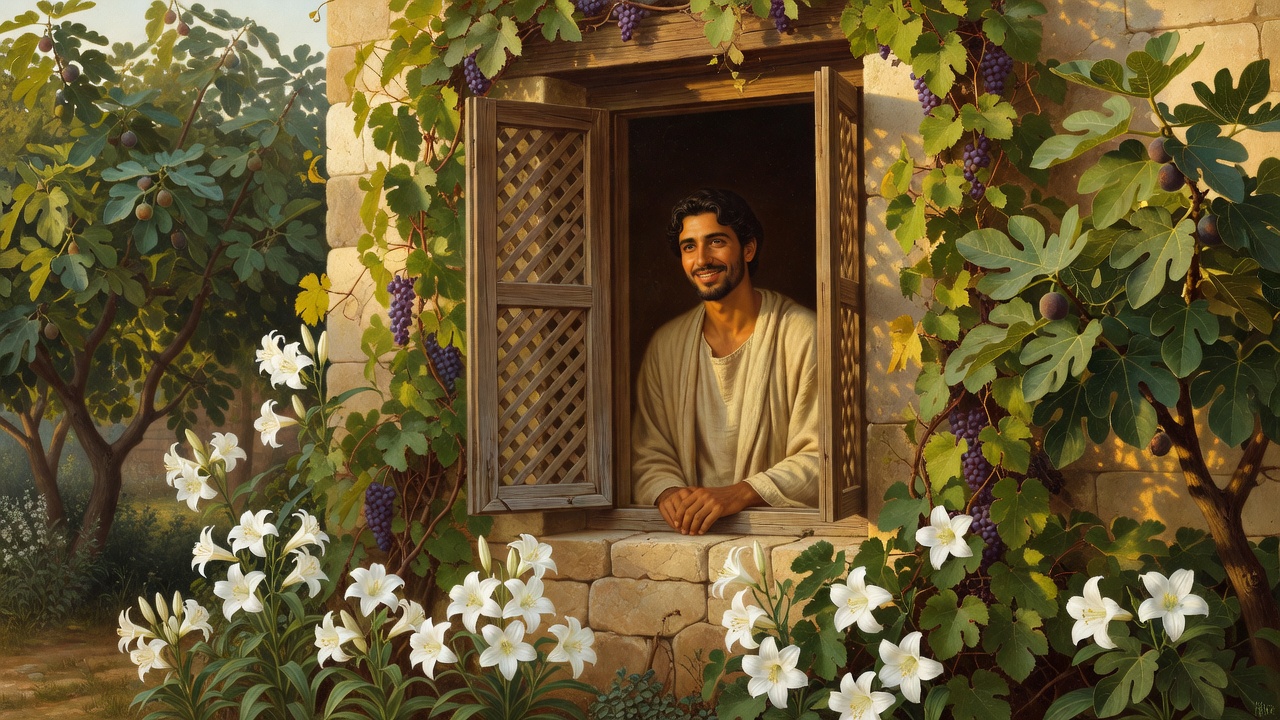
3Like the apple tree among the trees of the forest, so is my welbeloued among the sonnes of men: vnder his shadow had I delite, and sate downe: and his fruite was sweete vnto my mouth. 4Hee brought mee into the wine cellar, and loue was his banner ouer me. 5Stay me with flagons, and comfort me with apples: for I am sicke of loue. 6His left hande is vnder mine head, and his right hand doeth imbrace me. 7I charge you, O daughters of Ierusalem, by the roes and by the hindes of the fielde, that ye stirre not vp, nor waken my loue, vntill she please. 8It is the voyce of my welbeloued: beholde, hee commeth leaping by the mountaines, and skipping by the hilles. 9My welbeloued is like a roe, or a yong hart: loe, he standeth behinde our wall, looking forth of the windowes, shewing him selfe through the grates. 10My welbeloued spake and said vnto me, Arise, my loue, my faire one, and come thy way. 11For beholde, winter is past: the raine is changed, and is gone away. 12The flowers appeare in the earth: the time of the singing of birdes is come, and the voyce of the turtle is heard in our land. 13The figtree hath brought foorth her yong figges: and the vines with their small grapes haue cast a sauour: arise my loue, my faire one, and come away.
The Bridegroom
14My doue, that art in the holes of ye rocke, in the secret places of the staires, shewe mee thy sight, let mee heare thy voyce: for thy voyce is sweete, and thy sight comely.
The Friends
15Take vs the foxes, the little foxes, which destroy the vines: for our vines haue small grapes.
The Bride
16My welbeloued is mine, and I am his: hee feedeth among the lilies, 17Vntil the day breake, and the shadowes flee away: returne, my welbeloued, and be like a roe, or a yong hart vpon the mountaines of Bether.
Did you know?
Springtime and Awakening Love
- Sharon was a fertile coastal plain stretching between the Mediterranean Sea and the hill country west of Jerusalem, celebrated for its beauty and vegetation, which gave rise to imagery like the rose of Sharon.Sources: Saron · the Bible text itself
- The poem marks the arrival of spring through natural changes in the countryside, such as the end of winter rains, the cooing of turtledoves, ripening fig trees, and flowering grapevines that needed protection from foraging foxes.Sources: the Bible text itself
- The speaker repeatedly appeals to the daughters of Jerusalem, framing her cautions about love around wild animals of the open hills, such as gazelles and does of the field.Sources: Jerusalem · the Bible text itself
Notes written with AI assistance from open sources (Theographic Bible Metadata, CC BY-SA 4.0; Easton’s Bible Dictionary, public domain) and reviewed before publishing.
Places in this chapter
Only places identified with high confidence are shown (90% or more according to the scholarly sources compiled by OpenBible). Period map: DARE (Digital Atlas of the Roman Empire), CC BY 4.0; modern map: © OpenStreetMap contributors; places: OpenBible.info (CC BY 4.0).
Credits and license for this translation
Geneva Bible 1599
The Geneva Bible in Old English of 1599
Public Domain
Language: English
Dialect: Old
This digital copy is freely available world-wide, with no copyright restrictions, courtesy of eBible.org and many others. Note that the spelling used is the original spelling, which is not modern English.
2024-03-16
Section headings adapted from the Berean Standard Bible (public domain); they are not part of this translation’s text.
Source: http://ebible.org/enggnv/ · eBible.org