Numbers 19
Free Bible Version · Tap a verse to see its cross-references.
The Red Heifer
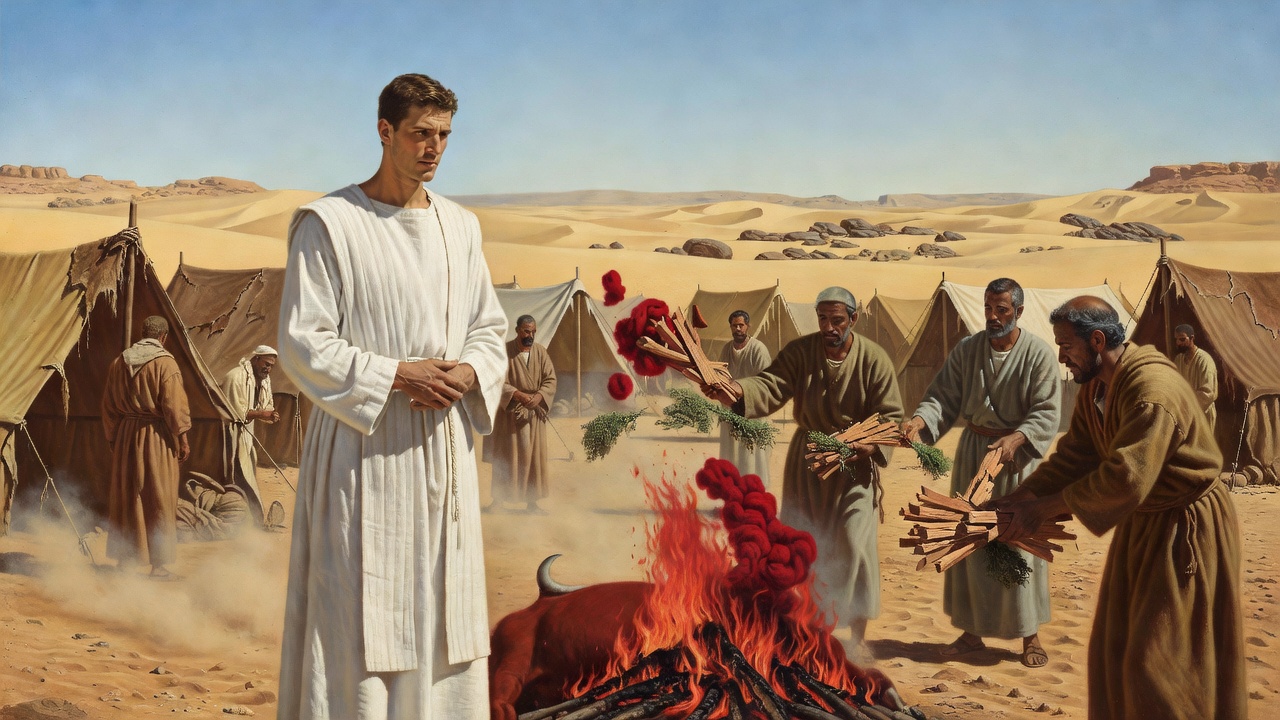
1The Lord told Moses and Aaron, 2“This is a legal regulation the Lord has ordered, saying, Tell the Israelites to bring you a red cow without defects which has never been yoked. 3Hand it over to Eleazar the priest, and he will take it outside the camp and have it slaughtered before him. 4Eleazar the priest will put some of its blood on his finger and sprinkle it seven times towards the entrance of the Tent of Meeting. 5Then the cow must be burned as he watches. All of it is to be burned—its skin, meat, and blood, as well as its excrement. 6The priest shall throw cedar wood, hyssop, and crimson thread on the burning cow.
7Then the priest shall wash his clothes and his body in water, and after that he may enter the camp, but he will remain unclean until the evening. 8The person who burned the cow shall also wash his clothes and his body in water, and he too will remain unclean until the evening.
9Then a man who is clean shall collect the ashes of the cow and keep them in a clean place outside the camp. They are to be kept by the Israelites to prepare the water of purification which is for purifying from sin. 10The man who collected the ashes of the cow shall also wash his clothes, and he will remain unclean until the evening. This is a permanent rule for the Israelites and for the foreigner that lives with them.
Purification of the Unclean
11If you touch a dead body you will be unclean for seven days. 12You must purify yourself with the water of purification on the third day and on the seventh day, and then you will be clean. But if you don't purify yourself on the third and seventh days, you won't be clean. 13If you touch a dead body and don't purify yourself, you make the Tabernacle of the Lord unclean and must be expelled from Israel. You are still unclean because the water of purification hasn't been sprinkled on you, and your uncleanness remains.
14The following regulation applies when a person dies in a tent. Everyone who comes into the tent and everyone who is already in the tent will be unclean for seven days. 15Any open container there that doesn't have a closed lid is unclean. 16If you're out in the open and you touch someone who has been killed by the sword or who has died naturally, or if you touch a human bone or a grave, then you'll be unclean for seven days.
17This is the process for the purification if you are unclean. Take some of the ashes of the burnt offering for purification, and put them in a jar with fresh water. 18A man who is clean shall take some hyssop and dip it in the water. Then sprinkle the tent and everything inside it, and everybody who was there. He would also need to sprinkle you if you touched a bone, or a grave, or someone who has died or has been killed.
19The man who is clean is to sprinkle you both on the third day and on the seventh day. After you are purified on the seventh day, you must wash your clothes and yourself in water, and that evening you'll be clean. 20But if you don't purify yourself, you will be expelled from the Israelites, because you have made the Tabernacle of the Lord unclean. The water of purification hasn't been sprinkled on you, and you remain unclean. 21This is a permanent rule for everyone. The man who sprinkles the water of purification must wash his clothes, and anyone who touches the water of purification will be unclean until the evening. 22Anything the unclean person touches will be unclean, and anyone who touches it will be unclean until the evening.”
Did you know?
The Red Heifer and Purification from Death
- Unlike typical sacrifices offered at the tabernacle altar, the unblemished red heifer that had never worn a yoke was taken outside the camp. There it was slaughtered in the presence of the priest Eleazar and burned whole along with cedar wood, hyssop, and scarlet wool.Sources: the Bible text itself · Eleazar
- The ashes of the heifer were stored outside the camp to prepare the water of purification. Paradoxically, while this mixture purified individuals who were defiled by death, everyone who handled the burning heifer, gathered its ashes, or sprinkled the water became temporarily unclean until evening.Sources: the Bible text itself
- Contact with a corpse, a human bone, a grave, or merely being inside a tent where someone died caused seven days of ceremonial uncleanness. To be restored, the person had to be sprinkled with the purification water on the third and seventh days and wash their clothes and body.Sources: the Bible text itself
Notes written with AI assistance from open sources (Theographic Bible Metadata, CC BY-SA 4.0; Easton’s Bible Dictionary, public domain) and reviewed before publishing.
Credits and license for this translation
Free Bible Version
The New Testament and Psalms in the Free Bible Version translation in American English
Copyright © 2018 Dr. Jonathan Gallagher
Language: English
Dialect: American
Translation by: Dr. Jonathan Gallagher
This translation is made available to you under the terms of the
Creative Commons Attribution Share-Alike license 4.0.
You have permission to share and redistribute this Bible translation in any format and to make reasonable revisions and adaptations of this translation, provided that:
You include the above copyright and source information.
If you make any changes to the text, you must indicate that you did so in a way that makes it clear that the original licensor is not necessarily endorsing your changes.
If you redistribute this text, you must distribute your contributions under the same license as the original.
Pictures included with Scriptures and other documents on this site are licensed just for use with those Scriptures and documents.
For other uses, please contact the respective copyright owners.
Note that in addition to the rules above, revising and adapting God's Word involves a great responsibility to be true to God's Word. See Revelation 22:18-19.
2026-10-02
Section headings adapted from the Berean Standard Bible (public domain); they are not part of this translation’s text.
Source: http://ebible.org/engfbv/ · eBible.org