Jonah 4
Free Bible Version · Tap a verse to see its cross-references.
Jonah’s Anger at the LORD’s Compassion
1But this really upset Jonah, and he became very angry. 2He prayed to the Lord and told him, “Lord, wasn't this what I said when I was back home? That's why I ran away to Tarshish in the first place! For I knew that you are a gracious and compassionate God, very patient and full of kindhearted love, who relents from sending disaster. 3So just kill me now, Lord, because I'd prefer to die than to live!”
4The Lord responded, “Do you have a good reason to be so angry?”
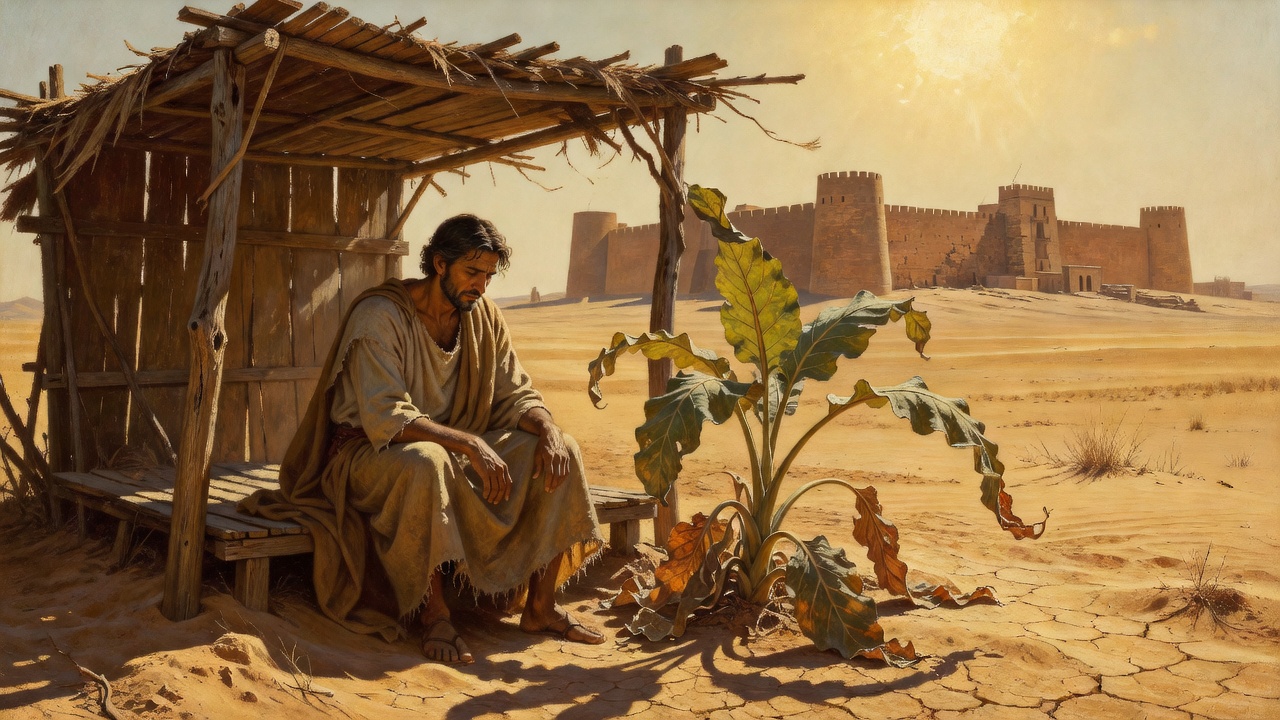
5Jonah left the city and sat down to the east of it. There he made himself a shelter so he could sit in the shade and watch what would happen to the city. 6The Lord God had a plant grow up and provide shade over Jonah's head to ease his discomfort. Jonah was very happy with the plant. 7The next day at dawn the Lord had a maggot attack the plant and it withered. 8Then as the sun came up the Lord arranged for a scorching east wind to blow, and the sun beat down on Jonah's head so that he became faint and wanted to die. “I'd rather die than live!” he said.
9But the Lord asked Jonah, “Do you have a good reason to be so angry about the plant?”
“Yes I do!” Jonah replied. “I'm angry enough to die!”
10Then the Lord told Jonah, “You're concerned about a plant which you did nothing about, and you didn't make it grow. It came up overnight and died overnight. 11Shouldn't I be concerned about the great city of Nineveh where one hundred and twenty thousand people live who don't know their right hand from their left, not to mention all the animals?”
Did you know?
Jonah's Anger and God's Compassion
- Jonah admits that he originally attempted to flee toward Tarshish precisely because he knew God is gracious, compassionate, slow to anger, and relents from sending disaster. His distress arose when God chose to spare Nineveh rather than destroy it.Sources: the Bible text itself · Tarshish
- Nineveh, the flourishing capital of the Assyrian empire, is described at the conclusion of the book as home to more than 120,000 people who cannot discern between their right and left hand, along with many cattle. God highlights this massive population to contrast divine compassion with Jonah's concern for a single withered plant.Sources: the Bible text itself · Nineveh
Notes written with AI assistance from open sources (Theographic Bible Metadata, CC BY-SA 4.0; Easton’s Bible Dictionary, public domain) and reviewed before publishing.
Places in this chapter
- Nineveh · 36.359, 43.153 · verse 11
Only places identified with high confidence are shown (90% or more according to the scholarly sources compiled by OpenBible). Period map: DARE (Digital Atlas of the Roman Empire), CC BY 4.0; modern map: © OpenStreetMap contributors; places: OpenBible.info (CC BY 4.0).
Credits and license for this translation
Free Bible Version
The New Testament and Psalms in the Free Bible Version translation in American English
Copyright © 2018 Dr. Jonathan Gallagher
Language: English
Dialect: American
Translation by: Dr. Jonathan Gallagher
This translation is made available to you under the terms of the
Creative Commons Attribution Share-Alike license 4.0.
You have permission to share and redistribute this Bible translation in any format and to make reasonable revisions and adaptations of this translation, provided that:
You include the above copyright and source information.
If you make any changes to the text, you must indicate that you did so in a way that makes it clear that the original licensor is not necessarily endorsing your changes.
If you redistribute this text, you must distribute your contributions under the same license as the original.
Pictures included with Scriptures and other documents on this site are licensed just for use with those Scriptures and documents.
For other uses, please contact the respective copyright owners.
Note that in addition to the rules above, revising and adapting God's Word involves a great responsibility to be true to God's Word. See Revelation 22:18-19.
2026-10-02
Section headings adapted from the Berean Standard Bible (public domain); they are not part of this translation’s text.
Source: http://ebible.org/engfbv/ · eBible.org