Job 4
Free Bible Version · Tap a verse to see its cross-references.
Eliphaz: The Innocent Prosper
1Then Eliphaz the Temanite answered Job. 2“Could I say a word? I don't want to upset you but who could keep quiet and not respond? 3You've certainly encouraged many people and supported those who are weak. 4Your advice has helped those who are stumbling not to fall, and you have strengthened those whose knees are weak. 5But now you're the one suffering and you're upset. 6Wasn't it your reverence for God that gave you confidence and your integrity that gave you hope? 7Think about it: since when did the innocent die? Since when were good people destroyed? 8From what I've seen it's those who plant evil and sow trouble who reap the same! 9A breath from God destroys them; a blast of his anger wipes them out. 10Lions may roar and growl, but their teeth still break. 11Even a lion dies from lack of food, and the lioness' cubs are scattered.
12A word quietly crept up on me; a whisper reached my ear. 13Troubling thoughts came to me in nightmares when you fall into a deep sleep. 14I became terrified and trembled; all my bones were shaking. 15Then a breath brushed my face and gave me goose-pimples. 16Something stopped, but I couldn't see its face. My eyes could only make out a shape. It was totally quiet, and then I heard a voice: 17‘Can anyone be right before God? Can anyone be pure before their Maker? 18If he doesn't even trust his servants, and he says his angels make mistakes, 19how much more does this apply to those who live in these houses made of clay, whose foundations are based on dust, who fall apart like clothing to a moth? 20Alive in the morning, they are dead by evening. They die, unnoticed. 21They are like tent ropes that are pulled up, and they collapse in death. They die without wisdom.’”
Did you know?
Eliphaz's First Speech
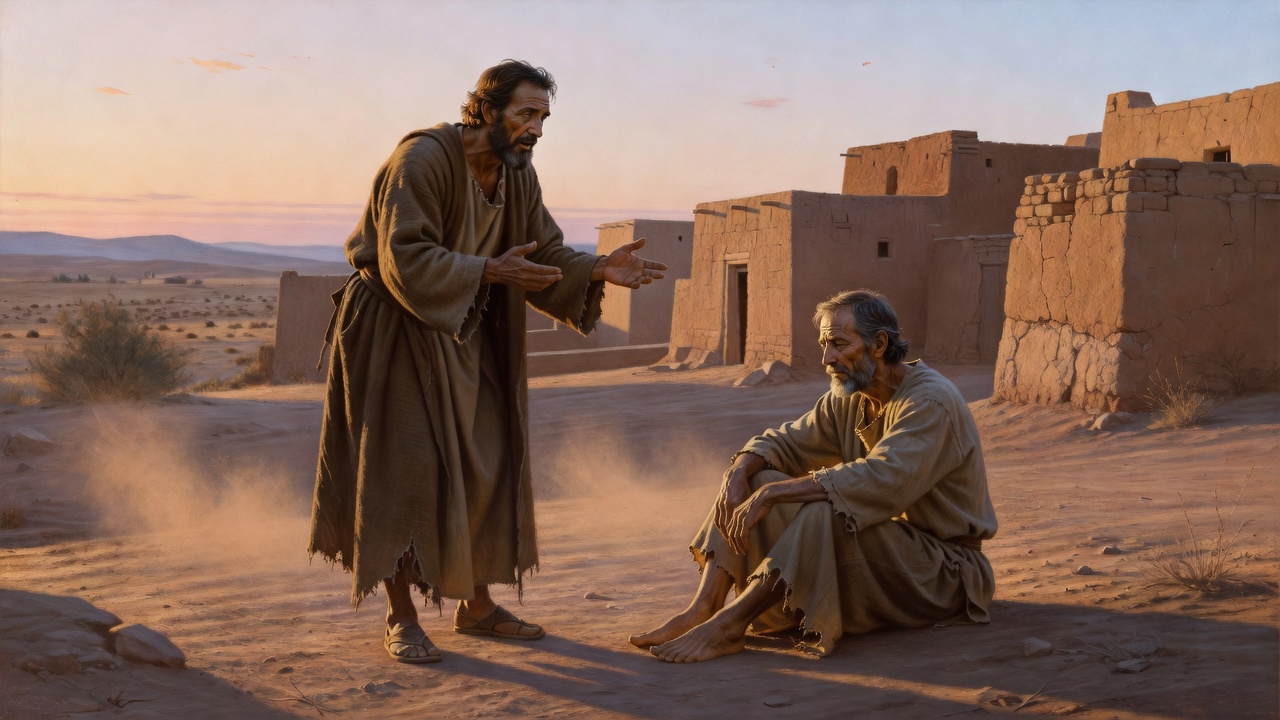
- Eliphaz the Temanite is the first of Job's companions to respond, breaking their week of silence. He acknowledges Job's past reputation for comforting and strengthening the distressed before questioning why Job cannot apply that same endurance to his own suffering.Sources: the Bible text itself · Eliphaz
- Eliphaz introduces the traditional principle of retribution, arguing that the innocent never perish and that individuals reap what they sow in life.Sources: the Bible text itself
- To support his theological claim, Eliphaz describes a chilling night vision where a mysterious spirit stood before him in the dark, declaring that fragile mortals dwelling in houses of clay cannot be more righteous or pure than their Maker.Sources: the Bible text itself
Notes written with AI assistance from open sources (Theographic Bible Metadata, CC BY-SA 4.0; Easton’s Bible Dictionary, public domain) and reviewed before publishing.
Credits and license for this translation
Free Bible Version
The New Testament and Psalms in the Free Bible Version translation in American English
Copyright © 2018 Dr. Jonathan Gallagher
Language: English
Dialect: American
Translation by: Dr. Jonathan Gallagher
This translation is made available to you under the terms of the
Creative Commons Attribution Share-Alike license 4.0.
You have permission to share and redistribute this Bible translation in any format and to make reasonable revisions and adaptations of this translation, provided that:
You include the above copyright and source information.
If you make any changes to the text, you must indicate that you did so in a way that makes it clear that the original licensor is not necessarily endorsing your changes.
If you redistribute this text, you must distribute your contributions under the same license as the original.
Pictures included with Scriptures and other documents on this site are licensed just for use with those Scriptures and documents.
For other uses, please contact the respective copyright owners.
Note that in addition to the rules above, revising and adapting God's Word involves a great responsibility to be true to God's Word. See Revelation 22:18-19.
2026-10-02
Section headings adapted from the Berean Standard Bible (public domain); they are not part of this translation’s text.
Source: http://ebible.org/engfbv/ · eBible.org