Hosea 6
Free Bible Version · Tap a verse to see its cross-references.
The Unrepentance of Israel and Judah
1“Come on! Let's go back to the Lord. He has torn us to pieces, but now he will heal us. He has struck us down, but now he will bind up our wounds. 2In two days he will heal us; after three days he will raise us up so we can live in his presence. 3Let's get to know the Lord, really strive to know him, and he will appear to us as surely as the sun will rise; he will come to us as certainly as the spring rains fall on the earth.”
4Ephraim, what shall I do with you? Judah, what shall I do with you? Your love disappears like mist at dawn; it vanishes like dew in the morning. 5So I cut you down through the prophets; I killed you with my words. My judgment shines out like a light. 6I want your true love, not your sacrifices; I want you to know me, not your burnt offerings.
7But you, just like Adam, broke our agreement; there you were unfaithful to me. 8Gilead is a city of evil people where footprints are tracked in blood. 9Priests are like a gang of bandits, lying in wait to ambush travelers on the road. They commit murder in Shechem, carrying out wicked crimes. 10I have seen in the house of Israel something totally disgusting: Ephraim engages in prostitution and Israel is sexually corrupt. 11And as for you, Judah, your harvest-time has been set! When I restore the fortunes of my people,
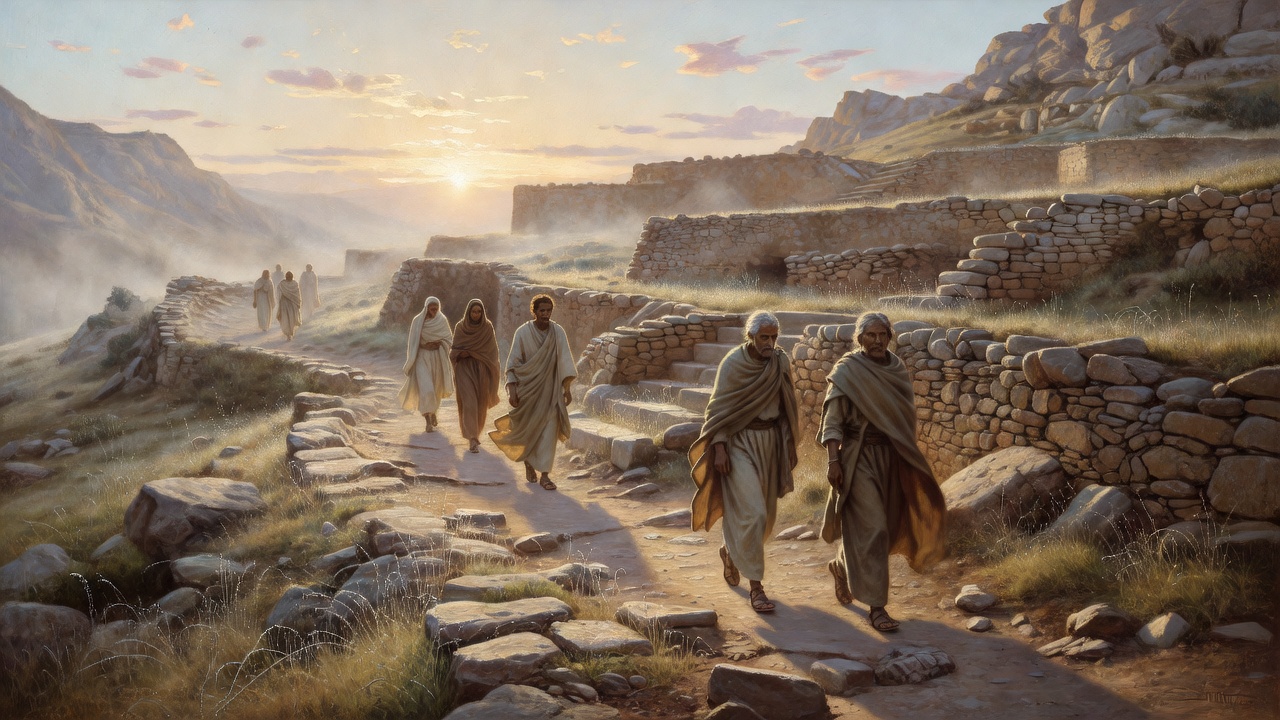
Did you know?
Fleeting Loyalty and True Devotion
- In Hosea 6:6, the prophet proclaims that God values mercy and the knowledge of God above ritual animal sacrifices and burnt offerings, emphasizing heartfelt covenant faithfulness over mere religious formalities.Sources: the Bible text itself
- The prophetic text compares the loyalty of Ephraim and Judah to morning mist and vanishing dew; Ephraim, originally named after Joseph's son for double fruitfulness, is frequently used in the book to address the northern kingdom of Israel.Sources: the Bible text itself · Ephraim
- The chapter condemns lawlessness in Gilead, a mountainous region located east of the Jordan River, and accuses corrupt bands of priests of committing violent ambushes on travelers along the road toward Shechem.Sources: the Bible text itself · Gilead
Notes written with AI assistance from open sources (Theographic Bible Metadata, CC BY-SA 4.0; Easton’s Bible Dictionary, public domain) and reviewed before publishing.
Places in this chapter
- Shechem · Today: Tell Balatah · 32.214, 35.282 · verse 9
Only places identified with high confidence are shown (90% or more according to the scholarly sources compiled by OpenBible). Period map: DARE (Digital Atlas of the Roman Empire), CC BY 4.0; modern map: © OpenStreetMap contributors; places: OpenBible.info (CC BY 4.0).
Credits and license for this translation
Free Bible Version
The New Testament and Psalms in the Free Bible Version translation in American English
Copyright © 2018 Dr. Jonathan Gallagher
Language: English
Dialect: American
Translation by: Dr. Jonathan Gallagher
This translation is made available to you under the terms of the
Creative Commons Attribution Share-Alike license 4.0.
You have permission to share and redistribute this Bible translation in any format and to make reasonable revisions and adaptations of this translation, provided that:
You include the above copyright and source information.
If you make any changes to the text, you must indicate that you did so in a way that makes it clear that the original licensor is not necessarily endorsing your changes.
If you redistribute this text, you must distribute your contributions under the same license as the original.
Pictures included with Scriptures and other documents on this site are licensed just for use with those Scriptures and documents.
For other uses, please contact the respective copyright owners.
Note that in addition to the rules above, revising and adapting God's Word involves a great responsibility to be true to God's Word. See Revelation 22:18-19.
2026-10-02
Section headings adapted from the Berean Standard Bible (public domain); they are not part of this translation’s text.
Source: http://ebible.org/engfbv/ · eBible.org