Ezekiel 48
Free Bible Version · Tap a verse to see its cross-references.
The Portions for the Tribes
1This is a list of the allocations according to the names of the tribes. At the northern frontier, Dan's allocation borders the Hethlon road to Lebo-hamath and to Hazar-enan on the border of Damascus with Hamath to the north, and extends from the eastern boundary of the country to that on the west.
2Asher's allocation borders that of Dan from east to west.
3Naphtali's allocation borders that of Asher from east to west.
4Manasseh's allocation borders that of Naphtali from east to west.
5Ephraim's allocation borders that of Manasseh from east to west.
6Reuben's allocation borders that of east to west.
7Judah's allocation borders that of Reuben from east to west.
The Portions for the Priests and Levites
8Adjacent to Judah's allocation, from east to west, is the special area you are to make provision for. It is to be 25,000 cubits wide, and extend the same length as a tribal allocation from east to west. The sanctuary will be in the middle of it.
9The special allocation you make is for the Lord and shall be 25,000 cubits by 10,000 cubits.
10This is to be the holy allocation for the priests. It will be 25,000 cubits long on the north and south sides, and 10,000 cubits wide on the west and east sides. The sanctuary will be in the middle of it. 11It is for the holy priests, descendants of Zadok, who stayed faithful and did not abandon me when the Israelites abandoned me. 12It will be a special part of the land provided for them, a most holy allocation next to that of the Levites.
13The Levites shall have an area 25,000 cubits by 10,000 cubits adjacent to the allocation of the priests. Its entire length will be 25,000 cubits, and its width 10,000 cubits. 14They are not permitted to sell exchange or transfer any of it, for it is the best part of the land, and is holy to the Lord.
The Common Portion
15The remainder, 5,000 cubits by 25,000 cubits, is for ordinary use by the city for houses and pastureland. The city will be in the middle of it, 16and this will be its measurements: 4,500 cubits on all sides, north, south, east, and west. 17The city's pastureland will surround it for 250 cubits on all sides, north, south, east, and west.
18What remains of the land bordering the holy allocation and running beside it will be 10,000 cubits on both the east side and the west side. The crops it produces will provide food for those who work in the city. 19These workers who farm the land will be from all the Israelite tribes.
20The whole allocation will be a square, 25,000 cubits by 25,000 cubits. You are to make provision for the holy allocation, together with the area for the city.
The Portion for the Prince
21The land that remains on both sides of the holy allocation and of the area for the city will belong to the prince. This land will be next to the tribal allocations and extend east from the 25,000 cubits of the holy section to the eastern border, on the other side west from the 25,000 cubits to the western border. In the middle of them will be the holy section and the Temple sanctuary.
22The Levites area and the city's area will lie in the middle of the prince's allocation, and will lie between the borders of the allocations of Judah and Benjamin.
The Portions for the Remaining Tribes
23These are the allocations for the rest of the tribes:
Benjamin's allocation extends from the eastern boundary of the country to that on the west.
24Simeon's allocation borders that of Benjamin from east to west.
25Issachar's allocation borders that of Simeon from east to west.
26Zebulun's allocation borders that of Issachar from east to west.
27Gad's allocation borders that of Zebulun from east to west.
28The southern border of Gad's allocation will be from Tamar to the waters of Meribath-kadesh, then along the Wadi of Egypt to the Mediterranean Sea. 29This is the land you are to allocate for the tribes of Israel to own and pass on as an inheritance. These are their assigned allocations, declares the Lord God.
The City Gates and Dimensions
30These are to be the city exits, starting on the north side, which is 4,500 cubits long. 31The city gates are to be named after the tribes of Israel.
There will be three gates on the north side: the gates of Reuben, Judah, and Levi.
32There will be three gates on the east side (also 4,500 cubits long): the gates of Joseph, Benjamin, and Dan.
33There will be three gates on the south side (also 4,500 cubits long): the gates of Simeon, Issachar, and Zebulun.
34There will be three gates on the west side (also 4,500 cubits long): the gate of Gad, the gate of Asher, and the gate of Naphtali.
35The distance around the outside of the city will be 18,000 cubits. From that day on the name of the city will be “The Lord Is There.”
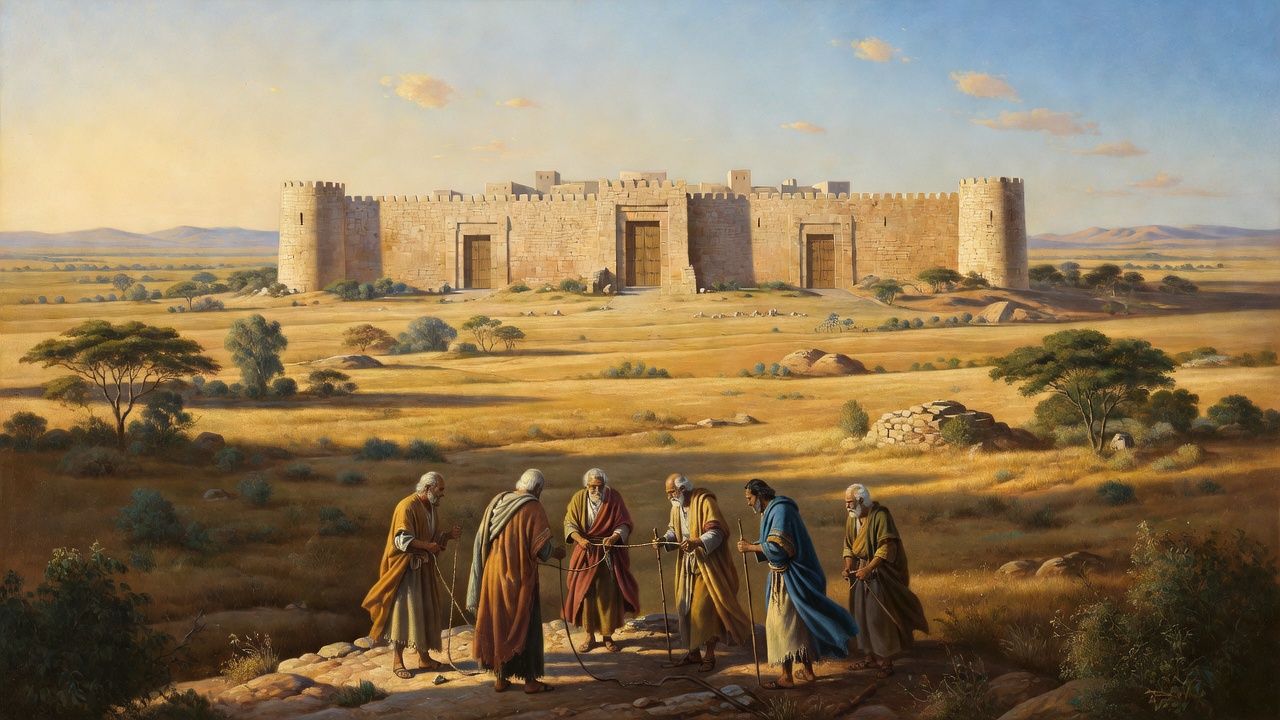
Did you know?
Division of the Land and the City of God
- The vision allocates parallel horizontal strips of land running from east to west to each of the twelve tribes, stretching from Dan in the north near Damascus and Hazar-enan to Gad in the south at Tamar and Meribath-kadesh.Sources: the Bible text itself · Damascus · Hazar-enan · Tamar
- Between the territories of Judah and Benjamin lies a designated sacred district measuring 25,000 cubits square, containing the sanctuary, land for the Zadokite priests and Levites, allotments for the prince, and a shared city cultivated by workers from all tribes.Sources: the Bible text itself
- The square city features twelve gates named after the twelve tribes of Israel—three on each of its four sides—and the prophetic book concludes with the city being given the name 'The LORD Is There.'Sources: the Bible text itself
Notes written with AI assistance from open sources (Theographic Bible Metadata, CC BY-SA 4.0; Easton’s Bible Dictionary, public domain) and reviewed before publishing.
Places in this chapter
- Damascus · 33.511, 36.306 · verse 1
- Hamath · Today: Hama · 35.136, 36.750 · verse 1
- Most Holy Place · Today: on Mount Moriah · 31.778, 35.236 · verse 12
- Great Sea · Today: Mediterranean Sea · 31.805, 34.170 · verse 28
- Meribah · Today: Ain el Qudeirat · 30.648, 34.422 · verse 28
- Negeb · 31.245, 34.841 · verse 28
- The Lord Is There · Today: Jerusalem · 31.777, 35.234 · verse 35
Only places identified with high confidence are shown (90% or more according to the scholarly sources compiled by OpenBible). Period map: DARE (Digital Atlas of the Roman Empire), CC BY 4.0; modern map: © OpenStreetMap contributors; places: OpenBible.info (CC BY 4.0).
Credits and license for this translation
Free Bible Version
The New Testament and Psalms in the Free Bible Version translation in American English
Copyright © 2018 Dr. Jonathan Gallagher
Language: English
Dialect: American
Translation by: Dr. Jonathan Gallagher
This translation is made available to you under the terms of the
Creative Commons Attribution Share-Alike license 4.0.
You have permission to share and redistribute this Bible translation in any format and to make reasonable revisions and adaptations of this translation, provided that:
You include the above copyright and source information.
If you make any changes to the text, you must indicate that you did so in a way that makes it clear that the original licensor is not necessarily endorsing your changes.
If you redistribute this text, you must distribute your contributions under the same license as the original.
Pictures included with Scriptures and other documents on this site are licensed just for use with those Scriptures and documents.
For other uses, please contact the respective copyright owners.
Note that in addition to the rules above, revising and adapting God's Word involves a great responsibility to be true to God's Word. See Revelation 22:18-19.
2026-10-02
Section headings adapted from the Berean Standard Bible (public domain); they are not part of this translation’s text.
Source: http://ebible.org/engfbv/ · eBible.org