Deuteronomy 20
Free Bible Version · Tap a verse to see its cross-references.
Laws of Warfare
1When you go to war with your enemies and you see horses and chariots, and a larger army than yours, don't be afraid of them, because the Lord your God who led you out of Egypt is with you. 2Before you go into battle, the priest shall come and speak to the army. 3He is to tell them, “Listen, men of Israel! Today you are going to fight your enemies. Don't be nervous or afraid; don't be panicked or terrified by them. 4For the Lord your God is going with you to fight for you against your enemies, and he will give you the victory.”
5The officers shall also speak to the army and tell them, “Is there any man here who has built a new house and hasn't dedicated it to the Lord? He can go home, otherwise he might die in battle and another man will dedicate it. 6Is there any man here who has planted a vineyard and hasn't yet enjoyed its fruit? He can go home, otherwise he might die in battle and another man will enjoy its fruit. 7Is there any man here who is engaged to a woman and hasn't married her? He can go home, otherwise he might die in battle and another man will marry her.”
8The officers are also to tell the army, “Is there any man here who is afraid or nervous? He can go home, so he won't affect his fellow-soldiers and make them as frightened as himself.”
9After the officers have finished speaking to the army, they are to put commanders in charge to lead it into battle.
10When you arrive at a town, ready to attack it, you must first make an offer of peace to the people living there. 11If they accept your offer of peace and open their gates to you, all the inhabitants will become your slave-laborers.
12However, if they refuse to make peace with you and decide to fight you, then lay siege to the town. 13Once the Lord your God has handed it over to you, kill every male with the sword. 14But you can take as plunder the women, children, livestock, and everything else in the town. You can take and use all your enemies' possessions the Lord your God gives you. 15This is the way you are to deal with all the towns that are a long way from you and don't belong to neighboring nations.
16However, when it comes to the towns of those nations whose land the Lord your God is giving you to occupy, don't leave anything alive that breathes. 17Set them apart for complete destruction—the Hittites, Amorites, Canaanites, Perizzites, Hivites, and Jebusites—as the Lord your God has ordered you to do. 18This is to prevent them from teaching you all the offensive things that they do in worshiping their gods, and by doing so make you sin against the Lord your God.
19Now when you lay siege to a town and it goes on for a long time as you fight to capture it, don't destroy the fruit trees there. You can eat their fruit. Don't cut them down. Are the trees in the orchard human beings that you should also attack? 20However, you may destroy the trees that you know are not fruit trees. You can use them to build siege equipment to attack the town that is fighting against you until it falls.
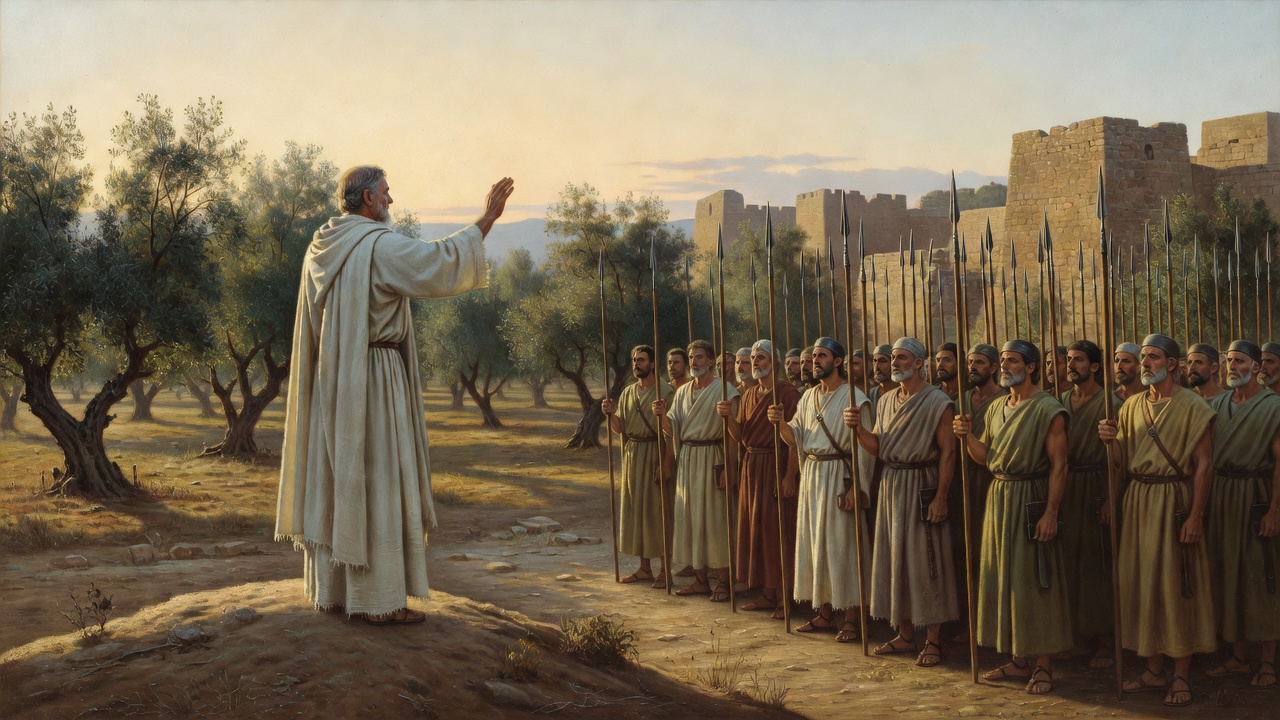
Did you know?
Laws Concerning Warfare
- Before entering combat, Israelite officers announced specific exemptions from military duty, releasing men who had built a house not yet dedicated, planted a vineyard not yet harvested, become engaged to be married, or felt afraid.Sources: the Bible text itself
- The law established different warfare policies for distant cities compared to cities within the Promised Land; distant cities were first offered terms of peace, whereas the inhabitants of nearby nations were marked for complete destruction to avoid idolatry.Sources: the Bible text itself
- During long sieges, Israelite forces were forbidden from cutting down fruit-bearing trees to construct siege works, limiting their timber harvesting only to trees known not to produce food.Sources: the Bible text itself
Notes written with AI assistance from open sources (Theographic Bible Metadata, CC BY-SA 4.0; Easton’s Bible Dictionary, public domain) and reviewed before publishing.
Places in this chapter
- Egypt · 30.129, 31.308 · verse 1
Only places identified with high confidence are shown (90% or more according to the scholarly sources compiled by OpenBible). Period map: DARE (Digital Atlas of the Roman Empire), CC BY 4.0; modern map: © OpenStreetMap contributors; places: OpenBible.info (CC BY 4.0).
Credits and license for this translation
Free Bible Version
The New Testament and Psalms in the Free Bible Version translation in American English
Copyright © 2018 Dr. Jonathan Gallagher
Language: English
Dialect: American
Translation by: Dr. Jonathan Gallagher
This translation is made available to you under the terms of the
Creative Commons Attribution Share-Alike license 4.0.
You have permission to share and redistribute this Bible translation in any format and to make reasonable revisions and adaptations of this translation, provided that:
You include the above copyright and source information.
If you make any changes to the text, you must indicate that you did so in a way that makes it clear that the original licensor is not necessarily endorsing your changes.
If you redistribute this text, you must distribute your contributions under the same license as the original.
Pictures included with Scriptures and other documents on this site are licensed just for use with those Scriptures and documents.
For other uses, please contact the respective copyright owners.
Note that in addition to the rules above, revising and adapting God's Word involves a great responsibility to be true to God's Word. See Revelation 22:18-19.
2026-10-02
Section headings adapted from the Berean Standard Bible (public domain); they are not part of this translation’s text.
Source: http://ebible.org/engfbv/ · eBible.org