2 Kings 16
Free Bible Version · Tap a verse to see its cross-references.
Ahaz Reigns in Judah
1Ahaz, son of Jotham, became king of Judah in the seventeenth year of the reign of Pekah, son of Remaliah. 2Ahaz was twenty when he became king, and he reigned in Jerusalem for sixteen years. But unlike David his forefather, he did not do what was right in the sight of the Lord his God. 3He followed the ways of the kings of Israel, and he even sacrificed his son in the fire, participating in the disgusting practices of the nations the Lord had driven out before the Israelites. 4He sacrificed and presented burnt offerings on the high places and on the hills and under every green tree.
5Rezin, king of Aram, and Pekah, son of Remaliah, king of Israel, came and attacked Jerusalem. They besieged Ahaz but couldn't defeat him. 6This was when Rezin, king of Aram, recovered Elath for Edom. He expelled the people of Judah, and sent Edomites to Elath, where they still live to this day.
7Ahaz sent messengers to Tiglath-pileser, king of Assyria, saying, “I'm your servant, and your son. Please come and rescue me from the kings of Aram and Israel who are attacking me.” 8Ahaz took the silver and gold from the Lord's Temple and from the treasuries of the king's palace, and he sent it to the king of Assyria as a gift.
9The king of Assyria responded positively to him. He went and attacked Damascus, and captured it. He deported its inhabitants to Kir and executed Rezin.
The Idolatry of Ahaz
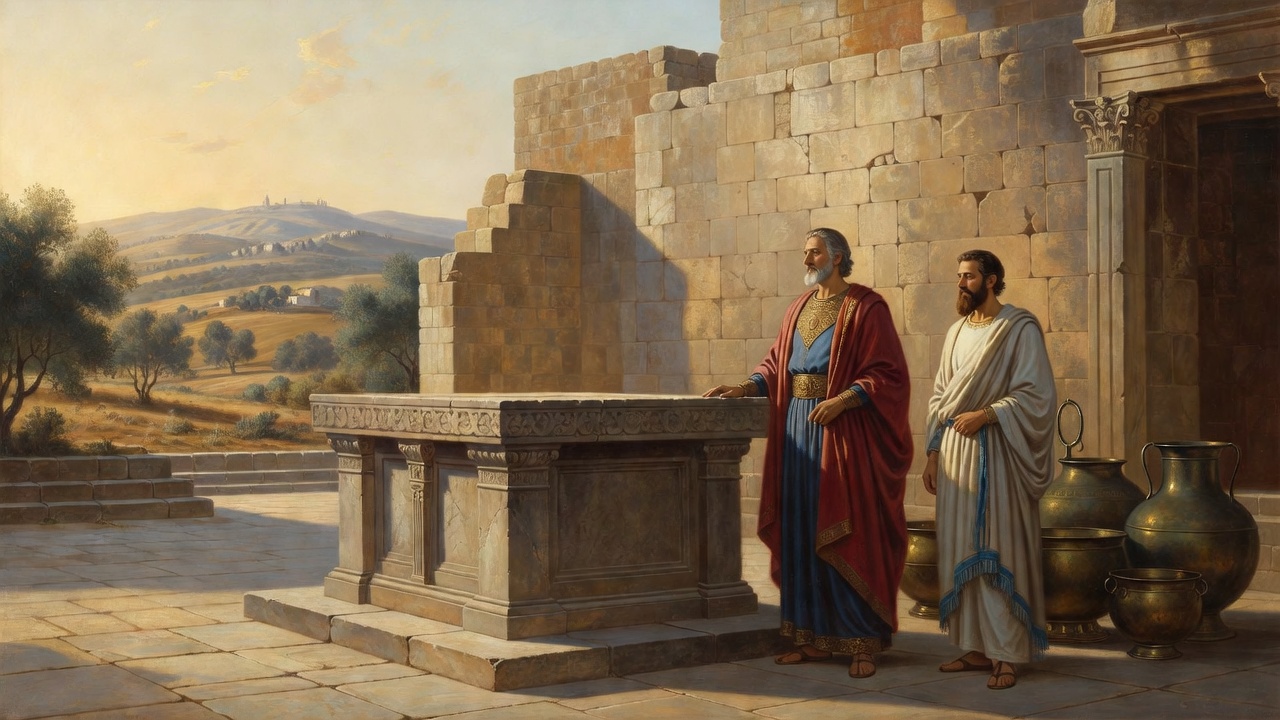
10King Ahaz went to Damascus to meet Tiglath-Pileser, king of Assyria. During his visit he saw an altar in Damascus, and he sent Uriah the priest a drawing of the altar, along with instructions how to build it. 11So Uriah the priest built an altar following all the instructions King Ahaz had sent from Damascus, completing it before King Ahaz returned.
12When the king came back from Damascus he saw the altar. He went over to it and made offerings on it. 13He presented his burnt offering and his grain offering, he poured out his drink offering, and sprinkled the blood of his friendship offerings on it. 14He also moved the bronze altar that stood before the Lord from the front of the Temple, between the new altar and the Lord's Temple, and he placed it to the north of the new altar.
15Then King Ahaz ordered Uriah the priest: “Use this new important altar to offer the morning burnt offering, the evening grain offering, the king's burnt offering and grain offering, and the burnt offering of all the people, and their grain offerings and their drink offerings. Sprinkle on this altar the blood of all the burnt offerings and sacrifices. The old bronze altar I'll use for divination.”
16Uriah the priest followed King Ahaz's orders. 17King Ahaz also removed the frames of the movable carts, and also took out the bronze basin from each of them. He removed the Sea from the bronze bulls it rested on and placed it on a stone pedestal. 18He took down the Sabbath canopy they had built in the Temple, as well as the king's outer entrance to the Lord's Temple. He did this to please the king of Assyria.
19The rest of what happened in Ahaz's reign and all he did are recorded in the Book of Chronicles of the Kings of Judah. 20Ahaz died and was buried with his forefathers in the City of David. His son Hezekiah succeeded him as king.
Did you know?
The Reign of Ahaz and the Assyrian Alliance
- Facing a military coalition led by King Rezin of Damascus and King Pekah of Israel, King Ahaz stripped silver and gold from the temple and palace treasuries to secure the intervention of Tiglath-pileser, king of Assyria. The Assyrians responded by capturing Damascus, executing Rezin, and deporting its population to Kir.Sources: the Bible text itself · Ahaz · Rezin · Kir
- While visiting Tiglath-pileser in Damascus, Ahaz was impressed by an altar there and sent detailed architectural plans to Uriah the priest in Jerusalem. Uriah constructed the replica in the temple courtyard before the king returned, where it took over the central sacrificial duties from the original bronze altar.Sources: the Bible text itself · Urijah · Damascus
Notes written with AI assistance from open sources (Theographic Bible Metadata, CC BY-SA 4.0; Easton’s Bible Dictionary, public domain) and reviewed before publishing.
Places in this chapter
- Jerusalem · 31.777, 35.234 · verses 2, 5
- Syria · Today: Aram · 33.511, 36.306 · verses 5, 6, 7
- Edom · 30.746, 35.604 · verse 6
- Assyria · 36.359, 43.153 · verses 7, 8, 9, 10, 18
- Damascus · 33.511, 36.306 · verses 9, 10, 11, 12
- City of David · 31.774, 35.236 · verse 20
Only places identified with high confidence are shown (90% or more according to the scholarly sources compiled by OpenBible). Period map: DARE (Digital Atlas of the Roman Empire), CC BY 4.0; modern map: © OpenStreetMap contributors; places: OpenBible.info (CC BY 4.0).
Credits and license for this translation
Free Bible Version
The New Testament and Psalms in the Free Bible Version translation in American English
Copyright © 2018 Dr. Jonathan Gallagher
Language: English
Dialect: American
Translation by: Dr. Jonathan Gallagher
This translation is made available to you under the terms of the
Creative Commons Attribution Share-Alike license 4.0.
You have permission to share and redistribute this Bible translation in any format and to make reasonable revisions and adaptations of this translation, provided that:
You include the above copyright and source information.
If you make any changes to the text, you must indicate that you did so in a way that makes it clear that the original licensor is not necessarily endorsing your changes.
If you redistribute this text, you must distribute your contributions under the same license as the original.
Pictures included with Scriptures and other documents on this site are licensed just for use with those Scriptures and documents.
For other uses, please contact the respective copyright owners.
Note that in addition to the rules above, revising and adapting God's Word involves a great responsibility to be true to God's Word. See Revelation 22:18-19.
2026-10-02
Section headings adapted from the Berean Standard Bible (public domain); they are not part of this translation’s text.
Source: http://ebible.org/engfbv/ · eBible.org