Acts 27
The New Testament with Commentary · Tap a verse to see its cross-references.
Paul sent to Rome
1Now when it was decided that we should sail for Italy, they delivered Paul and certain other prisoners to a centurion named Julius, of the imperial cohort. 2So we embarked in a ship of Atramytium, being about to sail to points along the Asian coast, and we put to sea; Aristarchus, a Macedonian of Thessalonica, was with us. 3The next day we landed at Sidon; Julius treated Paul kindly and permitted him to go to his friends and receive care. 4Putting to sea from there, we sailed under the lee of Cyprus, because the winds were contrary. 5And when we had sailed across the sea that is off Cilicia and Pamphylia, we landed at Myra in Lycia. 6There the centurion found a ship of Alexandria sailing for Italy and put us on board. 7When we had sailed slowly many days and scarcely arrived opposite Cnidus, the wind did not allow us to go forward, so we sailed for the lee of Crete by way of Salmone; 8sailing along it with difficulty we came to a certain place called Fair Havens, near the town of Lasea.
A difference of opinion
9Much time had been lost and sailing was already dangerous, because even the Fast had already taken place; Paul repeatedly warned them 10saying, “Men, I perceive that the voyage is about to be with damage and great loss, not only of the cargo and the ship, but even of our lives.” 11But the centurion was persuaded by the pilot and ship owner rather than by what Paul said. 12And since the harbor was not suitable to winter in, the majority advised sailing on, to see if they could get to Phoenix in order to winter, it being a harbor of Crete facing southwest and northwest.
The storm
13So when the south wind blew gently, supposing that they had obtained their purpose, they weighed anchor and sailed along Crete, close to shore. 14But not long after, a cyclonic wind blasted down from the land (it is called Euroclydon). 15Well the ship was caught and could not head into the wind, so we gave up and were driven along. 16Running under the lee of a small island called Clauda, we barely managed to secure the skiff; 17when they had hoisted it aboard, they used cables to undergird the ship; and fearing that they might fall into the Syrtis, they lowered the sea anchor and so were driven along. 18We were being so violently battered by the storm that the next day they began to jettison things, 19and on the third we threw off the ship's tackle with our own hands. 20When neither sun nor stars appeared for many days and a major storm was still pounding us, all hope that we would be saved was now taken away.
21Now after long abstinence from food, Paul stood up in the midst of them and said: “Well men, it would have been better to take my advice and not sail from Crete, only to ‘gain’ this damage and loss. 22But now I urge you to take heart, because there will be no loss of life among you, only of the ship. 23This night an angel of the God whose I am and whom I serve stood by me 24and said: ‘Do not be afraid, Paul; you must stand before Caesar. Furthermore, God has granted you all those who sail with you.’ 25So take courage, men, because I believe in God that it will be just as it was told me. 26Also, we must run aground on a certain island.”
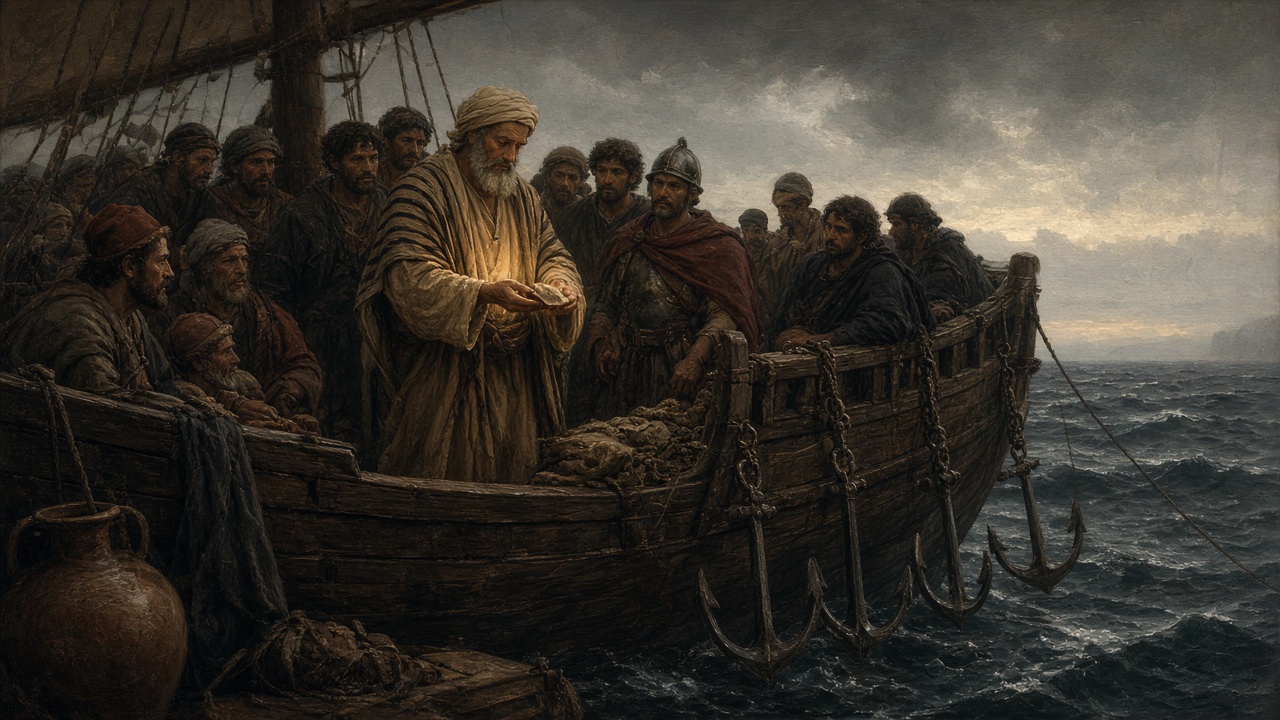
27Now when the fourteenth night had come, as we were being driven here and there in the Adriatic, about midnight the sailors sensed that they were nearing some land. 28They took a sounding and found twenty fathoms; going on a little they took a sounding again and found fifteen fathoms. 29So fearing that we might be driven into a rocky area, they dropped four anchors from the stern and started praying for day to come. 30Now under pretense of putting out anchors from the prow, the sailors lowered the skiff into the sea, intending to flee from the ship; 31so Paul said to the centurion and to the soldiers, “Unless these stay in the ship, you cannot be saved.” 32Then the soldiers severed the ropes of the skiff and let it fall away.
33While the day was coming on, Paul started urging them all to receive food, saying: “Today is the fourteenth day of waiting—you continue without eating, having taken nothing. 34Therefore I urge you to take nourishment, because this is for our survival, since not a hair will fall from the head of any of you.” 35Upon saying this he picked up some bread and gave thanks to God in front of them all; then he broke it and began to eat. 36So they all were encouraged and took food themselves. 37(In all, we were two hundred seventy-six souls on the ship.) 38So when they had eaten enough, they started lightening the ship by throwing out the wheat into the sea.
39When it was day, they did not recognize the land, but they noticed a bay with a beach, onto which they planned to run the ship, if possible. 40Casting off the anchors they left them in the sea, at the same time untying the rudder ropes; and hoisting the foresail to the wind, they made for the beach. 41But they fell into a place where two seas met and ran the vessel aground; the prow stuck fast and remained immovable, but the stern began to be broken up by the violence of the waves.
42Now the plan of the soldiers was to kill the prisoners, lest any of them should swim away and escape. 43But the centurion, wanting to save Paul, stopped them from doing it and ordered those who could swim to jump in first and go toward the land, 44followed by the rest, some on planks and some on things from the ship. And in this way they all escaped safely to the land.
Did you know?
Storm and Shipwreck on the Way to Rome
- Paul and the other prisoners did not sail straight to Italy. At Caesarea they boarded a ship of Adramyttium, a city on the coast of Mysia in Asia Minor, bound for ports along the coast of Asia, a name Easton's Bible Dictionary takes in this verse as probably Asia Minor, and that ship carried them only as far as Myra in Lycia. There the centurion put them aboard an Alexandrian ship sailing for Italy; the dictionary notes that it was rare for a ship to sail from any port of Palestine direct to Italy.Sources: Adramyttium · Asia · the Bible text itself
- The prisoners were handed over to Julius, a centurion of the Imperial Regiment. Easton's Bible Dictionary identifies him as centurion of the Augustan cohort, or the emperor's body-guard, and describes his courteous regard for Paul. At Sidon, about twenty-five miles north of Tyre, he let Paul visit friends and receive care; later he blocked the soldiers' plan to kill the prisoners so that Paul's life would be spared.Sources: Julius · Sidon · the Bible text itself
- After Cnidus the ship worked along Crete, one of the largest islands in the Mediterranean, about 140 miles long and 35 broad, which Paul visited on this voyage to Rome. The account says the voyage had already become dangerous because it was after the Fast, and Fair Havens was unsuitable for wintering. One chronology dates the start of the journey to Rome to AD 56 and the shipwreck in the storm to AD 57.Sources: Crete · Journey to Rome begins · Paul is shipwrecked by a storm · the Bible text itself
Notes written with AI assistance from open sources (Theographic Bible Metadata, CC BY-SA 4.0; Easton’s Bible Dictionary, public domain) and reviewed before publishing.
Places in this chapter
- Italy · 41.892, 12.485 · verses 1, 6
- Adramyttium · Today: Oren · 39.501, 26.933 · verse 2
- Asia · 38.400, 28.300 · verse 2
- Thessalonica · Today: Thessaloniki · 40.638, 22.946 · verse 2
- Sidon · Today: Sandikli archaeological site in Sidon · 33.561, 35.372 · verse 3
- Cyprus · 35.000, 33.000 · verse 4
- Cilicia · 36.913, 34.892 · verse 5
- Lycia · 36.733, 29.900 · verse 5
- Myra · 36.259, 29.985 · verse 5
- Pamphylia · 37.000, 31.000 · verse 5
- Alexandria · 31.183, 29.896 · verse 6
- Cnidus · 36.686, 27.375 · verse 7
- Crete · 35.310, 24.893 · verses 7, 8, 12, 13, 14, 21
- Salmone · Today: Cape Sideros · 35.316, 26.312 · verse 7
- Fair Havens · Today: Kaloi Limenes · 34.930, 24.800 · verses 8, 12
- Lasea · Today: Lasaea · 34.941, 24.811 · verse 8
- Cauda · Today: Gavdos · 34.833, 24.083 · verse 16
- Syrtis · Today: Sidra · 31.500, 18.000 · verse 17
- Adriatic Sea · Today: Adriatic and Ionian Seas · 38.000, 19.000 · verse 27
Only places identified with high confidence are shown (90% or more according to the scholarly sources compiled by OpenBible). Period map: DARE (Digital Atlas of the Roman Empire), CC BY 4.0; modern map: © OpenStreetMap contributors; places: OpenBible.info (CC BY 4.0).
Credits and license for this translation
The New Testament with Commentary
The New Testament with Commentary according to Family 35, 2nd Edition
copyright © 2016 Wilbur N. Pickering, ThM, PhD
Language: English
Dialect: American
This translation is made available to you under the terms of the
Creative Commons Attribution Share-Alike license 4.0.
You have permission to share and redistribute this Bible translation in any format and to make reasonable revisions and adaptations of this translation, provided that:
You include the above copyright and source information.
If you make any changes to the text, you must indicate that you did so in a way that makes it clear that the original licensor is not necessarily endorsing your changes.
If you redistribute this text, you must distribute your contributions under the same license as the original.
Pictures included with Scriptures and other documents on this site are licensed just for use with those Scriptures and documents.
For other uses, please contact the respective copyright owners.
Note that in addition to the rules above, revising and adapting God's Word involves a great responsibility to be true to God's Word. See Revelation 22:18-19.
2026-10-02
Source: http://ebible.org/engf35/ · eBible.org