Titus 1
Berean Standard Bible · Tap a verse to see its cross-references.
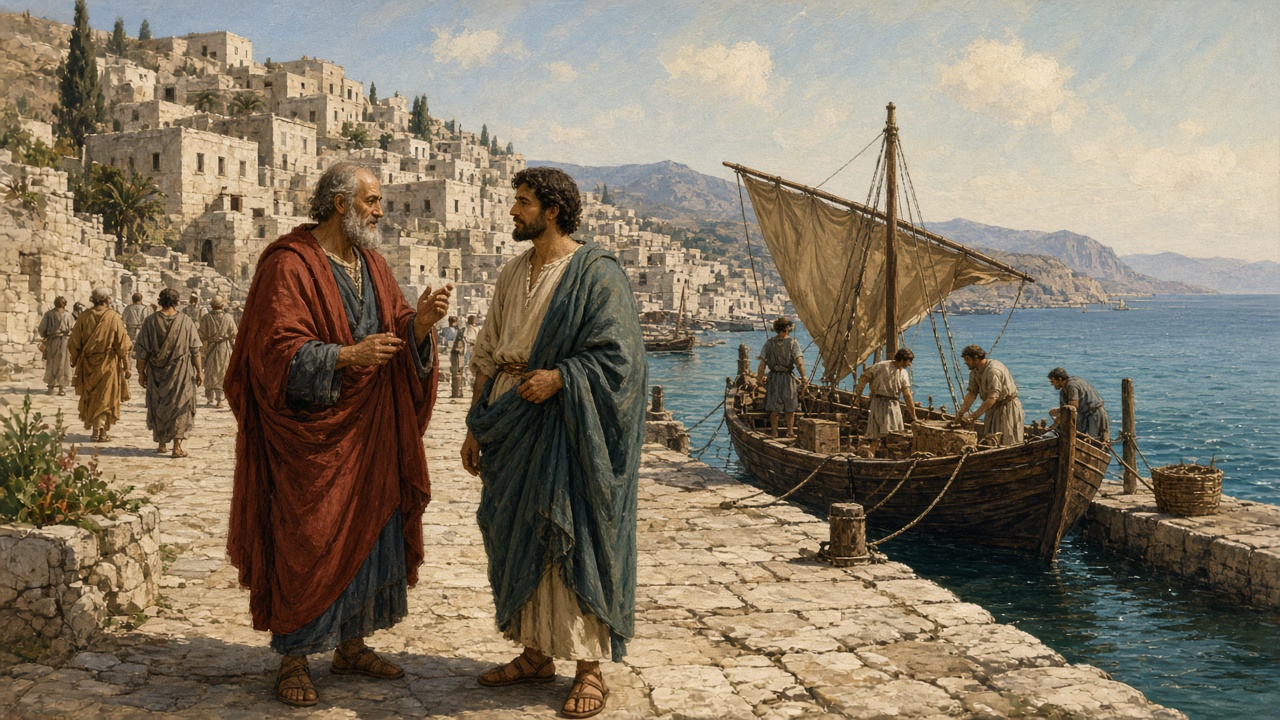
About this book
About Titus
- Easton's Bible Dictionary (1897) presents the Letter to Titus as written by Paul, probably about the same time as the first letter to Timothy, with which it has many affinities. Easton places it about A.D. 66 or 67, after a visit to Crete that he understands as following Paul's release from two years of imprisonment in Rome, and he supposes that Paul wrote it from Nicopolis in Epirus.Sources: Easton: Titus, Epistle to
- In that reconstruction, Paul left Titus in Crete "to set in order the things that were wanting," then went to Ephesus, where he left Timothy, and afterward to Macedonia and Nicopolis. Titus, whose name does not appear in Acts, had been with Paul and Barnabas at Antioch and at the Jerusalem council; Easton describes him as a Gentile whom Paul refused to have circumcised.Sources: Easton: Titus, Epistle to · Titus
- Easton notes that both letters were addressed to men left to preside in their churches during the writer's absence, and that both are chiefly occupied with the qualifications to be sought in those appointed to church offices. Timothy and Titus are also cautioned against the same prevailing corruptions and against misdirecting their cares and studies, and the letters often share the same phrases, salutation, and transition into the main business.Sources: Easton: Titus, Epistle to
- Easton calls Crete Candia and describes it as one of the largest islands in the Mediterranean, about 140 miles long and 35 broad, once very prosperous and populous, with a "hundred cities." The letter quotes "one of their own poets," identified there as Epimenides, on the Cretans: "The Cretans are alway liars, evil beasts, slow bellies."Sources: Crete
- Paul intended to winter at Nicopolis, "city of victory"; Easton thinks this was most probably the city in Epirus built by Augustus to commemorate his victory at Actium in 31 B.C., the modern Paleoprevesa. A later subscription calls the place "Nicopolis of Macedonia," but Easton says no such place is known and that the subscriptions to the epistles are not authentic. He also notes Zenas, called "the lawyer," whom Paul wished Titus to bring with him.Sources: Nicopolis · Easton: Titus, Epistle to · Zenas
Notes written with AI assistance from open sources (Theographic Bible Metadata, CC BY-SA 4.0; Easton’s Bible Dictionary, public domain) and reviewed before publishing.
Paul’s Greeting to Titus
1Paul, a servant of God and an apostle of Jesus Christ for the faith of God’s elect and their knowledge of the truth that leads to godliness, 2in the hope of eternal life, which God, who cannot lie, promised before time began. 3In His own time He has made His word evident in the proclamation entrusted to me by the command of God our Savior.
4To Titus, my true child in our common faith:
Grace and peace from God the Father and Christ Jesus our Savior.
Appointing Elders on Crete
5The reason I left you in Crete was that you would set in order what was unfinished and appoint elders in every town, as I directed you. 6An elder must be blameless, the husband of but one wife, having children who are believers and who are not open to accusation of indiscretion or insubordination.
7As God’s steward, an overseer must be above reproach—not self-absorbed, not quick-tempered, not given to drunkenness, not violent, not greedy for money. 8Instead, he must be hospitable, a lover of good, self-controlled, upright, holy, and disciplined. 9He must hold firmly to the faithful word as it was taught, so that he can encourage others by sound teaching and refute those who contradict it.
Correcting False Teachers
10For many are rebellious and full of empty talk and deception, especially those of the circumcision, 11who must be silenced. For the sake of dishonorable gain, they undermine entire households and teach things they should not. 12As one of their own prophets has said, “Cretans are always liars, evil beasts, lazy gluttons.”
13This testimony is true. Therefore rebuke them sternly, so that they will be sound in the faith 14and will pay no attention to Jewish myths or to the commands of men who have rejected the truth.
15To the pure, all things are pure; but to the defiled and unbelieving, nothing is pure. Indeed, both their minds and their consciences are defiled. 16They profess to know God, but by their actions they deny Him. They are detestable, disobedient, and unfit for any good deed.
Did you know?
Elders in the towns of Crete
- Titus, whom Paul calls his true child in their common faith, appears to have been a Gentile and was chiefly engaged in ministry among Gentiles. He was with Paul and Barnabas at Antioch and went with them to the council in Jerusalem, where Paul refused to have him circumcised; his name never appears in Acts. Paul writes that he left Titus in Crete to set in order what was unfinished and to appoint elders in every town.Sources: Titus · the Bible text itself
- Crete is one of the largest islands in the Mediterranean, about 140 miles long and 35 miles wide, and it was once prosperous and populous, with a “hundred cities.” In this chapter Paul quotes a saying he attributes to one of the Cretans’ own prophets—“Cretans are always liars, evil beasts, lazy gluttons”—and the notes on the island identify that poet as Epimenides.Sources: Crete · the Bible text itself
- Jews from Crete were in Jerusalem on the day of Pentecost. Writing to Titus, Paul says that many are rebellious and full of empty talk and deception, especially those of the circumcision, who for dishonorable gain undermine whole households. He calls for a stern rebuke so that they will be sound in the faith and pay no attention to Jewish myths or to the commands of men who have rejected the truth.Sources: Crete · the Bible text itself
Notes written with AI assistance from open sources (Theographic Bible Metadata, CC BY-SA 4.0; Easton’s Bible Dictionary, public domain) and reviewed before publishing.
Places in this chapter
Only places identified with high confidence are shown (90% or more according to the scholarly sources compiled by OpenBible). Period map: DARE (Digital Atlas of the Roman Empire), CC BY 4.0; modern map: © OpenStreetMap contributors; places: OpenBible.info (CC BY 4.0).
Credits and license for this translation
Berean Standard Bible
The Holy Bible in English: Berean Standard Bible
Public Domain
Language: English
Contributor: BSB Publishing, LLC
2026-10-02
Source: http://ebible.org/engbsb/ · eBible.org