Berean Standard Bible · Tap a verse to see its cross-references.
AI-generated narration · text: Berean Standard Bible (public domain)
The Fool Says There Is No God
For the choirmaster. According to Mahalath. A Maskil of David.
1The fool says in his heart,
“There is no God.”
They are corrupt; their ways are vile.
There is no one who does good.
2God looks down from heaven
upon the sons of men
to see if any understand,
if any seek God.
3All have turned away,
they have together become corrupt;
there is no one who does good,
not even one.
4Will the workers of iniquity never learn?
They devour my people like bread;
they refuse to call upon God.
5There they are, overwhelmed with dread,
where there was nothing to fear.
For God has scattered the bones
of those who besieged you.
You put them to shame,
for God has despised them.
6Oh, that the salvation of Israel would come from Zion!
When God restores His captive people,
let Jacob rejoice, let Israel be glad!
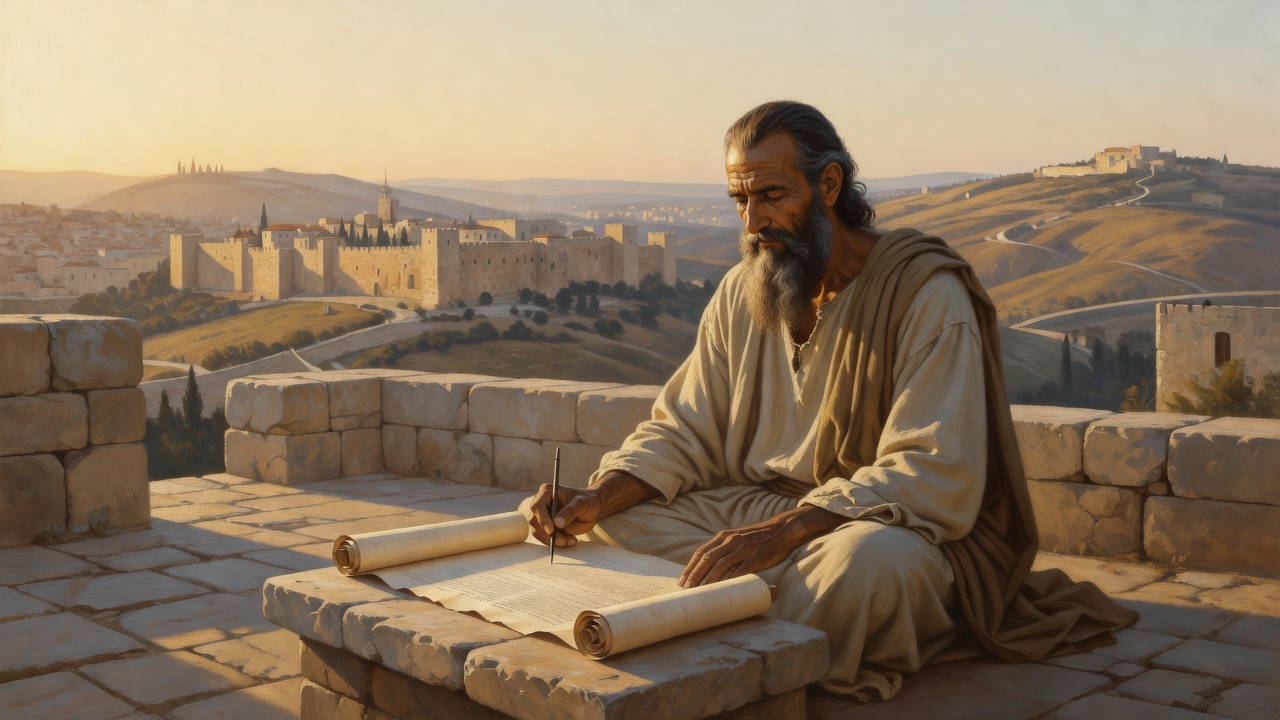
Artistic illustration — an interpretation, not a historical record.
Did you know?
A Reflection on Folly and Deliverance
The psalm depicts God observing humanity from heaven to see if any seek Him, observing that all have turned aside and become corrupt.Sources: the Bible text itself
The closing verse calls for salvation to come from Zion, the south-eastern hill of Jerusalem where David established his citadel and palace after capturing it from the Jebusites.Sources: the Bible text itself · Zion
The poem concludes by pairing the names Jacob and Israel in a call for rejoicing, recalling the patriarch Jacob, the son of Isaac, who also bore the name Israel.Sources: the Bible text itself · Jacob (Israel)
Notes written with AI assistance from open sources (Theographic Bible Metadata, CC BY-SA 4.0; Easton’s Bible Dictionary, public domain) and reviewed before publishing.
Places in this chapter
Zion · Today: Jerusalem · 31.777, 35.234 · verse 6