Proverbs 30
Berean Standard Bible · Tap a verse to see its cross-references.
The Words of Agur
1These are the words of Agur son of Jakeh—the burden that this man declared to Ithiel:
“I am weary, O God,
and worn out.
2Surely I am the most ignorant of men,
and I lack the understanding of a man.
3I have not learned wisdom,
and I have no knowledge of the Holy One.
4Who has ascended to heaven and come down?
Who has gathered the wind in His hands?
Who has bound up the waters in His cloak?
Who has established all the ends of the earth?
What is His name, and what is the name of His Son—
surely you know!
5Every word of God is flawless;
He is a shield to those who take refuge in Him.
6Do not add to His words,
lest He rebuke you and prove you a liar.
7Two things I ask of You—
do not refuse me before I die:
8Keep falsehood and deceitful words far from me.
Give me neither poverty nor riches;
feed me with the bread that is my portion.
9Otherwise, I may have too much
and deny You, saying, ‘Who is the LORD?’
Or I may become poor and steal,
profaning the name of my God.
10Do not slander a servant to his master,
or he will curse you, and you will bear the guilt.
11There is a generation of those who curse their fathers
and do not bless their mothers.
12There is a generation of those who are pure in their own eyes
and yet unwashed of their filth.
13There is a generation—how haughty are their eyes
and pretentious are their glances—
14there is a generation whose teeth are swords
and whose jaws are knives,
devouring the oppressed from the earth
and the needy from among men.
15The leech has two daughters:
Give and Give.
There are three things that are never satisfied, four that never say, ‘Enough!’:
16Sheol,
the barren womb,
land never satisfied with water,
and fire that never says, ‘Enough!’
17As for the eye that mocks a father
and scorns obedience to a mother,
may the ravens of the valley pluck it out
and young vultures devour it.
18There are three things too wonderful for me, four that I cannot understand:
19the way of an eagle in the sky,
the way of a snake on a rock,
the way of a ship at sea,
and the way of a man with a maiden.
20This is the way of an adulteress:
She eats and wipes her mouth
and says, ‘I have done nothing wrong.’
21Under three things the earth trembles, under four it cannot bear up:
22a servant who becomes king,
a fool who is filled with food,
23an unloved woman who marries,
and a maidservant who supplants her mistress.
24Four things on earth are small, yet they are exceedingly wise:
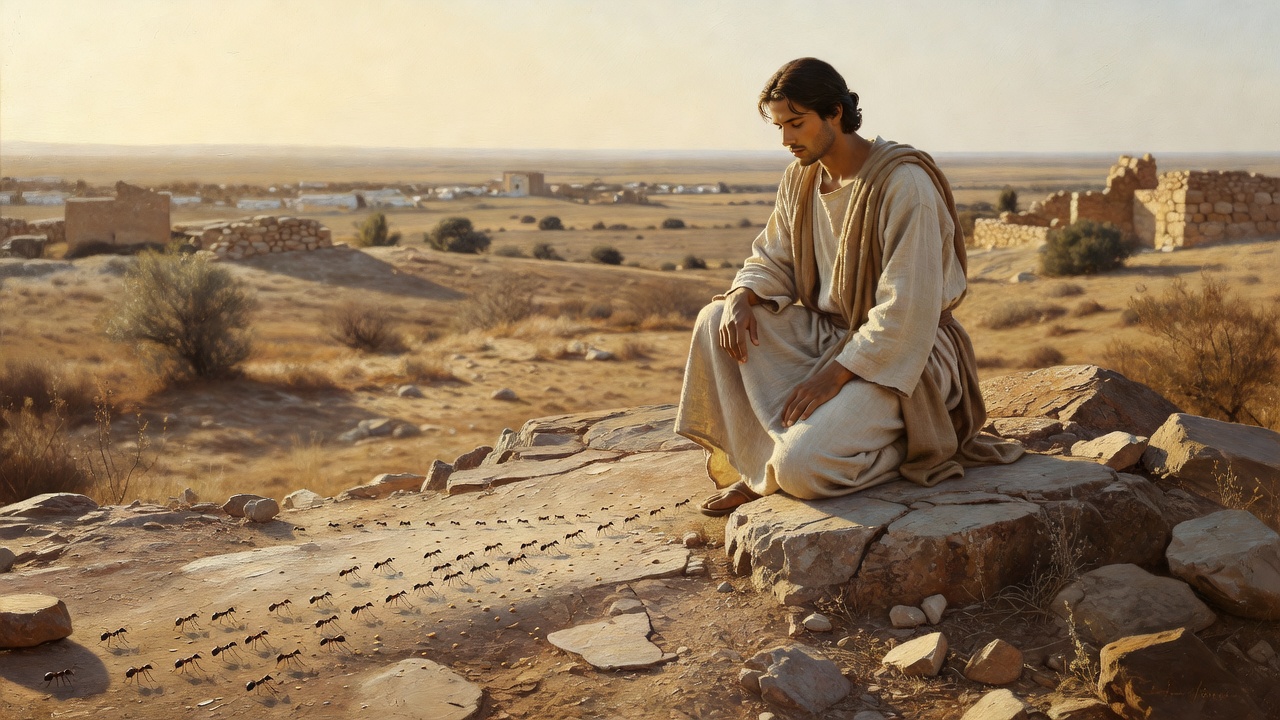
25The ants are creatures of little strength, yet they store up their food in the summer;
26the rock badgers are creatures of little power, yet they make their homes in the rocks;
27the locusts have no king, yet they all advance in formation;
28and the lizard can be caught in one’s hands, yet it is found in the palaces of kings.
29There are three things that are stately in their stride, and four that are impressive in their walk:
30a lion, mighty among beasts, refusing to retreat before anything;
31a strutting rooster;
a he-goat;
and a king with his army around him.
32If you have foolishly exalted yourself
or if you have plotted evil,
put your hand over your mouth.
33For as the churning of milk yields butter,
and the twisting of the nose draws blood,
so the stirring of anger brings forth strife.”
Did you know?
The Sayings of Agur
- Proverbs 30 is attributed to Agur son of Jakeh, who addressed his sayings to Ithiel and Ucal. Beyond what is recorded in this chapter, nothing further is known about Agur or his father.Sources: Agur · Jakeh · Ucal · the Bible text itself
- The chapter frequently uses a graded numerical pattern ('three things... four that...') to group observations about nature and human behavior. Agur applies this structure to marvels of creation, social disruptions, stately walkers, and four small creatures that display remarkable wisdom: ants, rock badgers, locusts, and lizards.Sources: the Bible text itself
- Agur makes a specific two-part request, asking to be granted neither poverty nor riches, but only his daily portion of food. He explains that having too much might lead someone to disown the Lord, while falling into poverty might tempt a person to steal.Sources: the Bible text itself
Notes written with AI assistance from open sources (Theographic Bible Metadata, CC BY-SA 4.0; Easton’s Bible Dictionary, public domain) and reviewed before publishing.
Credits and license for this translation
Berean Standard Bible
The Holy Bible in English: Berean Standard Bible
Public Domain
Language: English
Contributor: BSB Publishing, LLC
2026-10-02
Source: http://ebible.org/engbsb/ · eBible.org