Joshua 17
Berean Standard Bible · Tap a verse to see its cross-references.
Manasseh’s Western Inheritance
1Now this was the allotment for the tribe of Manasseh as Joseph’s firstborn son, namely for Machir the firstborn of Manasseh and father of the Gileadites, who had received Gilead and Bashan because Machir was a man of war. 2So this allotment was for the rest of the descendants of Manasseh—the clans of Abiezer, Helek, Asriel, Shechem, Hepher, and Shemida. These are the other male descendants of the clans of Manasseh son of Joseph.
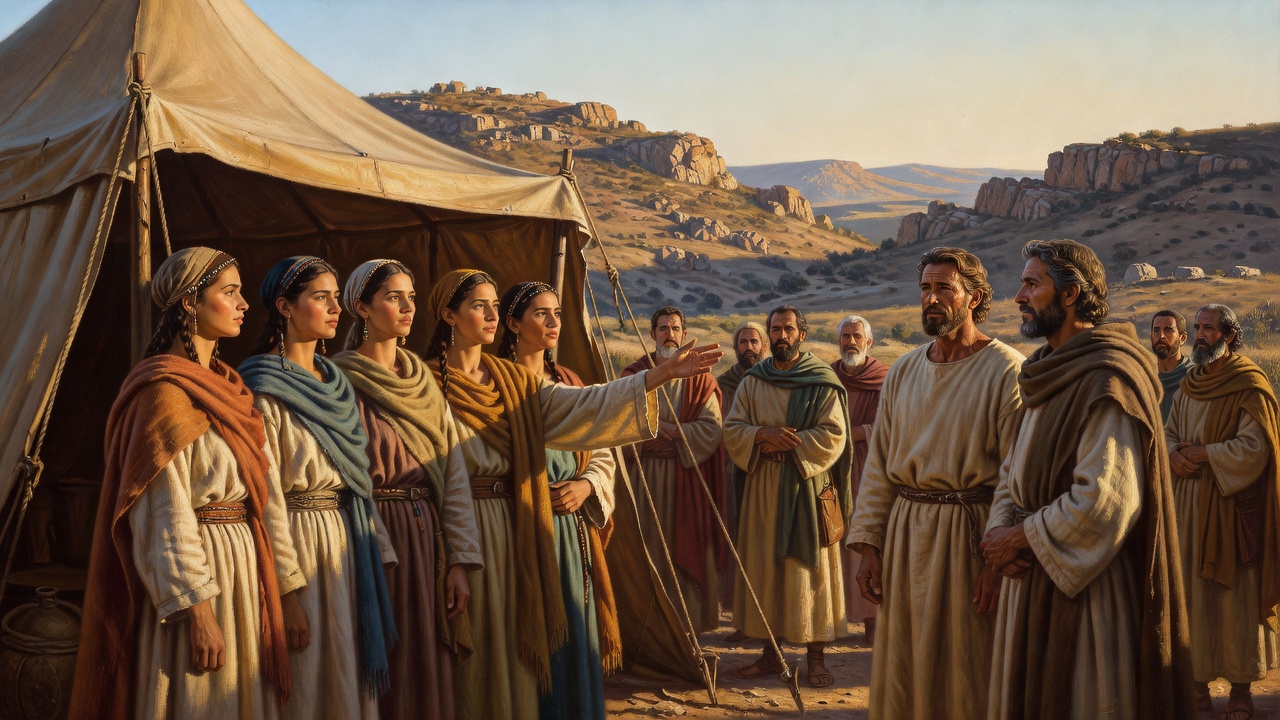
3But Zelophehad son of Hepher (the son of Gilead, the son of Machir, the son of Manasseh) had no sons but only daughters. These are the names of his daughters: Mahlah, Noah, Hoglah, Milcah, and Tirzah. 4They approached Eleazar the priest, Joshua son of Nun, and the leaders, and said, “The LORD commanded Moses to give us an inheritance among our brothers.”
So Joshua gave them an inheritance among their father’s brothers, in keeping with the command of the LORD. 5Thus ten shares fell to Manasseh, in addition to the land of Gilead and Bashan beyond the Jordan, 6because the daughters of Manasseh received an inheritance among his sons. And the land of Gilead belonged to the rest of the sons of Manasseh.
7Now the border of Manasseh went from Asher to Michmethath near Shechem, then southward to include the inhabitants of En-tappuah. 8The region of Tappuah belonged to Manasseh, but Tappuah itself, on the border of Manasseh, belonged to Ephraim. 9From there the border continued southward to the Brook of Kanah. There were cities belonging to Ephraim among the cities of Manasseh, but the border of Manasseh was on the north side of the brook and ended at the Sea. 10Ephraim’s territory was to the south, and Manasseh’s was to the north, having the Sea as its border and adjoining Asher on the north and Issachar on the east.
11Within Issachar and Asher, Manasseh was assigned Beth-shean, Ibleam, Dor (that is, Naphath), Endor, Taanach, and Megiddo, each with their surrounding settlements.
12But the descendants of Manasseh were unable to occupy these cities, because the Canaanites were determined to stay in this land. 13However, when the Israelites grew stronger, they put the Canaanites to forced labor; but they failed to drive them out completely.
14Then the sons of Joseph said to Joshua, “Why have you given us only one portion as an inheritance? We have many people, because the LORD has blessed us abundantly.”
15Joshua answered them, “If you have so many people that the hill country of Ephraim is too small for you, go to the forest and clear for yourself an area in the land of the Perizzites and the Rephaim.”
16“The hill country is not enough for us,” they replied, “and all the Canaanites who live in the valley have iron chariots, both in Beth-shean with its towns and in the Valley of Jezreel.”
17So Joshua said to the house of Joseph—to Ephraim and Manasseh—“You have many people and great strength. You shall not have just one allotment, 18because the hill country will be yours as well. It is a forest; clear it, and its farthest limits will be yours. Although the Canaanites have iron chariots and although they are strong, you can drive them out.”
Did you know?
The Allotment for Manasseh and the House of Joseph
- The tribe of Manasseh was split geographically on both sides of the Jordan River. Because the clan of Machir was renowned for warfare, they had already received the eastern territories of Gilead and Bashan, while the remaining clans received ten portions on the west side of the Jordan.Sources: the Bible text itself · Machir · Gilead · Bashan
- The daughters of Zelophehad—Mahlah, Noah, Hoglah, Milcah, and Tirzah—approached Joshua and Eleazar the priest to claim the property rights previously granted to them through Moses. Their claim resulted in female heirs receiving land portions alongside their father's brothers.Sources: the Bible text itself · Hepher · Machir
- When the tribes of Ephraim and Manasseh complained that their territory was too small, Joshua urged them to clear the forested hill country instead of fearing the lowland Canaanites, who possessed iron chariots around cities like Beth-shean.Sources: the Bible text itself · Joshua · Beth-shean
Notes written with AI assistance from open sources (Theographic Bible Metadata, CC BY-SA 4.0; Easton’s Bible Dictionary, public domain) and reviewed before publishing.
Places in this chapter
- Bashan · 32.781, 35.935 · verses 1, 5
- Gilead · Today: Gilead 1 · 32.187, 35.692 · verses 1, 5, 6
- Jordan · Today: Jordan River · 31.761, 35.558 · verses 1, 2, 5
- Shechem · Today: Tell Balatah · 32.214, 35.282 · verse 7
- Great Sea · Today: Mediterranean Sea · 31.805, 34.170 · verses 9, 10
- Megiddo · Today: Tel Megiddo · 32.585, 35.184 · verse 11
- Taanach · Today: Tell Ta’anakh · 32.522, 35.219 · verse 11
- Valley of Jezreel · Today: Jezreel Valley · 32.596, 35.242 · verse 16
Only places identified with high confidence are shown (90% or more according to the scholarly sources compiled by OpenBible). Period map: DARE (Digital Atlas of the Roman Empire), CC BY 4.0; modern map: © OpenStreetMap contributors; places: OpenBible.info (CC BY 4.0).
Credits and license for this translation
Berean Standard Bible
The Holy Bible in English: Berean Standard Bible
Public Domain
Language: English
Contributor: BSB Publishing, LLC
2026-10-02
Source: http://ebible.org/engbsb/ · eBible.org