Job 39
Berean Standard Bible · Tap a verse to see its cross-references.
The LORD Speaks of His Creation
1“Do you know when mountain goats give birth?
Have you watched the doe bear her fawn?
2Can you count the months they are pregnant?
Do you know the time they give birth?
3They crouch down and bring forth their young;
they deliver their newborn.
4Their young ones thrive and grow up in the open field;
they leave and do not return.
5Who set the wild donkey free?
Who released the swift donkey from the harness?
6I made the wilderness his home
and the salt flats his dwelling.
7He scorns the tumult of the city
and never hears the shouts of a driver.
8He roams the mountains for pasture,
searching for any green thing.
9Will the wild ox consent to serve you?
Will he stay by your manger at night?
10Can you hold him to the furrow with a harness?
Will he plow the valleys behind you?
11Can you rely on his great strength?
Will you leave your hard work to him?
12Can you trust him to bring in your grain
and gather it to your threshing floor?
13The wings of the ostrich flap joyfully,
but cannot match the pinions and feathers of the stork.
14For she leaves her eggs on the ground
and lets them warm in the sand.
15She forgets that a foot may crush them,
or a wild animal may trample them.
16She treats her young harshly, as if not her own,
with no concern that her labor was in vain.
17For God has deprived her of wisdom;
He has not endowed her with understanding.
18Yet when she proudly spreads her wings,
she laughs at the horse and its rider.
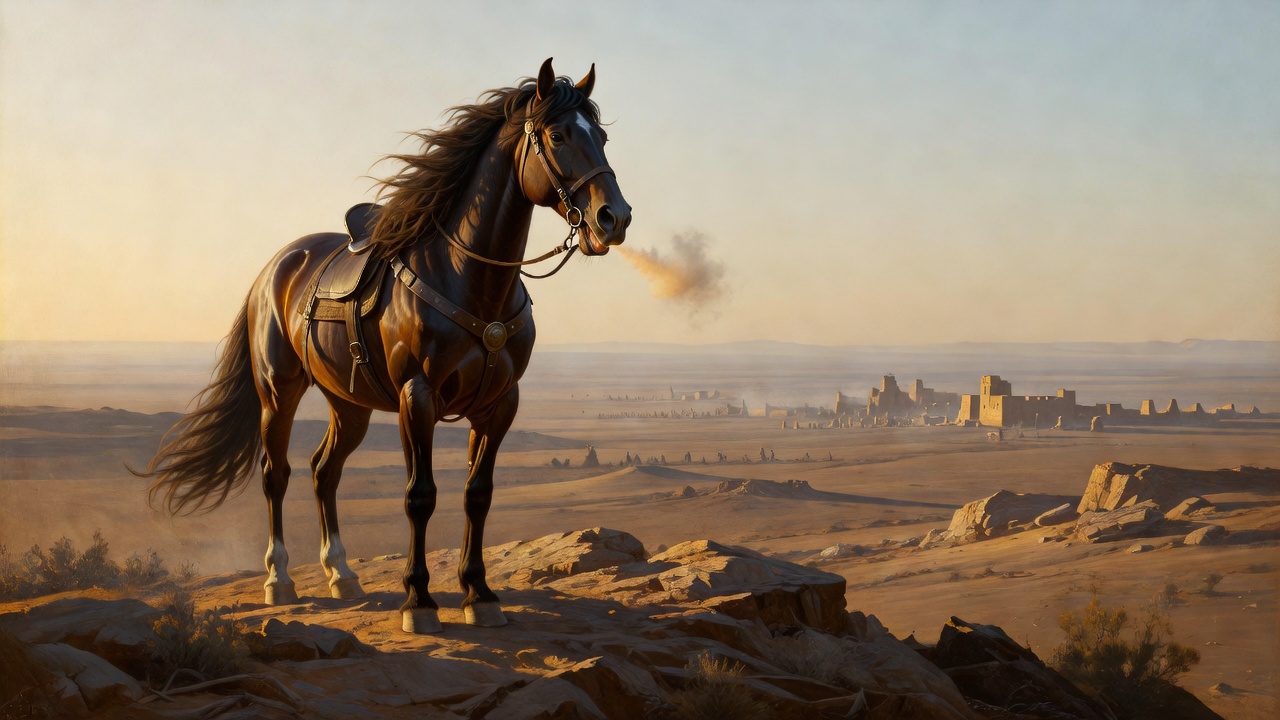
19Do you give strength to the horse
or adorn his neck with a mane?
20Do you make him leap like a locust,
striking terror with his proud snorting?
21He paws in the valley and rejoices in his strength;
he charges into battle.
22He laughs at fear, frightened of nothing;
he does not turn back from the sword.
23A quiver rattles at his side,
along with a flashing spear and lance.
24Trembling with excitement, he devours the distance;
he cannot stand still when the ram’s horn sounds.
25At the blast of the horn, he snorts with fervor.
He catches the scent of battle from afar—
the shouts of captains and the cry of war.
26Does the hawk take flight by your understanding
and spread his wings toward the south?
27Does the eagle soar at your command
and make his nest on high?
28He dwells on a cliff and lodges there;
his stronghold is on a rocky crag.
29From there he spies out food;
his eyes see it from afar.
30His young ones feast on blood;
and where the slain are, there he is.”
Did you know?
God’s Care and Design in the Animal Kingdom
- The divine speech challenges Job regarding the untamable nature of wild animals such as the wild donkey and the wild ox. Unlike domesticated livestock used for farming and threshing, these creatures dwell freely in the wilderness and salt flats, completely independent of human authority and labor.Sources: the Bible text itself
- The text highlights the ostrich’s peculiar nesting habits, describing how it leaves its eggs in the sand without the protective care seen in other birds, yet outruns horses when fleeing across open ground.Sources: the Bible text itself
- The vivid portrait of the warhorse describes its fearlessness, strength, and eagerness in the face of weapons and battle horns, emphasizing that its courage and nature are bestowed by God rather than human mastery.Sources: the Bible text itself
Notes written with AI assistance from open sources (Theographic Bible Metadata, CC BY-SA 4.0; Easton’s Bible Dictionary, public domain) and reviewed before publishing.
Credits and license for this translation
Berean Standard Bible
The Holy Bible in English: Berean Standard Bible
Public Domain
Language: English
Contributor: BSB Publishing, LLC
2026-10-02
Source: http://ebible.org/engbsb/ · eBible.org